







Question: please help will give a like Does Sesame Street help economically disadvantaged children 'catch-up' with economically advantaged children? In the early 1970s, researchers at Educational
please help will give a like 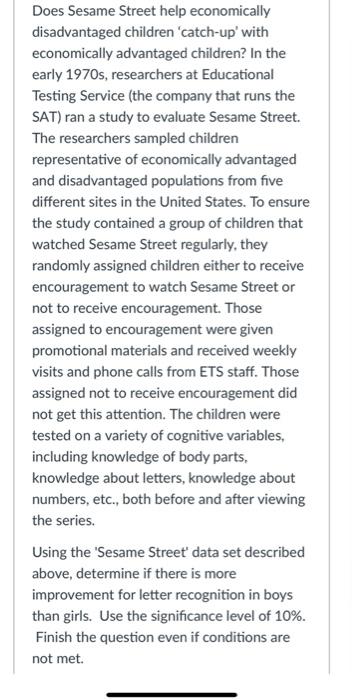

Does Sesame Street help economically disadvantaged children 'catch-up' with economically advantaged children? In the early 1970s, researchers at Educational Testing Service (the company that runs the SAT) ran a study to evaluate Sesame Street. The researchers sampled children representative of economically advantaged and disadvantaged populations from five different sites in the United States. To ensure the study contained a group of children that watched Sesame Street regularly, they randomly assigned children either to receive encouragement to watch Sesame Street or not to receive encouragement. Those assigned to encouragement were given promotional materials and received weekly visits and phone calls from ETS staff. Those assigned not to receive encouragement did not get this attention. The children were tested on a variety of cognitive variables, including knowledge of body parts, knowledge about letters, knowledge about numbers, etc., both before and after viewing the series. Using the 'Sesame Street data set described above, determine if there is more improvement for letter recognition in boys than girls. Use the significance level of 10%. Finish the question even if conditions are not met. 6. Verify conditions are met [ Select ] 7. Name of the hypothesis test used [ Select] 8. Identify the P-value [ Select] 9. State decision [ Select ] 10. Conclusion in non-statistical terms [ Select] Does Sesame Street help economically disadvantaged children 'catch-up' with economically advantaged children? In the early 1970s, researchers at Educational Testing Service (the company that runs the SAT) ran a study to evaluate Sesame Street. The researchers sampled children representative of economically advantaged and disadvantaged populations from five different sites in the United States. To ensure the study contained a group of children that watched Sesame Street regularly, they randomly assigned children either to receive encouragement to watch Sesame Street or not to receive encouragement. Those assigned to encouragement were given promotional materials and received weekly visits and phone calls from ETS staff. Those assigned not to receive encouragement did not get this attention. The children were tested on a variety of cognitive variables, including knowledge of body parts, knowledge about letters, knowledge about numbers, etc., both before and after viewing the series. Using the 'Sesame Street data set described above, determine if there is more improvement for letter recognition in boys than girls. Use the significance level of 10%. Finish the question even if conditions are not met. 6. Verify conditions are met [ Select ] 7. Name of the hypothesis test used [ Select] 8. Identify the P-value [ Select] 9. State decision [ Select ] 10. Conclusion in non-statistical terms [ Select]
Step by Step Solution
There are 3 Steps involved in it
1 Expert Approved Answer
Step: 1 Unlock

Question Has Been Solved by an Expert!
Get step-by-step solutions from verified subject matter experts
Step: 2 Unlock
Step: 3 Unlock
 Study Help