







Question: Please help with all of the drop down boxes. The first 6 drop down boxes give the choices of corporate, market, or stand-alone. The 7th
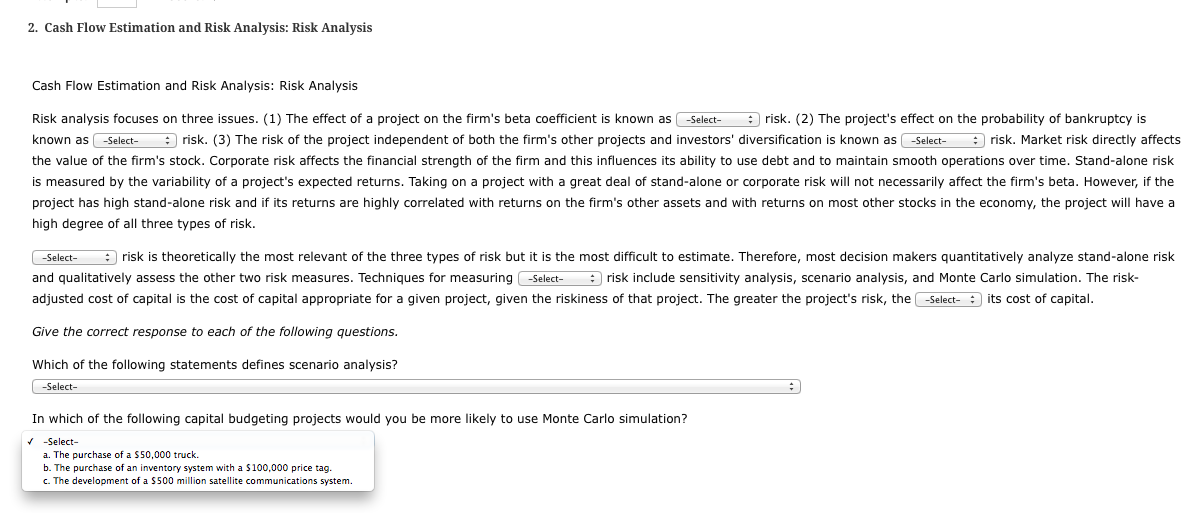 Please help with all of the drop down boxes. The first 6 drop down boxes give the choices of corporate, market, or stand-alone. The 7th gives the choices of a risk analysis technique in which proable future events are simulated on a computer generating estimated rates of return and risk indexes, a risk analysis technique in which the percentage in change in NPV resulting from a given percentage change in an input variable in provided, other things held, or a risk analysis technique in which bad and good sets of finanical circumstances are compared wtih most likely, base-case situation. And the 8th one is at the very bottom and I opened the choices for you in the picture so it was easily seen. Thank-you!
2. Cash Flow Estimation and Risk Analysis: Risk Analysis Cash Flow Estimation and Risk Analysis: Risk Analysis Risk analysis focuses on three issues. (1) The effect of a project on the firm's beta coefficient is known as -Select known as -Select- risk. (3) The risk of the project independent of both the firm's other projects and investors' diversification is known as -Select-risk. Market risk directly affects the value of the firm's stock. Corporate risk affects the financial strength of the firm and this influences its ability to use debt and to maintain smooth operations over time. Stand-alone risk is measured by the variability of a project's expected returns. Taking on a project with a great deal of stand-alone or corporate risk will not necessarily affect the firm's beta. However, if the project has high stand-alone risk and if its returns are highly correlated with returns on the firm's other assets and with returns on most other stocks in the economy, the project will have a high degree of all three types of risk. risk. (2) The project's effect on the probability of bankruptcy is -Select-risk is theoretically the most relevant of the three types of risk but it is the most difficult to estimate. Therefore, most decision makers quantitatively analyze stand-alone risk and qualitatively assess the other two risk measures. Techniques for measuring -Select-risk include sensitivity analysis, scenario analysis, and Monte Carlo simulation. The risk adjusted cost of capital is the cost of capital appropriate for a given project, given the riskiness of that project. The greater the project's risk, the -Select-its cost of capital Give the correct response to each of the following questions. Which of the following statements defines scenario analysis? Select In which of the following capital budgeting projects would you be more likely to use Monte Carlo simulation? Select a. The purchase of a S50,000 truck. b. The purchase of an inventory system with a S100,000 price tag. c. The development of a S500 million satellite communications system
Step by Step Solution
There are 3 Steps involved in it

Get step-by-step solutions from verified subject matter experts
 Study Help