







Question: please help with part A and B Problem Statement Consider a very large container filled with water (refer to Figure 1); the prevailing conditions are
please help with part A and B
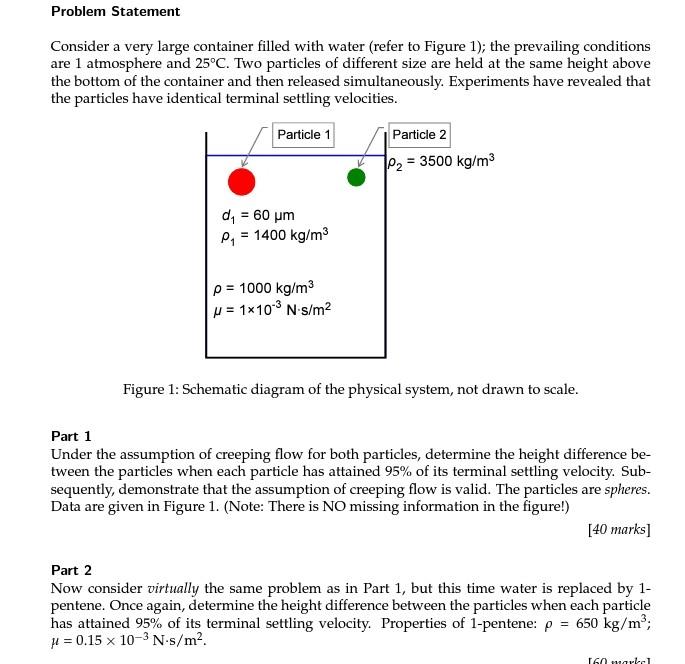
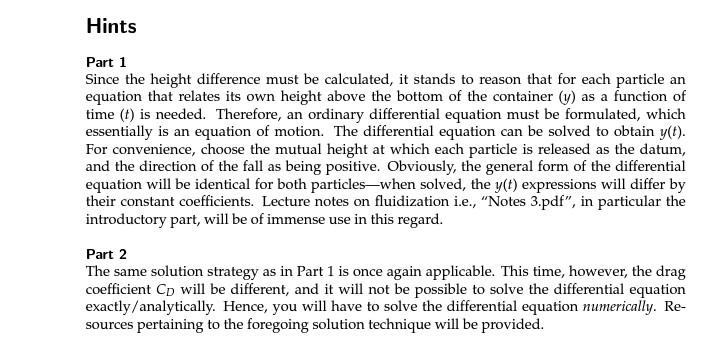
Problem Statement Consider a very large container filled with water (refer to Figure 1); the prevailing conditions are 1 atmosphere and 25C. Two particles of different size are held at the same height above the bottom of the container and then released simultaneously. Experiments have revealed that the particles have identical terminal settling velocities. Particle 1 Particle 2 122 = 3500 kg/m3 di = 60 pm PA = 1400 kg/m3 p = 1000 kg/m3 = 110-3 Ns/m2 Figure 1: Schematic diagram of the physical system, not drawn to scale. Part 1 Under the assumption of creeping flow for both particles, determine the height difference be- tween the particles when each particle has attained 95% of its terminal settling velocity. Sub- sequently, demonstrate that the assumption of creeping flow is valid. The particles are spheres. Data are given in Figure 1. (Note: There is NO missing information in the figure!) [40 marks] Part 2 Now consider virtually the same problem as in Part 1, but this time water is replaced by 1- pentene. Once again, determine the height difference between the particles when each particle has attained 95% of its terminal settling velocity. Properties of 1-pentene: p = 650 kg/m; u = 0.15 x 10⁻³ N.s/m2. 16 martel Hints Part 1 Since the height difference must be calculated, it stands to reason that for each particle an equation that relates its own height above the bottom of the container (y) as a function of time (t) is needed. Therefore, an ordinary differential equation must be formulated, which essentially is an equation of motion. The differential equation can be solved to obtain y(t). For convenience, choose the mutual height at which each particle is released as the datum, and the direction of the fall as being positive. Obviously, the general form of the differential equation will be identical for both particleswhen solved, the y(t) expressions will differ by their constant coefficients. Lecture notes on fluidization i.e., "Notes 3.pdf", in particular the introductory part, will be of immense use in this regard. Part 2 The same solution strategy as in Part 1 is once again applicable. This time, however, the drag coefficient Cp will be different, and it will not be possible to solve the differential equation exactly/analytically. Hence, you will have to solve the differential equation numerically. Re- sources pertaining to the foregoing solution technique will be provided
Step by Step Solution
There are 3 Steps involved in it

Get step-by-step solutions from verified subject matter experts
 Study Help