Question: please help with questions 22,23,24, and 27 500 APPENDIX B Muffler Magic really have an incentive pay poblem, or were the problems more broad? Furthermoge,
please help with questions 22,23,24, and 27
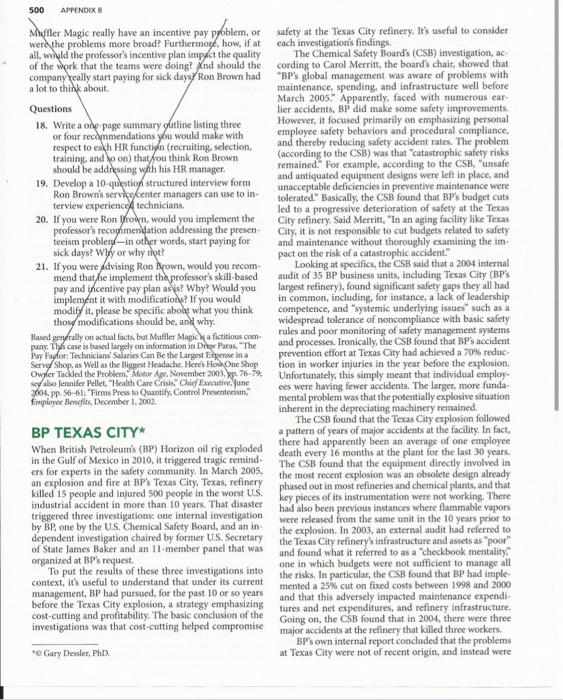
500 APPENDIX B Muffler Magic really have an incentive pay poblem, or were the problems more broad? Furthermoge, how, if at all, would the professor's incentive plan implct the quality of the work that the teams were doing? And should the company really start paying for sick days/Ron Brown had a lot to think about Questions 18. Write a one-page summary glitline listing three or four recommendations you would make with respect to cash HR function (recruiting, selection, training, and to on) that you think Ron Brown should be addressing with his HR manager 19. Develop a 10-question structured interview form Ron Brown's service center managers can use to in- terview experience technicians. 20. If you were Ron roin, would you implement the professor's recoghmendation addressing the presen- teeism probler/-in other words, start paying for sick days? Why or why not? 21. If you were advising Ron Brown, would you recom- mend that he implement the professor's skill-based pay and incentive pay plan asis? Why? Would you implement it with modifications? If you would modify it, please be specific about what you think those modifications should be, and why. Based generally on actual facts, but Muffler Magica fictitious com pany. This case is based largely on information in Die Paras, "The Pay Fayfor: Technicians Salaries Can Be the Largest Expense in a Server Shop, as well as the Biggest Headache. Here's Hors One Shop Owyler Tackled the Problem. Motor Age, November 2003. p. 76-79; se also Jennifer Pellet. "Health Care Crisis," Chief Executive, June 2004, pp. 56-61:"Firm Press to Quantify Control Presenteeism," Employee Benefits, December 1, 2002 safety at the Texas City refinery. It's useful to consider each investigation's findings. The Chemical Safety Board's (CSB) investigation, ac cording to Carol Merritt, the board's chair, showed that "BP's global management was aware of problems with maintenance, spending, and infrastructure well before March 2005." Apparently, faced with numerous ear- lier accidents, BP did make some safety improvements. However, it focused primarily on emphasizing personal employee safety behaviors and procedural compliance, and thereby reducing safety accident rates. The problem (according to the CSB) was that "catastrophic safety risks remained. For example, according to the CSB, "unsafe and antiquated equipment designs were left in place, and unacceptable deficiencies in preventive maintenance were tolerated." Basically, the CSB found that BP's budget cuts led to a progressive deterioration of safety at the Texas City refinery, Said Merritt, "In an aging facility like Texas City, it is not responsible to cut budgets related to safety and maintenance without thoroughly examining the im pact on the risk of a catastrophic accident." Looking at specifics, the CSB said that a 2004 internal audit of 35 BP business units, including Texas City (BP's largest refinery), found significant safety gaps they all had in common, including, for instance, a lack of leadership competence, and systemic underlying issues such as a widespread tolerance of noncompliance with basic safety rules and poor monitoring of safety management systems and processes. Ironically, the CSB found that BP's accident prevention effort at Texas City had achieved a 70% reduc. tion in worker injuries in the year before the explosion Unfortunately, this simply meant that individual employ ees were having fewer accidents. The larger, more funda mental problem was that the potentially explosive situation inherent in the depreciating machinery remained. The CSB found that the Texas City explosion followed a pattern of years of major accidents at the facility. In fact, there had apparently been an average of one employee death every 16 months at the plant for the last 30 years. The CSB found that the equipment directly involved in the most recent explosion was an obsolete design already phased out in most refineries and chemical plants, and that key pieces of its instrumentation were not working. There had also been previous instances where flammable vapors were released from the same unit in the 10 years prior to the explosion. In 2003, an external audit had referred to the Texas City refinery's infrastructure and assets as "poor" and found what it referred to as a "checkbook mentality." one in which budgets were not sufficient to manage all the risks. In particular, the CSB found that BP had imple mented a 25% cut on fixed costs between 1998 and 2000 and that this adversely impacted maintenance expendi- tures and net expenditures, and refinery infrastructure. Going on, the CSB found that in 2004, there were three major accidents at the refinery that killed three workers. BP's own internal report concluded that the problems at Texas City were not of recent origin, and instead were BP TEXAS CITY When British Petroleum's (BP) Horizon oil rig exploded in the Gulf of Mexico in 2010, it triggered tragic remind- ers for experts in the safety community. In March 2005, an explosion and fire at BPS Texas City, Texas, refinery killed 15 people and injured 500 people in the worst U.S. industrial accident in more than 10 years. That disaster triggered three investigations: one internal investigation by BP, one by the U.S. Chemical Safety Board, and an in- dependent investigation chaired by former U.S. Secretary of State James Baker and an 11-member panel that was organized at BP's request. To put the results of these three investigations into context, it's useful to understand that under its current management, BP had pursued, for the past 10 or so years before the Texas City explosion, a strategy emphasizing cost-cutting and profitability. The basic conclusion of the investigations was that cost-cutting helped compromise Gary Dessler, PhD APPENDIX 501 years in the making. It said BP was taking steps to address them. Its investigation found "no evidence of anyone consciously or intentionally taking actions or making de cisions that put others at risk." Said BP's report, "The un derlying reasons for the behaviors and actions displayed during the incident are complex, and the team has spent much time trying to understand them-it is evident that they were many years in the making and will require con certed and committed actions to address." BP's report concluded that there were five underlying causes for the massive explosion: A working environment had eroded to one charac- terized by resistance to change, and a lack of trust. Safety, performance, and risk reduction priorities had not been set and consistently reinforced by management Changes in the complex organization" led to a lack of clear accountabilities and poor communication A poor level of hazard awareness and understanding of safety resulted in workers accepting levels of risk that were considerably higher than at comparable installations Adequate early warning systems for problems were lacking, and there were no independent means of un- derstanding the deteriorating standards at the plant. The report from the BP initiated but independent 11-person panel chaired by former U.S. Secretary of State James Baker contained specific conclusions and recom- mendations. The Baker panel looked at BP's corporate safety oversight, the corporate safety culture, and the pro cess safety management systems at BP at the Texas City plant as well as at BP's other refineries. Basically, the Baker panel concluded that BP had not provided effective safety process leadership and had not established safety as a core value at the five refineries it looked at (including Texas City). Like the CSB, the Baker panel found that BP had em- phasized personal safety in recent years and had in fact improved personal safety performance, but had not empha- sized the overall safety process, thereby mistakenly inter preting "improving personal injury rates as an indication of acceptable process safety performance at its US.refineries." In fact, the Baker panel went on, by focusing on these some what misleading improving personal injury rates, BP created a false sense of confidence that it was properly addressing process safety risks. It also found that the safety culture at Texas City did not have the positive, trusting, open environ ment that a proper safety culture required. The Baker panel's other findings included the following BP did not always ensure that adequate resources were effectively allocated to support or sustain a high level of process safety performance. BPs refinery personnel are overloaded" by corporate initiatives. Operators and maintenance personnel work high rates of overtime. BP tended to have a short-term focus and its decen- tralized management system and entrepreneurial cul- ture delegated substantial discretion to refinery plant managers without clearly defining process safety expectations, responsibilities, or accountabilities There was no common, unifying process safety culture among the five refineries The company's corporate safety management system did not make sure there was timely compliance with internal process safety standards and programs. BP's executive management either did not receive refinery-specific information that showed that pro- cess safety deficiencies existed at some of the plants, or did not effectively respond to any information it did receive. . These findings and the following suggestions are based on "BP Safety Report Finds Company's Process Safety Culture Ineffective. Global Refining Fuels Report, January 17, 2007 The Baker panel made several safety recommendations for BP, including the following 1. The company's corporate management must pro vide leadership on process safety. 2. The company should establish a process safety management system that identifies, reduces, and manages the process safety risks of the refineries. 3. The company should make sure its employees have an appropriate level of process safety knowledge and expertise 4. The company should involve "relevant stakehold- ers" in developing a positive, trusting, and open process safety culture at each refinery 5. BP should clearly define expectations and strengthen accountability for process safety performance 6. BP should better coordinate its process safety support for the refining line organization. 7. BP should develop an integrated set of leading and lagging performance indicators for effectively mon- itoring process safety performance. 8. BP should establish and implement an effective system to audit process safety performance. 9. The company's board should monitor the imple mentation of the panel's recommendations and the ongoing process safety performance of the refineries. 10. BP should transform itself into a recognized indus- try leader in process safety management In making its recommendations, the panel singled out addressing problems like the ones that apparently the company's chief executive at the time, Lord Browne, existed at the Texas City plant? If so, how would by saying, "In hindsight, the panel believes if Browne had you explain the fact that problems like these could demonstrated comparable leadership on and commit have continued for so many years? ment to process safety (as he did for responding to climate 24. Since there were apparently at least three deaths in change that would have resulted in a higher level of safety the year prior to the major explosion, and an aver- at refineries." age of about one employee death per 16 months for Overall, the Baker panel found that BP's top manage the previous 10 years, how would you account for ment had not provided "effective leadership" on safety. It the fact that mandatory OSHA inspections missed found that the failings went to the very top of the orga. these glaring sources of potential catastrophic nization, to the company's chief executive, and to several events? of his top lieutenants. The Baker panel emphasized the importance of top management commitment, saying, for 25. The text lists numerous suggestions for "how to instance, that "it is imperative that BP leadership set the prevent accidents." Based on what you know about process safety tone at the top of the organization and es- the Texas City explosion, what do you say Texas tablish appropriate expectations regarding process safety City tells you about the most important three steps performance." It also said BP "has not provided effective an employer can take to prevent accidents? leadership in making certain its management and U.S. 26. Based on what you learned in Chapter 14, would refining workforce understand what is expected of them you make any additional recommendations to BP regarding process safety performance." over and above those recommendations made by Lord Browne, the chief executive, stepped down the Baker panel and the CSB? If so, what would about a year after the explosion. About the same time, those recommendations be? some BP shareholders were calling for the company's ex 27. Explain specifically how strategic human resource ecutives and board directors to have their bonuses more management at BP seems to have supported the closely tied to the company's safety and environmen company's broader strategic aims. What does this tal performance in the wake of Texas City. In October say about the advisability of always linking human 2009, OSHA announced it was filing the largest fine in resource strategy to a company's strategic aims? its history for this accident, for $87 million, against BP. One year later, BP's Horizon oil rig in the Gulf of Mexico Source: Notes for BP Texas City: Sheila McNulty, "BP Knew exploded, taking 11 lives. In September 2014, the U.S. of Safety Problems, Says Report." Financial Times, October 31, District judge presiding over negligence claims in the en- 2006, p. 1; "CBS: Documents Show BP Was Aware of Texas City Safety Problems." World Refining Fuels Today, October 30, suing case found BP guilty of gross negligence, basically 2006 "BP Safety Report Finds Company's Process Safety Culture reckless and extreme behavior; the company will appeal Ineffective," Global Refining - Fuels Report, January 17, 2007: his ruling "BP Safety Record Under Attack." Europe Intelligence Wire, January 17, 2007, Mark Hofmann, "BP Slammed for Poor Leader Questions ship on Safety, Oil Firm Agrees to Act on Review Panel's Recom- mendations, Business Intelligence, January 22, 2007, p. 3: "Call 22. The text defines ethics as "the principles of conduct for Bonuses to Include Link with Safety Performance." Guardian, governing an individual or a group" and specifi January 18, 2007, p. 24; www.bp.com/genericarticle.do?categoryld cally as the standards one uses to decide what his or -9005029&contentId=7015905, accessed July 12, 2009, her conduct should be. To what extent do you be- Steven Greenhouse, "BP Faces Record Fine for Os Blast," New lieve that what happened at BP is as much a break- York Times, October 30, 2009, pp. 1, 6; Kyle W. Morrison, "Blame to Go Around." Safety Health, 183, no. 3, March 2011, p. 40; down in the company's ethical systems as it is in Ed Crooks, "BP Had Tools to End Spill Sooner, Court Told" its safety systems, and how would you defend your www.ft.com/cms/s/0/40d7b076-2ae8-11e3-8fb8-00144feab7de conclusion? .html?ftcamp published_links%2Fr%2Fhome_uk%2Ffeed 2F %2Fproduct#axzz2gZshHFOC, accessed October 2, 2013; Daniel 23. Are the Occupational Safety and Health Admin Gilbert and Justin Scheck, "Judge Hammers BP for Gulf Disaster istration's standards, policies, and rules aimed at The Wall Street Journal, September 5, 2014, pp. B1, B2









 Study Help