







Question: please help with the case study Question 1 MANCOSA: ADVANCED DIPLOMA IN BUSINESS MANAGEMENT ASSIGNMENT 8: OPERATIONS MANAGEMENT IN SUPPLY CHAIN (PROJECT) QUESTION 1 Read
please help with the case study Question 1
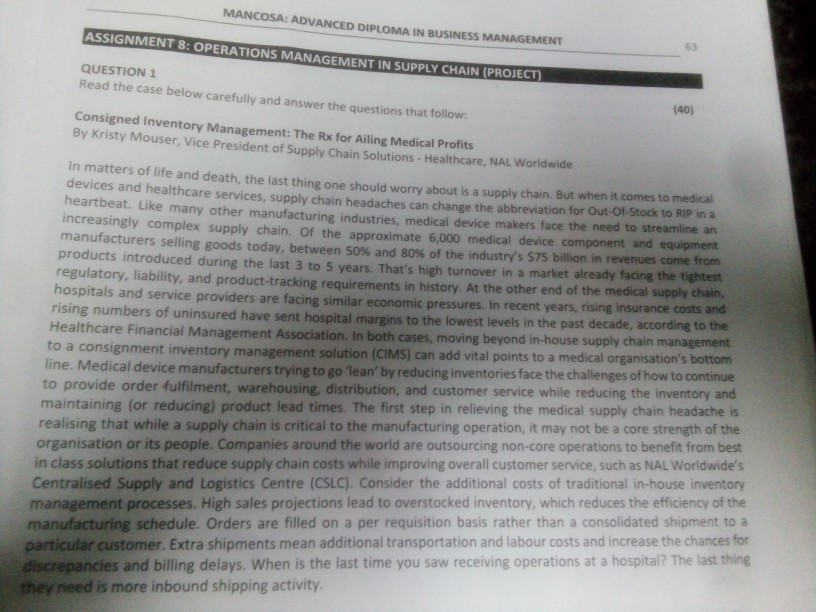
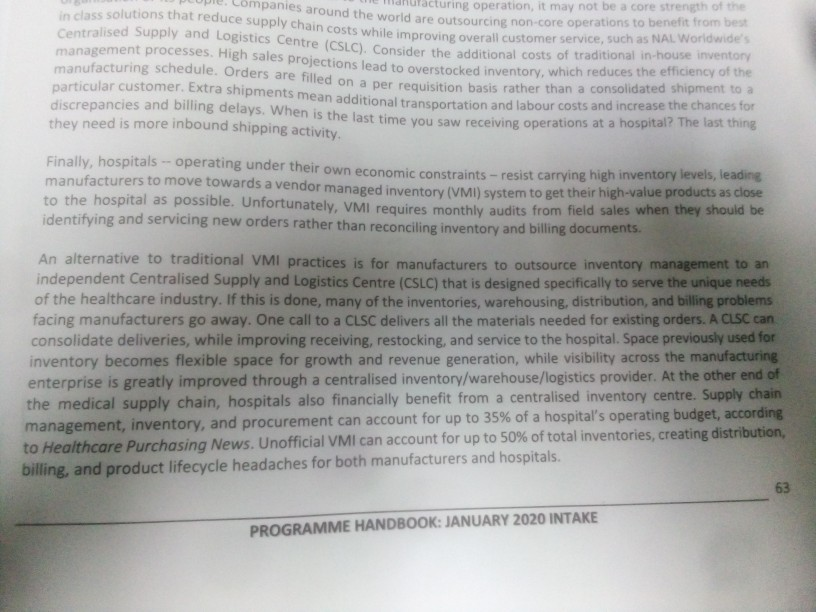
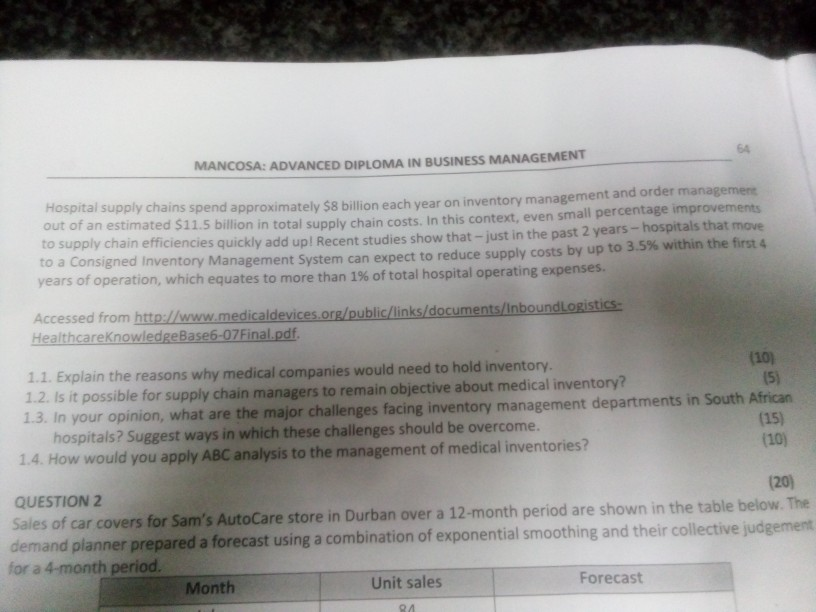
MANCOSA: ADVANCED DIPLOMA IN BUSINESS MANAGEMENT ASSIGNMENT 8: OPERATIONS MANAGEMENT IN SUPPLY CHAIN (PROJECT) QUESTION 1 Read the case below carefully and answer the questions that follow: Consigned Inventory Management: The Rx for Ailing Medical Profits By Kristy Mouser, Vice President of Supply Chain Solutions - Healthcare, NAL Worldwide (40) In matters of life and death, the last thing one should worry about is a supply chain. But when it comes to medical devices and healthcare services, supply chain headaches can change the abbreviation for Out-Of-Stock to RIP in a heartbeat. Like many other manufacturing industries, medical device makers face the need to streamline an increasingly complex supply chain of the approximate 6,000 medical device component and equipment manufacturers selling goods today, between 50% and 80% of the industry's 575 billion in revenues come from products introduced during the last 3 to 5 years. That's high turnover in a market already facing the tightest regulatory, liability, and product-tracking requirements in history. At the other end of the medical supply chain, hospitals and service providers are facing similar economic pressures. In recent years, rising insurance costs and rising numbers of uninsured have sent hospital margins to the lowest levels in the past decade, according to the Healthcare Financial Management Association. In both cases, moving beyond in-house supply chain management to a consignment inventory management solution (CIMS) can add vital points to a medical organisation's bottom line. Medical device manufacturers trying to go 'lean' by reducing inventories face the challenges of how to continue to provide order fulfilment, warehousing, distribution, and customer service while reducing the inventory and maintaining (or reducing) product lead times. The first step in relieving the medical supply chain headache is realising that while a supply chain is critical to the manufacturing operation, it may not be a core strength of the organisation or its people. Companies around the world are outsourcing non-core operations to benefit from best in class solutions that reduce supply chain costs while improving overall customer service, such as NAL Worldwide's Centralised Supply and Logistics Centre (CSLC). Consider the additional costs of traditional in-house inventory management processes. High sales projections lead to overstocked inventory, which reduces the efficiency of the manufacturing schedule. Orders are filled on a per requisition basis rather than a consolidated shipment to a particular customer. Extra shipments mean additional transportation and labour costs and increase the chances for discrepancies and billing delays. When is the last time you saw receiving operations at a hospital? The last thing they need is more inbound shipping activity. acturing operation, it may not be a core strength of the in class solutions that reduce supply chain costs while improving overall customer service, such as NAL Worldwide companies around the world are outsourcing non-core operations to benefit from best Centralised Supply and Logistics Centre (CSLC). Consider the additional costs of traditional in-house inventory management processes. High sales projections lead to overstocked inventory, which reduces the efficiency of the manufacturing schedule. Orders are filled on a per requisition basis rather than a consolidated shipment to a particular customer. Extra shipments mean additional transportation and labour costs and increase the chances for discrepancies and billing delays. When is the last time you saw receiving operations at a hospital? The last thing they need is more inbound shipping activity, Finally, hospitals -- Operating under their own economic constraints - resist carrying high inventory levels, leading manufacturers to move towards a vendor managed inventory (VMI) system to get their high-value products as close to the hospital as possible. Unfortunately, VMI requires monthly audits from field sales when they should be identifying and servicing new orders rather than reconciling inventory and billing documents. An alternative to traditional VMI practices is for manufacturers to outsource inventory management to an independent Centralised Supply and Logistics Centre (CSLC) that is designed specifically to serve the unique needs of the healthcare industry. If this is done, many of the inventories, warehousing, distribution, and billing problems facing manufacturers go away. One call to a CLSC delivers all the materials needed for existing orders. A CLSC can consolidate deliveries, while improving receiving, restocking, and service to the hospital. Space previously used for inventory becomes flexible space for growth and revenue generation, while visibility across the manufacturing enterprise is greatly improved through a centralised inventory/warehouse/logistics provider. At the other end of the medical supply chain, hospitals also financially benefit from a centralised inventory centre. Supply chain management, inventory, and procurement can account for up to 35% of a hospital's operating budget, according to Healthcare Purchasing News. Unofficial VMI can account for up to 50% of total inventories, creating distribution, billing, and product lifecycle headaches for both manufacturers and hospitals. 63 PROGRAMME HANDBOOK: JANUARY 2020 INTAKE 54 MANCOSA: ADVANCED DIPLOMA IN BUSINESS MANAGEMENT Hospital supply chains spend approximately $8 billion each year on inventory management and order managemene out of an estimated $11.5 billion in total supply chain costs. In this context, even small percentage improvements to supply chain efficiencies quickly add up! Recent studies show that just in the past 2 years - hospitals that move to a Consigned Inventory Management System can expect to reduce supply costs by up to 3.5% within the first 4 years of operation, which equates to more than 1% of total hospital operating expenses. Accessed from http://www.medicaldevices.org/public/links/documents/Inbound Logistics HealthcareKnowledgeBase6-07 Final.pdf. 1.1. Explain the reasons why medical companies would need to hold inventory. (5) 1.2. Is it possible for supply chain managers to remain objective about medical inventory? 1.3. In your opinion, what are the major challenges facing inventory management departments in South African hospitals? Suggest ways in which these challenges should be overcome. (15) 1.4. How would you apply ABC analysis to the management of medical inventories? (10) QUESTION 2 (20) Sales of car covers for Sam's AutoCare store in Durban over a 12-month period are shown in the table below. The demand planner prepared a forecast using a combination of exponential smoothing and their collective judgement for a 4-month period. Month Unit sales Forecast MANCOSA: ADVANCED DIPLOMA IN BUSINESS MANAGEMENT ASSIGNMENT 8: OPERATIONS MANAGEMENT IN SUPPLY CHAIN (PROJECT) QUESTION 1 Read the case below carefully and answer the questions that follow: Consigned Inventory Management: The Rx for Ailing Medical Profits By Kristy Mouser, Vice President of Supply Chain Solutions - Healthcare, NAL Worldwide (40) In matters of life and death, the last thing one should worry about is a supply chain. But when it comes to medical devices and healthcare services, supply chain headaches can change the abbreviation for Out-Of-Stock to RIP in a heartbeat. Like many other manufacturing industries, medical device makers face the need to streamline an increasingly complex supply chain of the approximate 6,000 medical device component and equipment manufacturers selling goods today, between 50% and 80% of the industry's 575 billion in revenues come from products introduced during the last 3 to 5 years. That's high turnover in a market already facing the tightest regulatory, liability, and product-tracking requirements in history. At the other end of the medical supply chain, hospitals and service providers are facing similar economic pressures. In recent years, rising insurance costs and rising numbers of uninsured have sent hospital margins to the lowest levels in the past decade, according to the Healthcare Financial Management Association. In both cases, moving beyond in-house supply chain management to a consignment inventory management solution (CIMS) can add vital points to a medical organisation's bottom line. Medical device manufacturers trying to go 'lean' by reducing inventories face the challenges of how to continue to provide order fulfilment, warehousing, distribution, and customer service while reducing the inventory and maintaining (or reducing) product lead times. The first step in relieving the medical supply chain headache is realising that while a supply chain is critical to the manufacturing operation, it may not be a core strength of the organisation or its people. Companies around the world are outsourcing non-core operations to benefit from best in class solutions that reduce supply chain costs while improving overall customer service, such as NAL Worldwide's Centralised Supply and Logistics Centre (CSLC). Consider the additional costs of traditional in-house inventory management processes. High sales projections lead to overstocked inventory, which reduces the efficiency of the manufacturing schedule. Orders are filled on a per requisition basis rather than a consolidated shipment to a particular customer. Extra shipments mean additional transportation and labour costs and increase the chances for discrepancies and billing delays. When is the last time you saw receiving operations at a hospital? The last thing they need is more inbound shipping activity. acturing operation, it may not be a core strength of the in class solutions that reduce supply chain costs while improving overall customer service, such as NAL Worldwide companies around the world are outsourcing non-core operations to benefit from best Centralised Supply and Logistics Centre (CSLC). Consider the additional costs of traditional in-house inventory management processes. High sales projections lead to overstocked inventory, which reduces the efficiency of the manufacturing schedule. Orders are filled on a per requisition basis rather than a consolidated shipment to a particular customer. Extra shipments mean additional transportation and labour costs and increase the chances for discrepancies and billing delays. When is the last time you saw receiving operations at a hospital? The last thing they need is more inbound shipping activity, Finally, hospitals -- Operating under their own economic constraints - resist carrying high inventory levels, leading manufacturers to move towards a vendor managed inventory (VMI) system to get their high-value products as close to the hospital as possible. Unfortunately, VMI requires monthly audits from field sales when they should be identifying and servicing new orders rather than reconciling inventory and billing documents. An alternative to traditional VMI practices is for manufacturers to outsource inventory management to an independent Centralised Supply and Logistics Centre (CSLC) that is designed specifically to serve the unique needs of the healthcare industry. If this is done, many of the inventories, warehousing, distribution, and billing problems facing manufacturers go away. One call to a CLSC delivers all the materials needed for existing orders. A CLSC can consolidate deliveries, while improving receiving, restocking, and service to the hospital. Space previously used for inventory becomes flexible space for growth and revenue generation, while visibility across the manufacturing enterprise is greatly improved through a centralised inventory/warehouse/logistics provider. At the other end of the medical supply chain, hospitals also financially benefit from a centralised inventory centre. Supply chain management, inventory, and procurement can account for up to 35% of a hospital's operating budget, according to Healthcare Purchasing News. Unofficial VMI can account for up to 50% of total inventories, creating distribution, billing, and product lifecycle headaches for both manufacturers and hospitals. 63 PROGRAMME HANDBOOK: JANUARY 2020 INTAKE 54 MANCOSA: ADVANCED DIPLOMA IN BUSINESS MANAGEMENT Hospital supply chains spend approximately $8 billion each year on inventory management and order managemene out of an estimated $11.5 billion in total supply chain costs. In this context, even small percentage improvements to supply chain efficiencies quickly add up! Recent studies show that just in the past 2 years - hospitals that move to a Consigned Inventory Management System can expect to reduce supply costs by up to 3.5% within the first 4 years of operation, which equates to more than 1% of total hospital operating expenses. Accessed from http://www.medicaldevices.org/public/links/documents/Inbound Logistics HealthcareKnowledgeBase6-07 Final.pdf. 1.1. Explain the reasons why medical companies would need to hold inventory. (5) 1.2. Is it possible for supply chain managers to remain objective about medical inventory? 1.3. In your opinion, what are the major challenges facing inventory management departments in South African hospitals? Suggest ways in which these challenges should be overcome. (15) 1.4. How would you apply ABC analysis to the management of medical inventories? (10) QUESTION 2 (20) Sales of car covers for Sam's AutoCare store in Durban over a 12-month period are shown in the table below. The demand planner prepared a forecast using a combination of exponential smoothing and their collective judgement for a 4-month period. Month Unit sales ForecastStep by Step Solution
There are 3 Steps involved in it
1 Expert Approved Answer
Step: 1 Unlock

Question Has Been Solved by an Expert!
Get step-by-step solutions from verified subject matter experts
Step: 2 Unlock
Step: 3 Unlock
 Study Help