







Question: please help urgently he case study below is about Jaguar. You are required to use this case study to answer both Task 1 and POE
please help urgently 
he case study below is about Jaguar. You are required to use this case study to answer both Task 1 and POE sections of this document.
Jaguar
Introduction
This case study focuses on the way in which Jaguar, one of the worlds most prestigious car manufacturers, has employed lean manufacturing processes. These lean manufacturing processes underpin the success of the new Jaguar S-Type. The Jaguar S-Type production line is located at its Castle Bromwich factory in Birmingham. This specific vehicle competes against the mid/top end of the BMW 5 Series and Mercedes E class.
The Independent Institute of Education (Pty) Ltd 2022
Page 3 of 13
22; 23; 24 2022
Jaguar is part of the Ford Group. Ford has for a number of years been improving its production methods, particularly by introducing manufacturing methods developed in Japanese industry. This includes lean manufacturing.
Jaguar S-Type target market
Once a market segment has been identified, more specific targeting can then take place.
This involves developing a marketing mix aimed at particular groups of individuals. The Jaguar S- Type is targeted at a younger average age of customer than the current XJ Series.
There are three distinct target groups:
Professionals in the 30-45 age range (singles and couples).
Executive families in the 40-50 age range (2+ children).
Third agers (couples aged 50+, childless or the children have left home).
Research has shown that the target groups identify certain criteria when buying a car. An ideal new car should be:
Stylish
Fun to drive
Safe
Secure
High quality
High performance
Technologically advanced
Lean Manufacturing
Lean manufacturing is the process of eliminating waste in production in order to guarantee quality and maximise efficiency. Lean production involves the standardisation of work processes to cut out waste. The key to lean production is to identify which processes within the organisation add value to the production process. Processes which do add value can then be reduced or eliminated so that labour and machinery can focus on added value activities.
The Independent Institute of Education (Pty) Ltd 2022
Page 4 of 13
22; 23; 24 2022
This does not mean that production line workers and machinery have to work harder - rather they need to be able to work smarter.
Matching supply to demand Just in time
One of the most significant changes has been creating a continuous flow system of production, based on a just-in-time approach. Previously, groups of employees had focused on specific processes in the production of Jaguar cars, using batches of component on these processes.
The work area for a particular process would then be cluttered with these batches of components. This resulted in a cramped working environment and less floor space.
The new approach is to cut down stocks of components in the workspace, to only what is required to keep production flowing smoothly. Teams press a signal button to call for fresh stocks when they are required. A quick response from a central store enables new parts to arrive at work stations just-in-time for them to be used.
This cuts out waste in a number of ways, for example:
Less floor space is required.
Cells are able to work in an uncluttered work area.
Walking (physically moving about between operations) is minimised.
Fewer components are damaged from standing around in batches on the workspace floor.
One of the greatest measures of improved working systems at Jaguar, has been to match the supply of new cars coming off the line at the Castle Bromwich plant, to the demand from Jaguar customers. Given the demand for Jaguar cars, production managers are able to calculate the volume of cars that need to come off the production line in any one week. Produce too few and you will not be able to meet demand; produce too many and you have the waste of rising inventory levels. The solution is to run the production line at the speed necessary to match demand patterns while retaining quality.
The Independent Institute of Education (Pty) Ltd 2022
Page 5 of 13
22; 23; 24 2022
Visible management/visual factory
A system of visible management has been introduced at Castle Bromwich to enable everyone involved in the process to understand how individual parts of the plant are performing in order that they can contribute to meeting performance requirements. An important part of this initiative is the use of Control Boards (i.e., visual screens) which everyone involved in the production process can read at a glance to check on the production performance of their production line. The Control Board reveals the daily production target for each production line and the performance of the production line against this target. At any one time, anyone on the production line can see where they are in relation to the target, or where bottlenecks are occurring. These bottlenecks are then targeted as priority areas for troubleshooting of problems and implementing improvements.
On the Jaguar production line, cars flow along a line, with teams processing the work on the car in an ordered sequence. It is essential that each line worker completes their specialist tasks to the highest quality before the car moves to the next position on the line. If a worker is having problems, they pull a cord which alerts their team leader who will provide assistance. If the team leader, who is more knowledgeable and multi-skilled than other production line workers, is able to quickly solve the problem he pulls the cord a second time and the line continues to flow forward.
However, if the problem cannot be immediately solved the whole line will halt and wait, while the problem is solved. It is estimated that typically there will be 130 - 150 pulls of the cord per shift. The running total is recorded on Control boards indicating the performance of each line. This makes it possible for production managers and supervisors to identify problems more easily.
Ownership of work
Under the new working arrangements at Jaguar, work teams have been encouraged to take responsibility for their own work. Work must be standardised so that everyone knows what they are accountable for and can ensure quality standards in their respective areas of responsibility.
The Independent Institute of Education (Pty) Ltd 2022
Page 6 of 13
22; 23; 24 2022
purpose of work teams is to discuss their work in order to identify ways of reducing the time spent on non-value-added related activities, i.e., to cut out waste - the purpose of lean production. Lean manufacturing requires thinking at all levels within the organisation.
The seven key opportunities for cutting down waste are:
1. Removing over-production. Producing too much, too soon takes up storage space, and involves extra handling. Parts and products which have to wait to be used can be damaged, or become obsolescent, leading to wasteful scrap.
2. Cutting out time spent waiting for parts to arrive.
3. Reducing conveyance (i.e., moving things around the factory). Some conveyance is
necessary, but it does not add value to the product.
4. Eliminating over-processing that is processing which goes beyond what the customer
requires or processes, and which does not add value to Jaguars product. Cutting inventory - i.e., the build-up of stock. Only the minimum amount is required to get the job done. Having too large inventories causes interest charges and storage costs, uses up space and creates extra handling.
5. Cutting down on wasteful movement by improving work plans and the management of parts and production facilities and human movement.
6. Eliminating the need for repair. Not getting it right first time is wasteful.
Production of the Jaguar S-Type
Castle Bromwich is a very impressive facility with a world-class plant and processes. Jaguar has completely refurbished three whole blocks in the factory. E-Block is the body construction facility. The manufacturing in E-Block takes place in a giant U-shape. It follows the logical progression of car manufacturing, starting with under-body assembly, followed by body-sides being fitted, welded, and validated for alignment, before going on to be fitted with closures - the doors, bonnet and boot - and also the bumpers and front wing assemblies.
The vehicle is washed and inspected before going to the Paint Shop. The painted bodies then enter D-Block on an overhead conveyor system for the trim and final assembly. This involves the fitting of the bumper cover, seat assemblies and instrument panel. The vehicle is glazed and partially trimmed before the fuel tank is fitted.
The Independent Institute of Education (Pty) Ltd 2022
Page 7 of 13
22; 23; 24 2022
The regeneration of an old derelict brownfield site rather than using valuable green space.
Energy management - a new gas-fired boiler house has replaced the old coal fired one,
saving significant amounts of money.
Recycling - the new X200 is 85% recyclable by weight.
Emission reduction - the new plant has eliminated ozone depleting CFCs and 111
trichloroethane from the manufacturing processes and the product. The new Powerhouse
has led to a 95% reduction in sulphur dioxide emissions.
An environmental management system - Jaguar is committed to the international
environmental management system standard (ISO 14001). This standard ensures that processes are in place to identify the impact of corporate activities and formulate measures to improve and, where possible, eliminate harmful or wasteful practices.
Paint process improvements - Old fashioned colour coats contribute 40-50% of solvent vapour emissions. Jaguar has therefore begun using new water-based colour coats (which use water instead of solvent). This has immediately reduced factory emissions. Jaguar has engaged in a 65 million investment in paint shop refurbishment. The key theme is environmental improvements to all processes.
Conclusion
Lean production is all about reducing waste. Lean production has enabled Jaguar to cut out waste in the production of the Jaguar S-type at Castle Bromwich. Ford is now seeking to spread the message about lean production by incorporating a total of 400 of its Halewood employees into working at Castle Bromwich. The successful implementation of lean production at Jaguar will form the benchmark for the systems introduction at Halewood.
Adapted from http://businesscasestudies.co.uk/case-studies/by- topic/operations.html#operations-new-product-development Date of Accessed: 22 February 2022.
The Independent Institute of Education (Pty) Ltd 2022
Page 8 of 13
22; 23; 24
2022
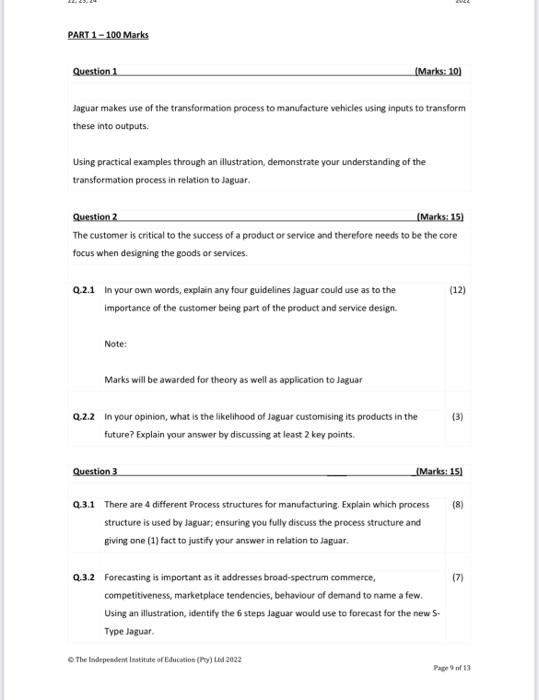
PART 1 100 Marks
Question 1 (Marks: 10)
Jaguar makes use of the transformation process to manufacture vehicles using inputs to transform these into outputs.
Using practical examples through an illustration, demonstrate your understanding of the transformation process in relation to Jaguar.
Question 2 (Marks: 15)
The customer is critical to the success of a product or service and therefore needs to be the core focus when designing the goods or services.
(12)
Q.2.1
In your own words, explain any four guidelines Jaguar could use as to the importance of the customer being part of the product and service design.
Note:
Marks will be awarded for theory as well as application to Jaguar
Q.2.2 In your opinion, what is the likelihood of Jaguar customising its products in the (3) future? Explain your answer by discussing at least 2 key points.
Question 3 ____ _(Marks: 15)
(8)
(7)
Q.3.1
There are 4 different Process structures for manufacturing. Explain which process structure is used by Jaguar; ensuring you fully discuss the process structure and giving one (1) fact to justify your answer in relation to Jaguar.
Q.3.2
Forecasting is important as it addresses broad-spectrum commerce, competitiveness, marketplace tendencies, behaviour of demand to name a few. Using an illustration, identify the 6 steps Jaguar would use to forecast for the new S- Type Jaguar.
The Independent Institute of Education (Pty) Ltd 2022
Page 9 of 13
22; 23; 24
2022
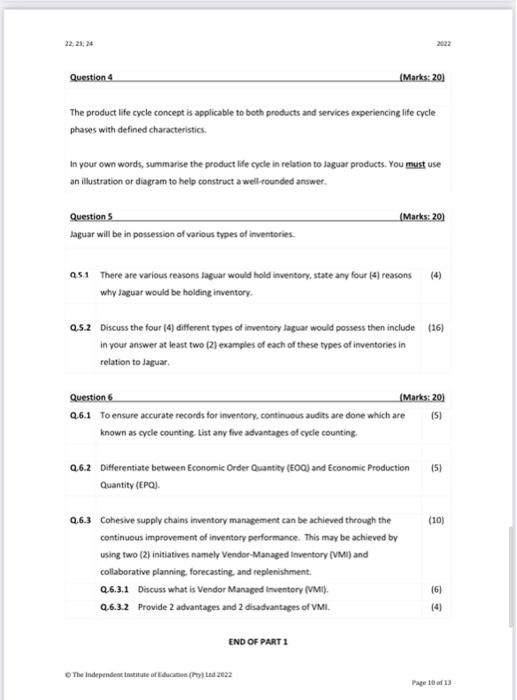
Question 4
(Marks: 20)
The product life cycle concept is applicable to both products and services experiencing life cycle phases with defined characteristics.
In your own words, summarise the product life cycle in relation to Jaguar products. You must use an illustration or diagram to help construct a well-rounded answer.
Question 5
Jaguar will be in possession of various types of inventories.
(Marks: 20)
Q.5.1 There are various reasons Jaguar would hold inventory, state any four (4) reasons (4) why Jaguar would be holding inventory.
Question 6 (Marks: 20)
Q.6.1 To ensure accurate records for inventory, continuous audits are done which are (5)
known as cycle counting. List any five advantages of cycle counting.
Q.6.2 Differentiate between Economic Order Quantity (EOQ) and Economic Production (5) Quantity (EPQ).
Q.6.3.1 Discuss what is Vendor Managed Inventory (VMI). (6)
Q.6.3.2 Provide 2 advantages and 2 disadvantages of VMI. (4)
END OF PART 1
The Independent Institute of Education (Pty) Ltd 2022
Q.5.2
Discuss the four (4) different types of inventory Jaguar would possess then include in your answer at least two (2) examples of each of these types of inventories in relation to Jaguar.
(16)
Q.6.3
Cohesive supply chains inventory management can be achieved through the continuous improvement of inventory performance. This may be achieved by using two (2) initiatives namely Vendor-Managed Inventory (VMI) and collaborative planning, forecasting, and replenishment.
(10)
Step by Step Solution
There are 3 Steps involved in it
1 Expert Approved Answer
Step: 1 Unlock

Question Has Been Solved by an Expert!
Get step-by-step solutions from verified subject matter experts
Step: 2 Unlock
Step: 3 Unlock
 Study Help