







Question: Please help with the following C++ program and show outputs for each step. This is my code so far: //Code #include #include using namespace std;
Please help with the following C++ program and show outputs for each step.
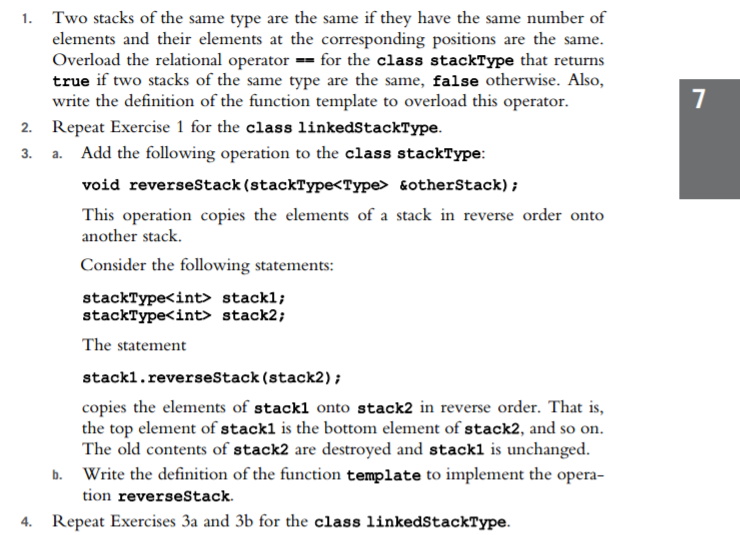
This is my code so far:
//Code
#include
bool operator==( const stackType
}; // end template class stackType
// initialize the stack template
// check for stack fullness template
// check for stack empty template
// insert an element into stack template // delete an element from the stack template // return the value of stack-top template // constructor for the class stackType template stackTop = 0; list = new Type[ maxStackSize ]; } // end constructor stackType // destructor for the class stackType template // overload the equality operator template return true; } //main function int main() { // let the user know about the program cout s1( 12 ); stackType //check and print whether the stacks are equal or not if ( s1 == s2 ) cout // insert one more element into the second stack cout //check and print whether the stacks are equal or not if ( s1 == s2 ) cout cout 9. //Code #include #include "simulation.h" using namespace std; void setSimulationParameters(int& sTime, int& numOfServers, int& transTime, int& tBetweenCArrival); bool isCustomerArrived(double arvTimeDiff); void generateStatistics(serverListType& serverList, queue int main() { runSimulation(); system("pause"); return 0; } void setSimulationParameters(int& sTime, int& numOfServers, int& transTime, int& tBetweenCArrival) { cout > sTime; cout cout > numOfServers; cout cout > transTime; cout cout > tBetweenCArrival; cout bool isCustomerArrived(double arvTimeDiff) { double value; value = static_cast return (value > exp(-1.0 / arvTimeDiff)); } void runSimulation() { int simulationTime; int numberOfServers; int transactionTime; int timeBetweenCustomerArrival; queue customerType customer; int custNumber = 0; int totalWaitTimeServedCustomers = 0; int totalWaitTime = 0; int numberOfCustomersServed = 0; int customersLeftInServers = 0; int clock = 0; int serverID; setSimulationParameters(simulationTime, numberOfServers, transactionTime, timeBetweenCustomerArrival); serverListType serverList(numberOfServers); for (clock = 1; clock if (!customerQueue.empty()) { for (int sz = customerQueue.size(); sz > 0; sz--) { customerType cust = customerQueue.front(); customerQueue.pop(); cust.incrementWaitingTime(); customerQueue.push(cust); } } if (isCustomerArrived(timeBetweenCustomerArrival)) { custNumber++; customer.setCustomerInfo(custNumber, clock, 0, transactionTime); customerQueue.push(customer); cout serverID = serverList.getFreeServerID(); if (serverID != -1 && !customerQueue.empty()) { customer = customerQueue.front(); customerQueue.pop(); totalWaitTimeServedCustomers = totalWaitTimeServedCustomers + customer.getWaitingTime(); serverList.setServerBusy(serverID, customer); } } cout cout generateStatistics(serverList, customerQueue, custNumber, totalWaitTimeServedCustomers); } void generateStatistics(serverListType& serverList, queue int totalWaitTime = waitTimeServedCustomers; customerType customer; while (!CQueue.empty()) { customer = CQueue.front(); CQueue.pop(); totalWaitTime = totalWaitTime + customer.getWaitingTime(); customersLeftInQueue++; } //Find number of customers left in servers int customersLeftInServers = serverList.getNumberOfBusyServers(); //Find number of customers completely served int numberOfCustomersServed = numOfCustArrived - customersLeftInServers - customersLeftInQueue; double averageWaitTime = 0; cout if (numOfCustArrived > 0) // If number of customers arrived is > 0 averageWaitTime = (static_cast cout // simulation.h #include using namespace std; //**************** customerType **************** class customerType { public: customerType(int cN = 0, int arrvTime = 0, int wTime = 0, int tTime = 0); //Constructor to initialize the instance variables //according to the parameters //If no value is specified in the object declaration, //the default values are assigned. //Postcondition: customerNumber = cN; // arrivalTime = arrvTime; // waitingTime = wTime; // transactionTime = tTime void setCustomerInfo(int customerN = 0, int inTime = 0, int wTime = 0, int tTime = 0); //Function to initialize the instance variables. //Instance variables are set according to the parameters. //Postcondition: customerNumber = customerN; // arrivalTime = arrvTime; // waitingTime = wTime; // transactionTime = tTime; int getWaitingTime() const; //Function to return the waiting time of a customer. //Postcondition: The value of waitingTime is returned. void setWaitingTime(int time); //Function to set the waiting time of a customer. //Postcondition: waitingTime = time; void incrementWaitingTime(); //Function to increment the waiting time by one time unit. //Postcondition: waitingTime++; int getArrivalTime() const; //Function to return the arrival time of a customer. //Postcondition: The value of arrivalTime is returned. int getTransactionTime() const; //Function to return the transaction time of a customer. //Postcondition: The value of transactionTime is returned. int getCustomerNumber() const; //Function to return the customer number. //Postcondition: The value of customerNumber is returned. private: int customerNumber; int arrivalTime; int waitingTime; int transactionTime; }; //************* serverType **************** class serverType { public: serverType(); //Default constructor //Sets the values of the instance variables to their default //values. //Postcondition: currentCustomer is initialized by its // default constructor; status = "free"; and // the transaction time is initialized to 0. bool isFree() const; //Function to determine if the server is free. //Postcondition: Returns true if the server is free, // otherwise returns false. void setBusy(); //Function to set the status of the server to busy. //Postcondition: status = "busy"; void setFree(); //Function to set the status of the server to "free". //Postcondition: status = "free"; void setTransactionTime(int t); //Function to set the transaction time according to the //parameter t. //Postcondition: transactionTime = t; void setTransactionTime(); //Function to set the transaction time according to //the transaction time of the current customer. //Postcondition: // transactionTime = currentCustomer.transactionTime; int getRemainingTransactionTime() const; //Function to return the remaining transaction time. //Postcondition: The value of transactionTime is returned. void decreaseTransactionTime(); //Function to decrease the transactionTime by 1 unit. //Postcondition: transactionTime--; void setCurrentCustomer(customerType cCustomer); //Function to set the info of the current customer //according to the parameter cCustomer. //Postcondition: currentCustomer = cCustomer; int getCurrentCustomerNumber() const; //Function to return the customer number of the current //customer. //Postcondition: The value of customerNumber of the // current customer is returned. int getCurrentCustomerArrivalTime() const; //Function to return the arrival time of the current //customer. //Postcondition: The value of arrivalTime of the current // customer is returned. int getCurrentCustomerWaitingTime() const; //Function to return the current waiting time of the //current customer. //Postcondition: The value of transactionTime is // returned. int getCurrentCustomerTransactionTime() const; //Function to return the transaction time of the //current customer. //Postcondition: The value of transactionTime of the // current customer is returned. private: customerType currentCustomer; string status; int transactionTime; }; //************* serverListType **************** class serverListType { public: serverListType(int num = 1); //Constructor to initialize a list of servers //Postcondition: numOfServers = num // A list of servers, specified by num, // is created and each server is // initialized to "free". ~serverListType(); //Destructor //Postcondition: The list of servers is destroyed. int getFreeServerID() const; //Function to search the list of servers. //Postcondition: If a free server is found, returns // its ID; otherwise, returns -1. int getNumberOfBusyServers() const; //Function to return the number of busy servers. //Postcondition: The number of busy servers is returned. void setServerBusy(int serverID, customerType cCustomer, int tTime); //Function to set a server as busy. //Postcondition: The server specified by serverID is set // to "busy", to serve the customer // specified by cCustomer, and the // transaction time is set according to the // parameter tTime. void setServerBusy(int serverID, customerType cCustomer); //Function to set a server as busy. //Postcondition: The server specified by serverID is set // to "busy", to serve the customer // specified by cCustomer. void updateServers(ostream& outFile); //Function to update the status of a server. //Postcondition: The transaction time of each busy // server is decremented by one unit. If // the transaction time of a busy server // is reduced to zero, the server is set // to "free". Moreover, if the actual // parameter corresponding to outFile is // cout, a message indicating which customer // has been served is printed on the screen, // together with the customer's departing // time. Otherwise, the output is sent to // a file specified by the user. private: int numOfServers; serverType *servers; }; //*************** customerType ************ void customerType::setCustomerInfo(int customerN, int arrvTime, int wTime, int tTime) { customerNumber = customerN; arrivalTime = arrvTime; waitingTime = wTime; transactionTime = tTime; } customerType::customerType(int customerN, int arrvTime, int wTime, int tTime) { setCustomerInfo(customerN, arrvTime, wTime, tTime); } int customerType::getWaitingTime() const { return waitingTime; } void customerType::incrementWaitingTime() { waitingTime++; } void customerType::setWaitingTime(int time) { waitingTime = time; } int customerType::getArrivalTime() const { return arrivalTime; } int customerType::getTransactionTime() const { return transactionTime; } int customerType::getCustomerNumber() const { return customerNumber; } //**************** serverType ********** serverType::serverType() { status = "free"; transactionTime = 0; } bool serverType::isFree() const { return (status == "free"); } void serverType::setBusy() { status = "busy"; } void serverType::setFree() { status = "free"; } void serverType::setTransactionTime(int t) { transactionTime = t; } void serverType::setTransactionTime() { int time; time = currentCustomer.getTransactionTime(); transactionTime = time; } void serverType::decreaseTransactionTime() { transactionTime--; } int serverType::getRemainingTransactionTime() const { return transactionTime; } void serverType::setCurrentCustomer(customerType cCustomer) { currentCustomer = cCustomer; } int serverType::getCurrentCustomerNumber() const { return currentCustomer.getCustomerNumber(); } int serverType::getCurrentCustomerArrivalTime() const { return currentCustomer.getArrivalTime(); } int serverType::getCurrentCustomerWaitingTime() const { return currentCustomer.getWaitingTime(); } int serverType::getCurrentCustomerTransactionTime() const { return currentCustomer.getTransactionTime(); } //************** serverListType *********** serverListType::serverListType(int num) { numOfServers = num; servers = new serverType[num]; } serverListType::~serverListType() { delete[] servers; } int serverListType::getFreeServerID() const { int serverID = -1; int i; for (i = 0; i return serverID; } int serverListType::getNumberOfBusyServers() const { int busyServers = 0; int i; for (i = 0; i return busyServers; } void serverListType::setServerBusy(int serverID, customerType cCustomer, int tTime) { servers[serverID].setBusy(); servers[serverID].setTransactionTime(tTime); servers[serverID].setCurrentCustomer(cCustomer); } void serverListType::setServerBusy(int serverID, customerType cCustomer) { int time; time = cCustomer.getTransactionTime(); servers[serverID].setBusy(); servers[serverID].setTransactionTime(time); servers[serverID].setCurrentCustomer(cCustomer); } void serverListType::updateServers(ostream& outFile) { int i; for (i = 0; i if (servers[i].getRemainingTransactionTime() == 0) { outFile
Step by Step Solution
There are 3 Steps involved in it

Get step-by-step solutions from verified subject matter experts
 Study Help