



Question: Please help with the question below. Thank you. (Hint: The two people have a constant marginal utility of income, whereas we considered a diminishing marginal
Please help with the question below. Thank you.
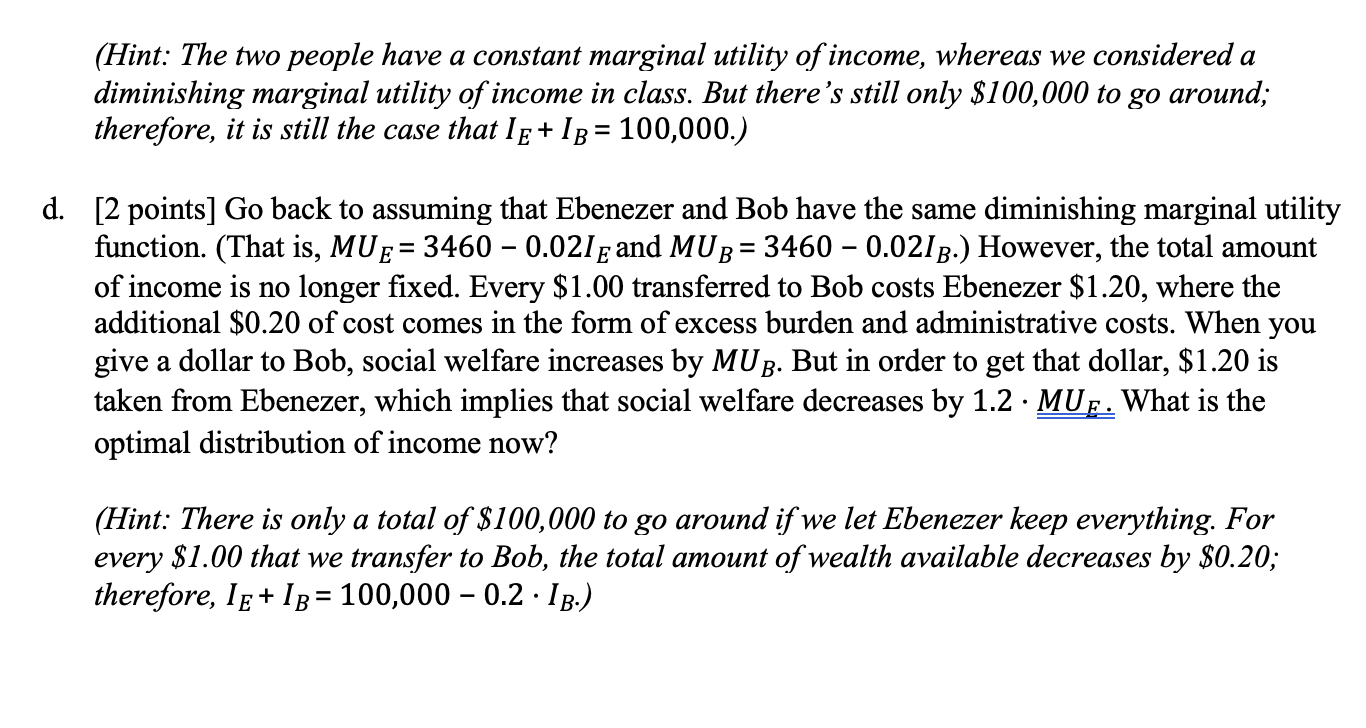
(Hint: The two people have a constant marginal utility of income, whereas we considered a diminishing marginal utility of income in class. But there 's still only $100, 000 to go around; therefore, it is still the case that [E + [B = 100,000.) [2 points] Go back to assuming that Ebenezer and Bob have the same diminishing marginal utility function. (That is, M U E = 3460 0.0213 and M U B = 3460 0.0213.) However, the total amount of income is no longer xed. Every $1.00 transferred to Bob costs Ebenezer $1.20, where the additional $0.20 of cost comes in the form of excess burden and administrative costs. When you give a dollar to Bob, social welfare increases by M U 3. But in order to get that dollar, $1.20 is taken from Ebenezer, which implies that social welfare decreases by 1.2 - M What is the optimal distribution of income now? (Hint: There is only a total of $1 00, 000 to go around if we let Ebenezer keep everything. For every $1.00 that we transfer to Bob, the total amount of wealth available decreases by $0.20; therefore, 15+ lg = 100,000 0.2 - 13.)
Step by Step Solution
There are 3 Steps involved in it

Get step-by-step solutions from verified subject matter experts