







Question: Please help with these physics questions! 1) A fully loaded Boeing 747 with all engines at full thrust accelerates at 2.6 m/s2. Its minimum takeoff
Please help with these physics questions!
![diagram. What will be the direction of acceleration. [1] b) Fill the](https://s3.amazonaws.com/si.experts.images/answers/2024/06/66642daf8b800_32766642daf638fa.jpg)
![values in this table. [2] Initial values Final values time ti tf](https://s3.amazonaws.com/si.experts.images/answers/2024/06/66642dafd9f46_32766642dafbf997.jpg)
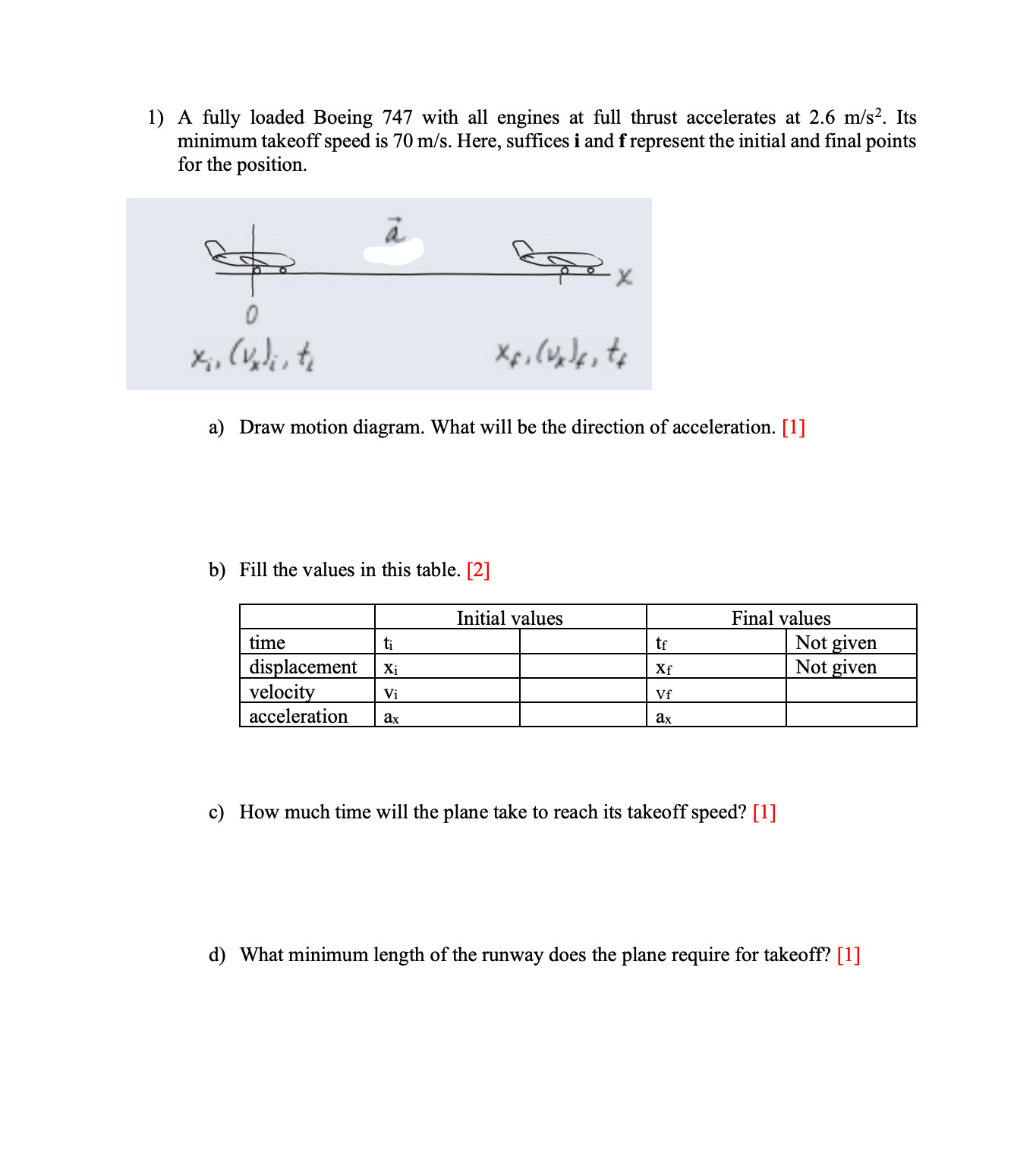
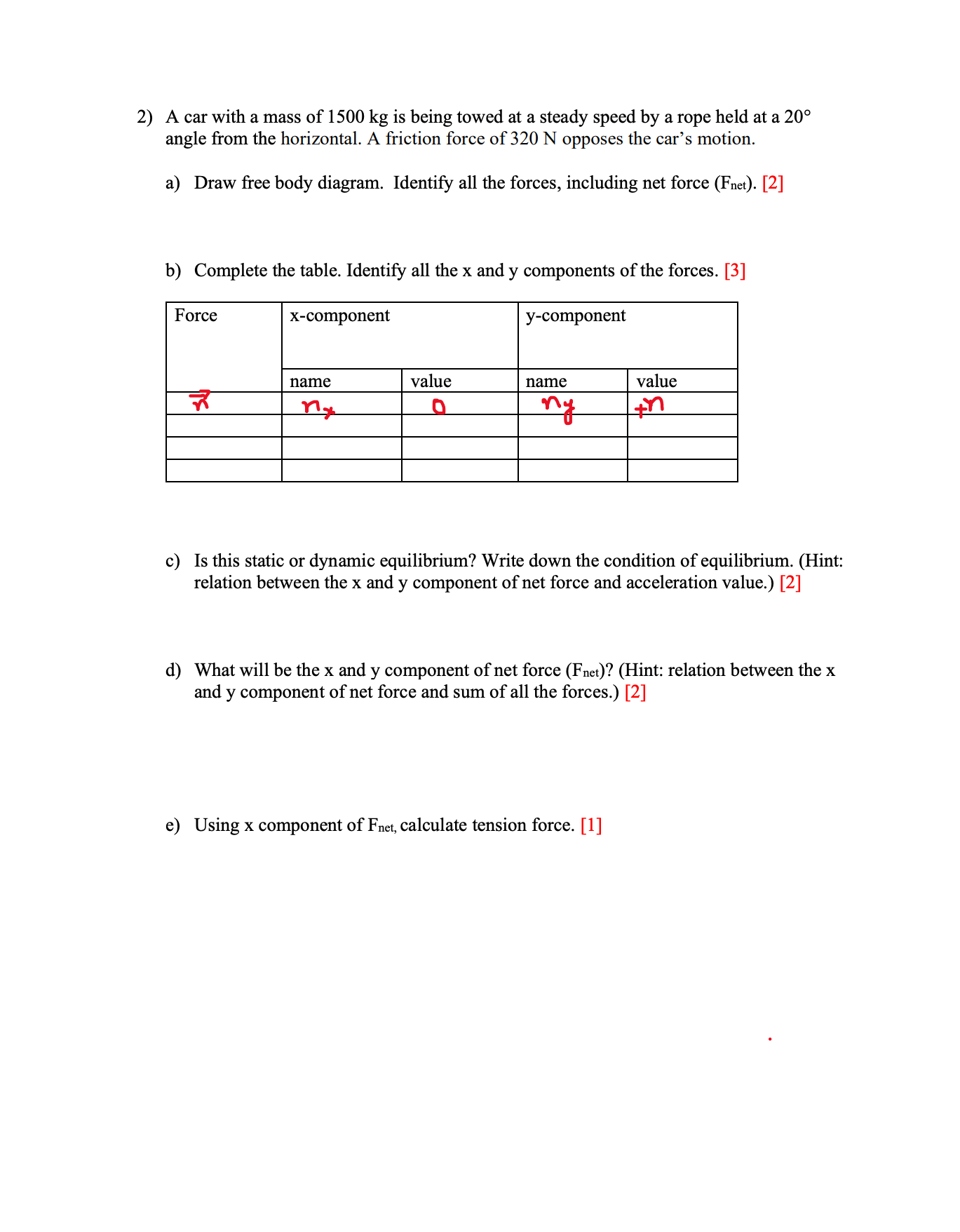
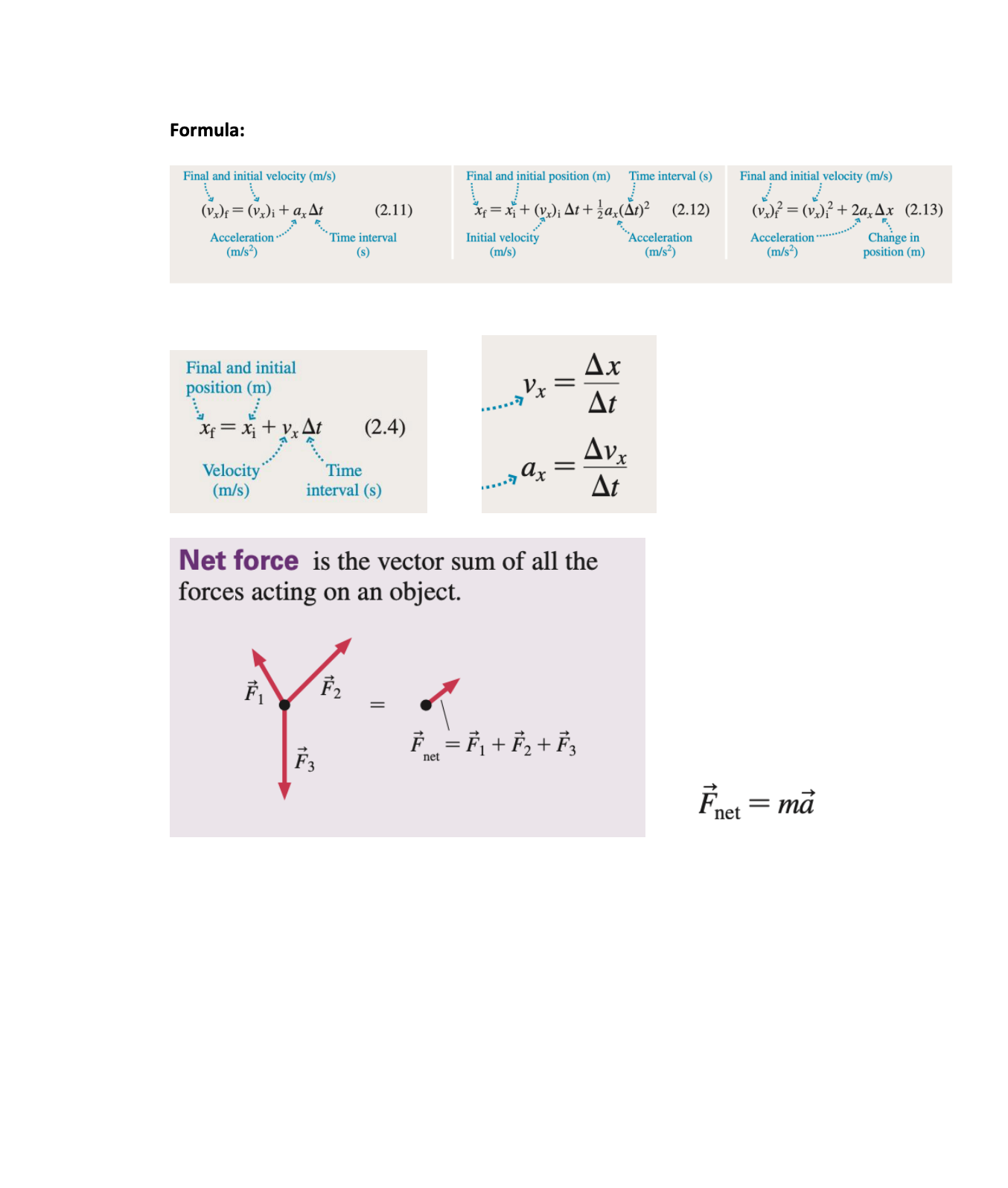
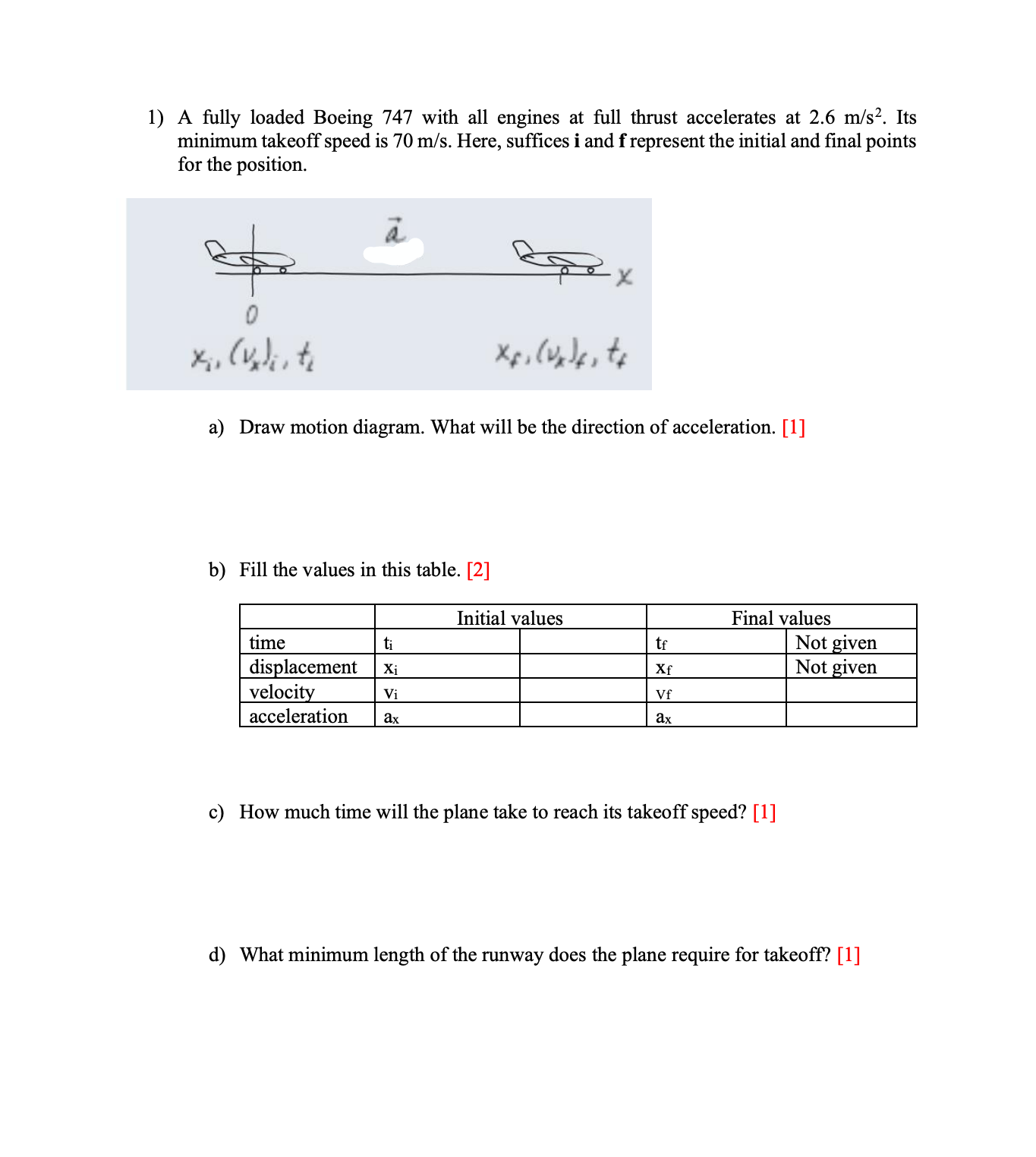
1) A fully loaded Boeing 747 with all engines at full thrust accelerates at 2.6 m/s2. Its minimum takeoff speed is 70 m/s. Here, suffices i and f represent the initial and final points for the position. 0 a) Draw motion diagram. What will be the direction of acceleration. [1] b) Fill the values in this table. [2] Initial values Final values time ti tf Not given displacement Xi Xf Not given velocity vi Vf acceleration ax ax c) How much time will the plane take to reach its takeoff speed? [1] d) What minimum length of the runway does the plane require for takeoff? [1]2) A car with a mass of 1500 kg is being towed at a steady speed by a rope held at a 20 angle from the horizontal. A friction force of 320 N opposes the car's motion. a) Draw free body diagram. Identify all the forces, including net force (Fnet). [2] b) Complete the table. Identify all the x and y components of the forces. [3] Force xcomponent y-component name \"1" \"_ c) Is this static or dynamic equilibrium? Write down the condition of equilibrium. (Hint: relation between the x and y component of net force and acceleration value.) [2] d) What will be the x and y component of net force (F net)? (Hint: relation between the x and y component of net force and sum of all the forces.) [2] e) Using 2; component of Fnet, calculate tension force. [1] Formula: Final and initial velocity (m/s) Final and initial position (m) Time interval (s) Final and initial velocity (m/s) (vx)f = (vx)it a, At (2.11) *, = xit ( vx ); At + lax (Ar)2 (2.12 ) (vx)? = (Vx)?+ 2ax Ax (2.13) Acceleration . Time interval Initial velocity Acceleration Acceleration ." Change in (m/s') (s) (m/s) (m/s-) (m/s2) position (m) Final and initial Ax position (m) Vx At " = xi + Vx At (2.4) AVx Velocity Time (m/s) interval (s) ..... ax At Net force is the vector sum of all the forces acting on an object. F1 F 2 F = F1 + F 2 + F3 Fnet = ma
Step by Step Solution
There are 3 Steps involved in it

Get step-by-step solutions from verified subject matter experts
 Study Help