







Question: Please help with this case study: 1. When was the company founded? 2. Discuss a brief history of the company. 3. Explain the challenges facing
Please help with this case study:
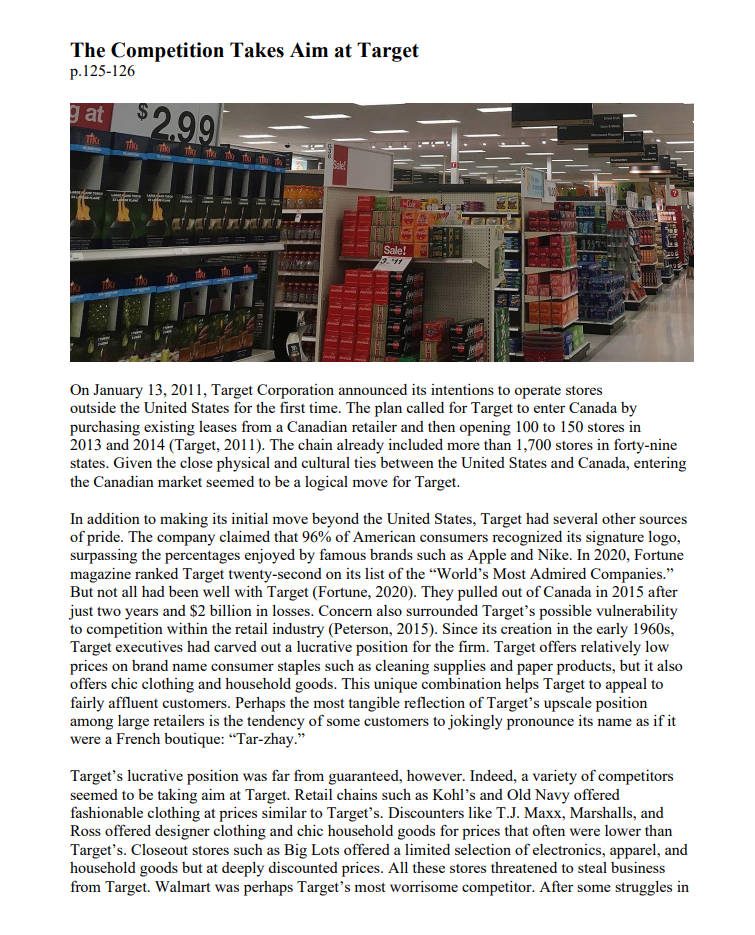
1. When was the company founded? 2. Discuss a brief history of the company. 3. Explain the challenges facing the company. 4. Explain major successes for the company 5. Who is the current CEO and how long has he/she been in that position? 6. Discuss at least 1 piece of information you found interesting from the case study.The Competition Takes Aim at Target p. 125-126 y at $ 299 Tiki Sale! PETER On January 13, 2011, Target Corporation announced its intentions to operate stores outside the United States for the first time. The plan called for Target to enter Canada by purchasing existing leases from a Canadian retailer and then opening 100 to 150 stores in 2013 and 2014 (Target, 2011). The chain already included more than 1,700 stores in forty-nine states. Given the close physical and cultural ties between the United States and Canada, entering the Canadian market seemed to be a logical move for Target. In addition to making its initial move beyond the United States, Target had several other sources of pride. The company claimed that 96% of American consumers recognized its signature logo, surpassing the percentages enjoyed by famous brands such as Apple and Nike. In 2020, Fortune magazine ranked Target twenty-second on its list of the "World's Most Admired Companies." But not all had been well with Target (Fortune, 2020). They pulled out of Canada in 2015 after just two years and $2 billion in losses. Concern also surrounded Target's possible vulnerability to competition within the retail industry (Peterson, 2015). Since its creation in the early 1960s, Target executives had carved out a lucrative position for the firm. Target offers relatively low prices on brand name consumer staples such as cleaning supplies and paper products, but it also offers chic clothing and household goods. This unique combination helps Target to appeal to fairly affluent customers. Perhaps the most tangible reflection of Target's upscale position among large retailers is the tendency of some customers to jokingly pronounce its name as if it were a French boutique: "Tar-zhay." Target's lucrative position was far from guaranteed, however. Indeed, a variety of competitors seemed to be taking aim at Target. Retail chains such as Kohl's and Old Navy offered fashionable clothing at prices similar to Target's. Discounters like T.J. Maxx, Marshalls, and Ross offered designer clothing and chic household goods for prices that often were lower than Target's. Closeout stores such as Big Lots offered a limited selection of electronics, apparel, and household goods but at deeply discounted prices. All these stores threatened to steal business from Target. Walmart was perhaps Target's most worrisome competitor. After some struggles inthe Es, the mammoth retailer's performance was strong enough that it ranked consistently above Target on Fortune's list ofthe \"World's Most Admired Companies" [eighteenth vs. twentysecond in EDED]. Walmart also was much bigger than Target. The resulting economies of scale meant that Walmart could undercut Target's prices anytime it desired. Just such a scenario had unfolded before. A few years ago1 Walmart's victory in a price war over Kmart led the latter into bardo'uptcy. One important difference between Kmart and Target is that Target is viewed by consumers as offering relatively highquality goods. But this difference might not protect Target. Although Walmart's products tended to lack the chic appeal of Target's, Walmart had begun offering better products during the recession of the late Ell-lls in an effort to expand its customer base. If Walmart executives chose to match Target's quality while charging lower prices, Target could find itself without a unique appeal for customers. As 2132f} continued1 a big question loomed: could Target maintain its unique appeal to customers or would the competitive arrows launched by Walmart and others force Target's executives to quiver
Step by Step Solution
There are 3 Steps involved in it

Get step-by-step solutions from verified subject matter experts
 Study Help