







Question: please help with this question paper QUESTION 1 [20 Marks] Calcite is a carbonate mineral and the most stable polymorph of calcium carbonate (CaCO3). It
![please help with this question paper QUESTION 1 [20 Marks] Calcite](https://dsd5zvtm8ll6.cloudfront.net/si.experts.images/questions/2024/09/66f90227454e4_04666f90226c4c47.jpg)
please help with this question paper
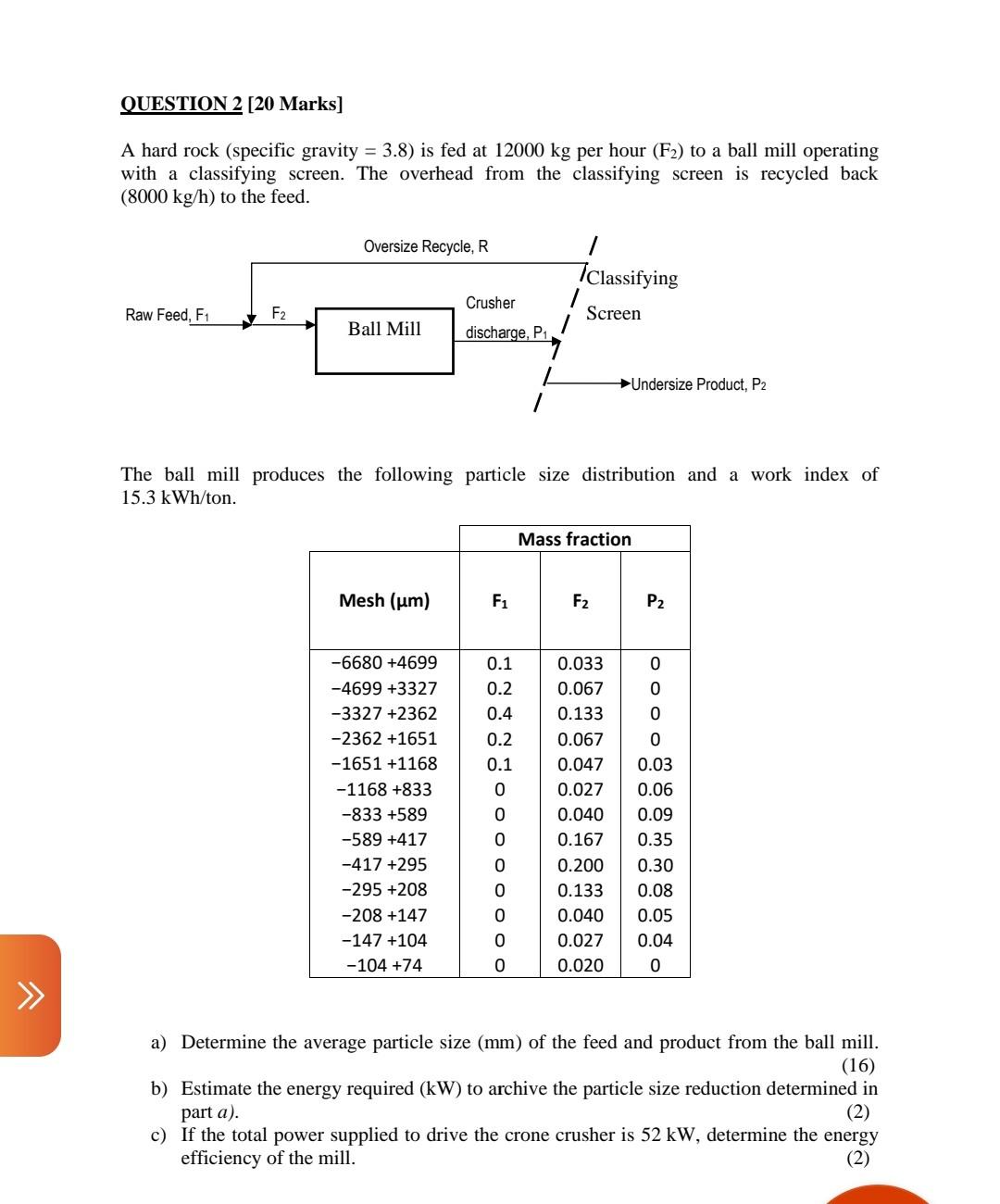
QUESTION 1 [20 Marks] Calcite is a carbonate mineral and the most stable polymorph of calcium carbonate (CaCO3). It is a very common and widespread mineral with highly variable forms and colours (Figure 1). Calcite is best recognized by its relatively low Mohs hardness (3) and its high reactivity with even weak acids, such as vinegar, plus its prominent rhombohedral cleavage in most varieties. An X-ray crystallography analysis showed the presence of mixture of particle sizes as shown in Table 1. From the tabulated data, determine the specific surface (g/m) of the mineral. Figure 1. Symmetrical three-dimensional solid shape. Density equation (kg/m?): p = 0.6 04 where: y = 765 and x = 1200 Table 1. Particle size distribution. ISS Mesh Mass retained (g) ISS Mesh Mass retained (9) 0 -20 +18 26 27 28 -100 +85 -85 +80 -80 +70 -70 +60 -60 +50 -50 +40 -40 +35 -35 +30 -30 +25 -25 +20 33.5 324 315.5 120 40 26 -18 +15 -15 +12 -12 +10 -10 +9 -9 +8 -8 +6 -6 +5 -5 +4 182 27 28 78 79 39 29 29 69 1 QUESTION 2 [20 Marks] A hard rock (specific gravity = 3.8) is fed at 12000 kg per hour (F2) to a ball mill operating with a classifying screen. The overhead from the classifying screen is recycled back (8000 kg/h) to the feed. Oversize Recycle, R Classifying Crusher Raw Feed, F1 F2 Screen Ball Mill discharge, P1 Undersize Product, P2 1 The ball mill produces the following particle size distribution and a work index of 15.3 kWh/ton. Mass fraction Mesh (um) F1 F2 P2 0 0.1 0.2 0.4 0.2 0.1 0 -6680 +4699 -4699 +3327 -3327 +2362 -2362 +1651 -1651 +1168 -1168 +833 -833 +589 -589 +417 -417 +295 -295 +208 -208 +147 -147 +104 -104 +74 0 0.033 0.067 0.133 0.067 0.047 0.027 0.040 0.167 0.200 0.133 0.040 0.027 0.020 0 0.03 0.06 0.09 0.35 0.30 0.08 0.05 0.04 0 0 Oo 0 >> a) Determine the average particle size (mm) of the feed and product from the ball mill. (16) b) Estimate the energy required (kW) to archive the particle size reduction determined in part a). (2) c) If the total power supplied to drive the crone crusher is 52 kW, determine the energy efficiency of the mill. (2)
Step by Step Solution
There are 3 Steps involved in it

Get step-by-step solutions from verified subject matter experts
 Study Help