







Question: Please help with this Suppose that the demand for units of some beverage comes from two types of household. They have the following utility functions
Please help with this
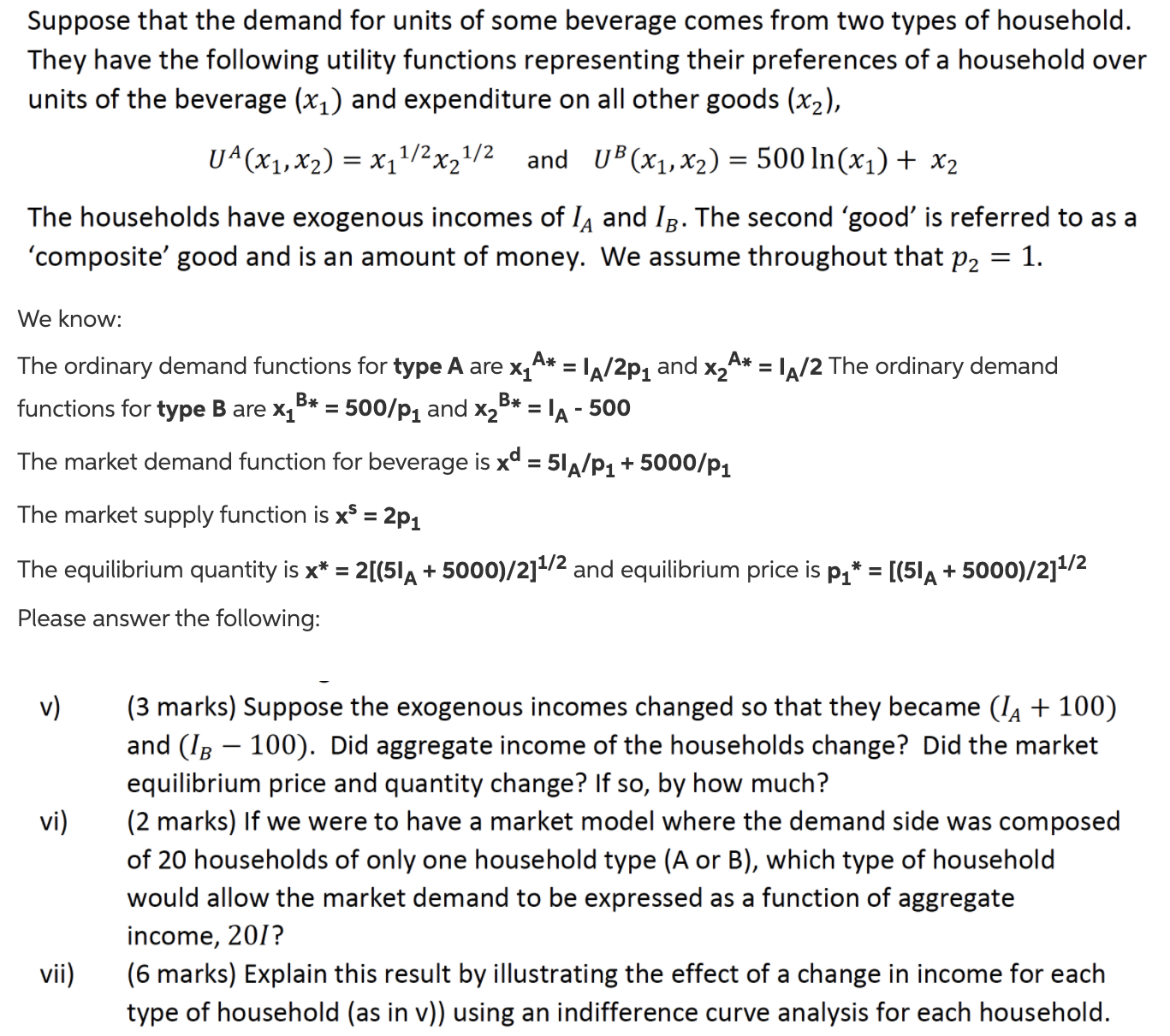
Suppose that the demand for units of some beverage comes from two types of household. They have the following utility functions representing their preferences of a household over units of the beverage (x1) and expenditure on all other goods (X2), UA(X1, X2) = x11/2x21/2 and UB(x1, X2) = 500 In(x1) + X2 The households have exogenous incomes of IA and I. The second 'good' is referred to as a 'composite' good and is an amount of money. We assume throughout that p2 = 1. We know: The ordinary demand functions for type A are x14* = lA/2p, and x2* = lA/2 The ordinary demand functions for type B are x15* = 500/p, and x2* B* = LA - 500 The market demand function for beverage is x = 51A/p1 + 5000/p1 The market supply function is x'S = 2p1 The equilibrium quantity is x* = 2[(51A + 5000)/2]1/2 and equilibrium price is p,* = [(51A + 5000)/2]1/2 Please answer the following: V) (3 marks) Suppose the exogenous incomes changed so that they became (IA + 100) and (IB - 100). Did aggregate income of the households change? Did the market equilibrium price and quantity change? If so, by how much? vi) (2 marks) If we were to have a market model where the demand side was composed of 20 households of only one household type (A or B), which type of household would allow the market demand to be expressed as a function of aggregate income, 201? vii) (6 marks) Explain this result by illustrating the effect of a change in income for each type of household (as in v)) using an indifference curve analysis for each household
Step by Step Solution
There are 3 Steps involved in it

Get step-by-step solutions from verified subject matter experts
 Study Help