







Question: Please I need a step-by-step information on how to answer this question and questions like this: Answer this question according to lecture and tutorial discussion.
Please I need a step-by-step information on how to answer this question and questions like this:
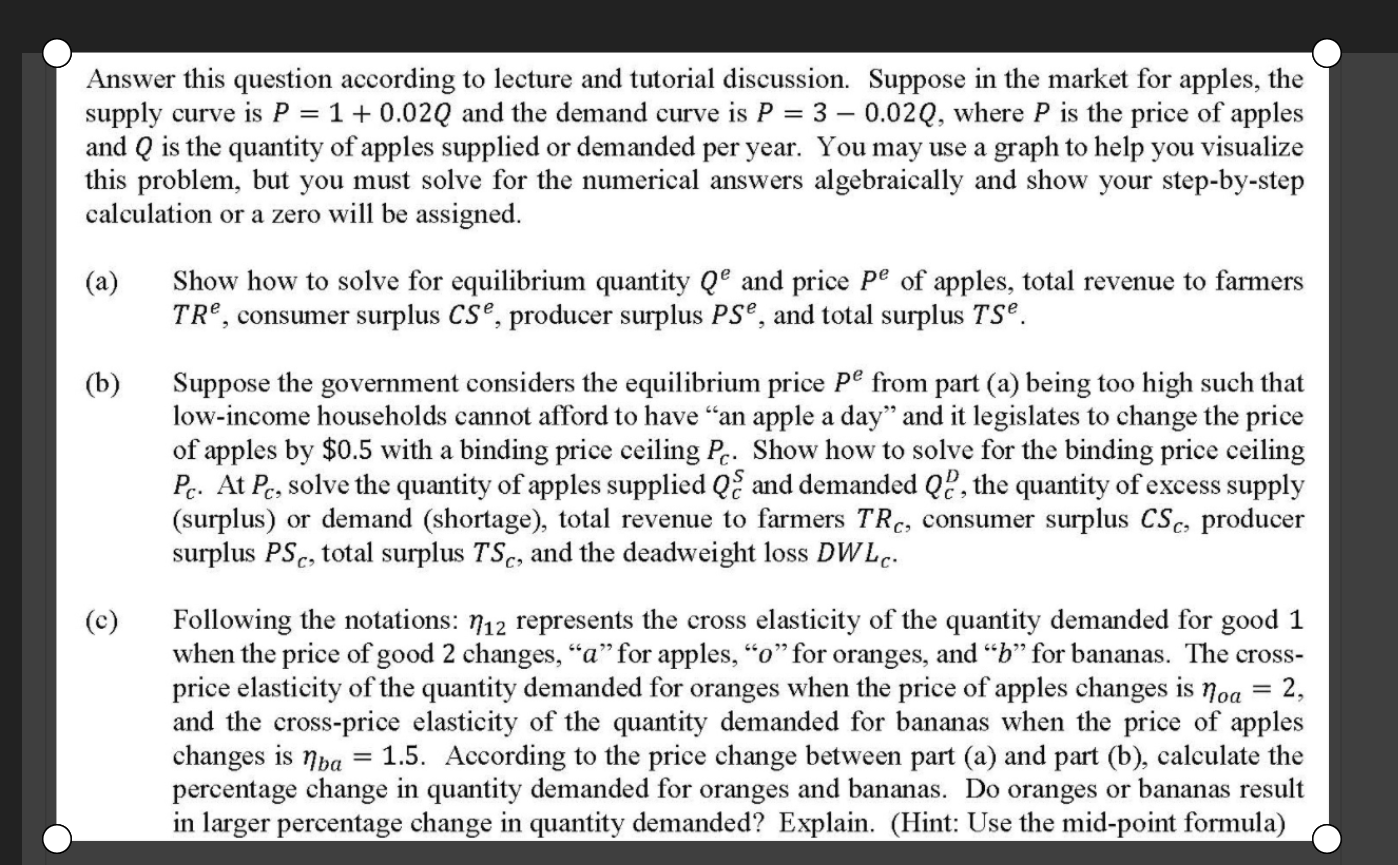
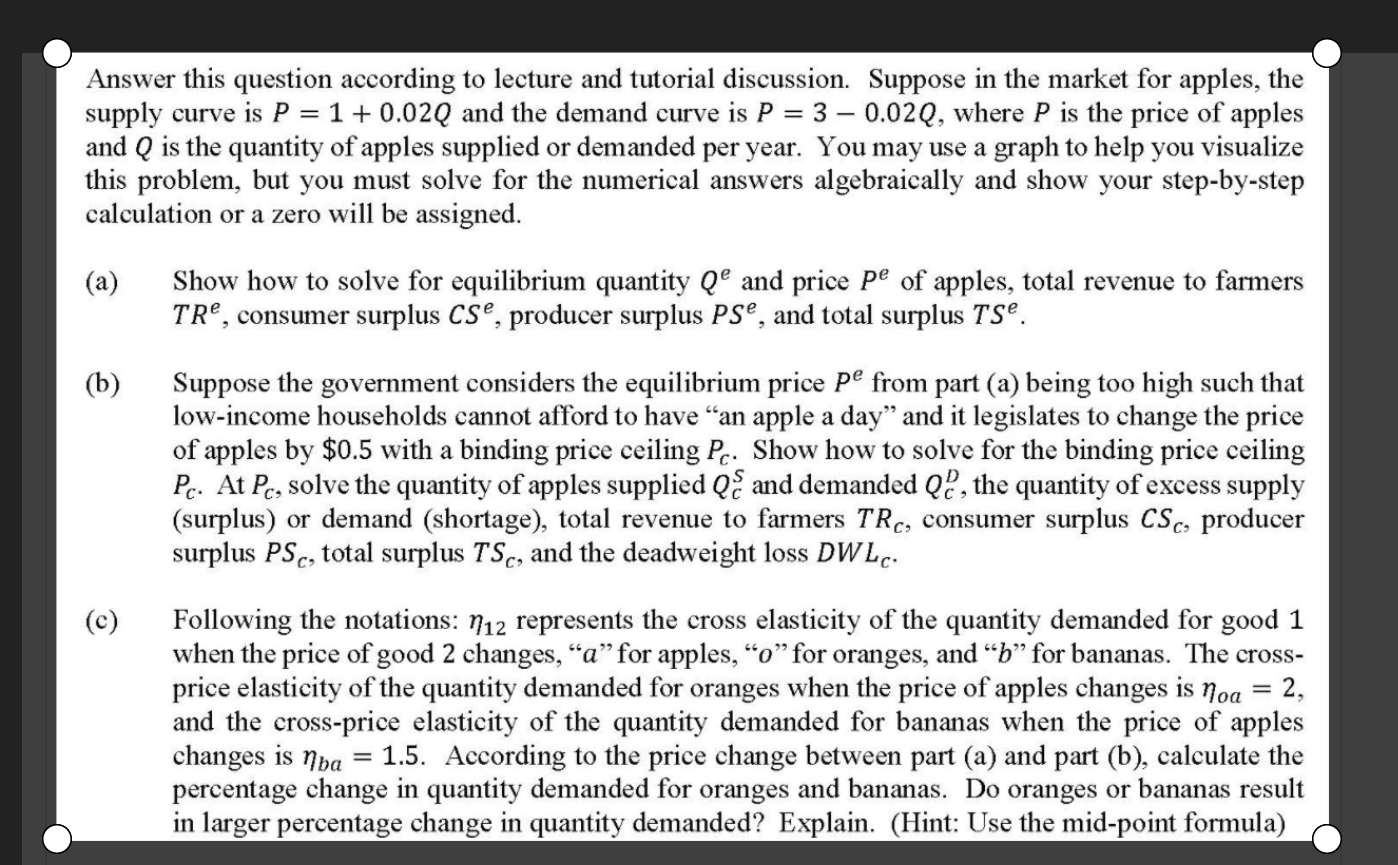
Answer this question according to lecture and tutorial discussion. Suppose in the market for apples, the supply curve is P = 1 + 0.02Q and the demand curve is P = 3 0.02Q, where P is the price of apples and Q is the quantity of apples supplied or demanded per year. You may use a graph to help you visualize this problem, but you must solve for the numerical answers algebraically and show your step-by-step calculation or a zero will be assigned. (a) Show how to solve for equilibrium quantity Q9 and price P9 of apples, total revenue to farmers TRe, consumer surplus CS 9, producer surplus P39, and total surplus T59. (b) Suppose the government considers the equilibrium price P'3 from part (a) being too high such that low-income households cannot afford to have \"an apple a day\" and it legislates to change the price of apples by $0.5 with a binding price ceiling PC. Show how to solve for the binding price ceiling PC. At P6, solve the quantity of apples supplied Q5! and demanded Q', the quantity of excess supply (surplus) or demand (shortage), total revenue to farmers TRC, consumer surplus C55, producer surplus PS 5, total surplus T56, and the deadweight loss DWLC. Following the notations: 7212 represents the cross elasticity of the quantity demanded for good 1 when the price of good 2 changes, \"a\" for apples, \"0" for oranges, and \"b\" for bananas. The cross- price elasticity of the quantity demanded for oranges when the price of apples changes is 17m = 2, and the cross-price elasticity of the quantity demanded for bananas when the price of apples changes is mm = 1.5. According to the price change between part (a) and part (b), calculate the percentage change in quantity demanded for oranges and bananas. Do oranges or bananas result in larger percentage change in quantity demanded? Explain. (Hint: Use the mid-point formula)
Step by Step Solution
There are 3 Steps involved in it

Get step-by-step solutions from verified subject matter experts
 Study Help