







Question: Please I need an answer!! can someone please help me with the answer as soon as possible, thank you! symptoms. Mini case solution must follow
Please I need an answer!! 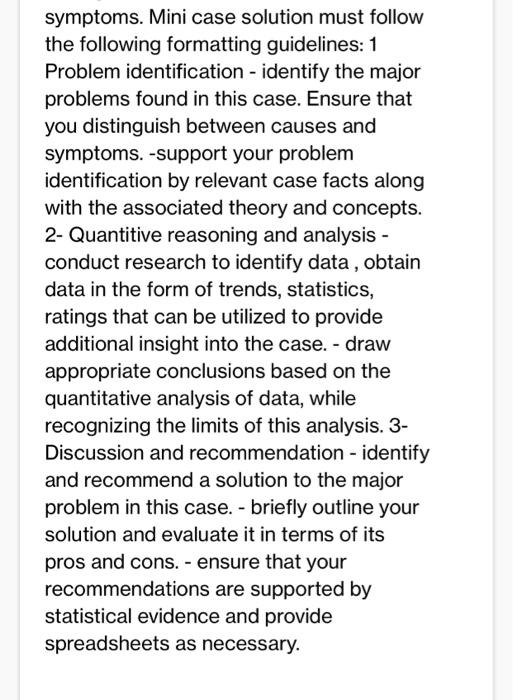
can someone please help me with the answer as soon as possible, thank you!
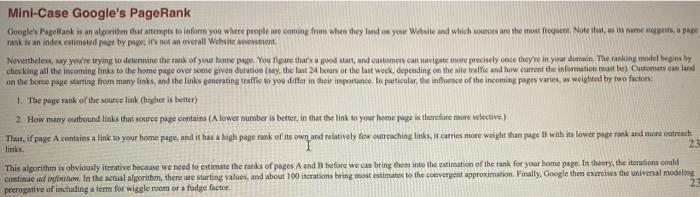
symptoms. Mini case solution must follow the following formatting guidelines: 1 Problem identification - identify the major problems found in this case. Ensure that you distinguish between causes and symptoms. -support your problem identification by relevant case facts along with the associated theory and concepts. 2- Quantitive reasoning and analysis - conduct research to identify data, obtain data in the form of trends, statistics, ratings that can be utilized to provide additional insight into the case. - draw appropriate conclusions based on the quantitative analysis of data, while recognizing the limits of this analysis. 3- Discussion and recommendation - identify and recommend a solution to the major problem in this case. - briefly outline your solution and evaluate it in terms of its pros and cons. - ensure that your recommendations are supported by statistical evidence and provide spreadsheets as necessary. Mini-Case Google's PageRank Google's PageRank is an algorithm that attempts to inform you where people are coming from when they land on your Website and which sources are the most frequent. Note that, as its name suggests, a page rank is an index estimated page by page; it's not an overall Website assessment. Nevertheless, say you're trying to determine the rank of your home page. You figure that's a good start, and customers can navigate more precisely once they're in your domain. The ranking model begins by checking all the incoming links to the home page over some given duration (say, the fast 24 hours or the last week, depending on the site traffic and how current the information must be). Customers can land on the home page starting from many links, and the links generating traffic to you differ in their importance. In particular, the influence of the incoming pages varies, as weighted by two factors 1. The page rank of the source link (higher is better) 2. How many outbound links that source page contains (A lower number is better, in that the link to your home page is therefore more selective.) Thus, if page A contains a link to your home page, and it has a high page rank of its own and relatively few outreaching links, it carries more weight than page 13 with its lower page rank and more outreach 23 links. This algorithm is obviously iterative because we need to estimate the ranks of pages A and B before we can bring them into the estimation of the rank for your home page. In theory, the iterations could continue ad infinition. In the actual algorithm, there are starting values, and about 100 iterations bring most estimates to the convergent approximation Finally, Google then exercises the universal modeling 23 prerogative of including a term for wiggle room or a fudge factor Step by Step Solution
There are 3 Steps involved in it
1 Expert Approved Answer
Step: 1 Unlock

Question Has Been Solved by an Expert!
Get step-by-step solutions from verified subject matter experts
Step: 2 Unlock
Step: 3 Unlock
 Study Help