



Question: please i need help with 5.1, 5.2, 5.3, 5.4 talings View Help Enable Editing Unless you need to edit it's safe to stay in Protected
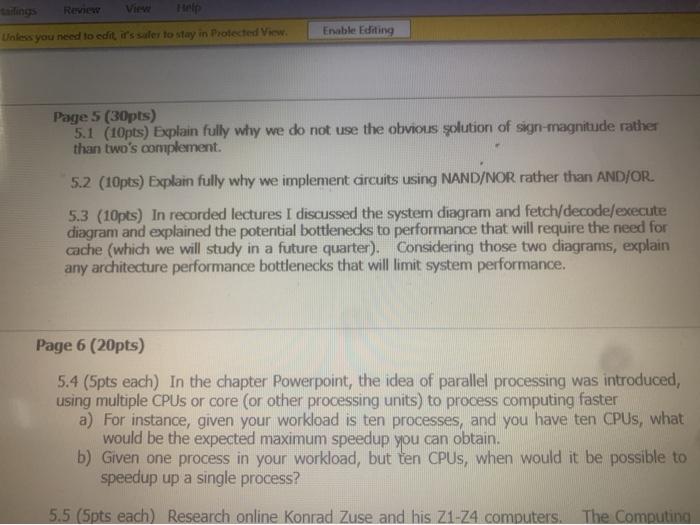
talings View Help Enable Editing Unless you need to edit it's safe to stay in Protected View Page 5 (30pts) 5.1 (10pts) Explain fully why we do not use the obvious solution of sign-magnitude rather than two's complement. 5.2 (10pts) Explain fully why we implement circuits using NAND/NOR rather than AND/OR. 5.3 (10pts) In recorded lectures I discussed the system diagram and fetch/decode/execute diagram and explained the potential bottlenecks to performance that will require the need for cache (which we will study in a future quarter). Considering those two diagrams, explain any architecture performance bottlenecks that will limit system performance. Page 6 (20pts) 5.4 (5pts each) In the chapter Powerpoint, the idea of parallel processing was introduced, using multiple CPUs or core (or other processing units) to process computing faster a) For instance, given your workload is ten processes, and you have ten CPUs, what would be the expected maximum speedup you can obtain. b) Given one process in your workload, but ten CPUs, when would it be possible to speedup up a single process? 5.5 (Spts each) Research online Konrad Zuse and his Z1-24 .computers. The Computing
Step by Step Solution
There are 3 Steps involved in it

Get step-by-step solutions from verified subject matter experts