







Question: please i need help with finding these learning outcomes and a article or web site i can get information from to ref 2. Evaluate the
please i need help with finding these learning outcomes and a article or web site i can get information from to ref
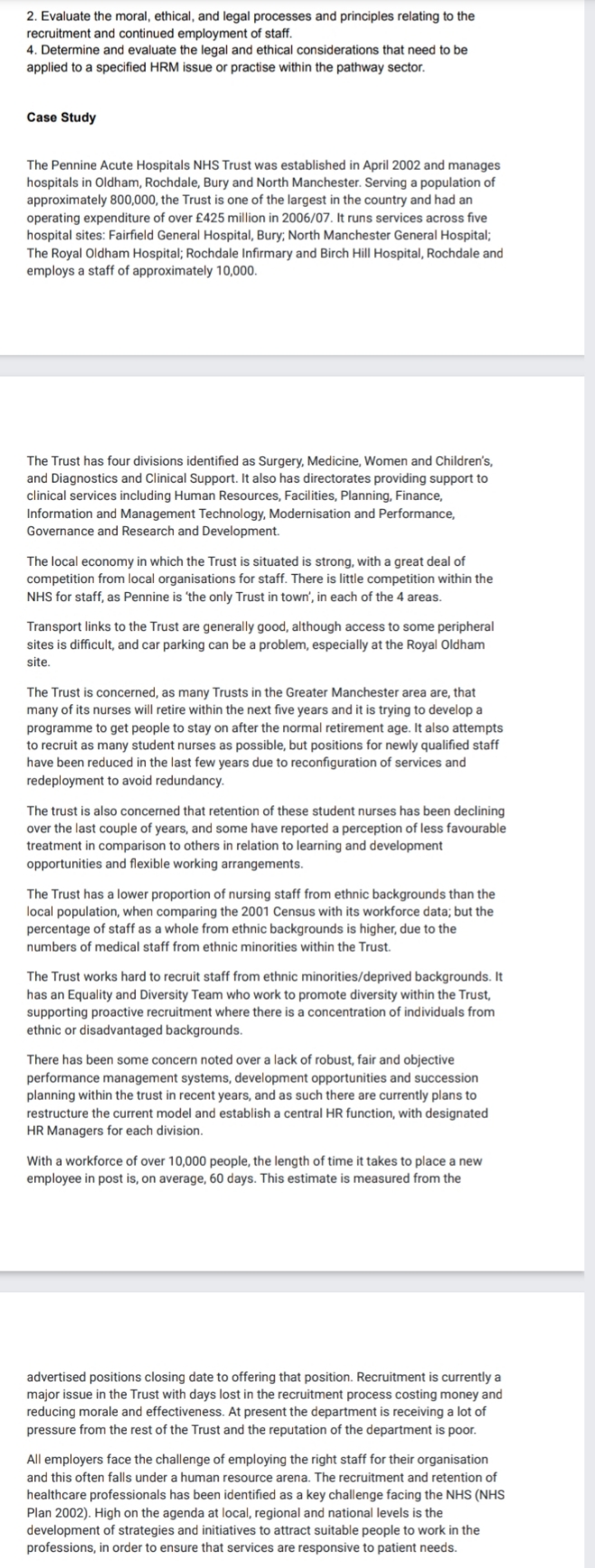
2. Evaluate the moral, ethical, and legal processes and principles relating to the recruitment and continued employment of staff. 4. Determine and evaluate the legal and ethical considerations that need to be applied to a specified HRM issue or practise within the pathway sector. Case Study The Pennine Acute Hospitals NHS Trust was established in April 2002 and manages hospitals in Oldham, Rochdale, Bury and North Manchester. Serving a population of approximately 800,000, the Trust is one of the largest in the country and had an operating expenditure of over E425 million in 2006/07. It runs services across five hospital sites: Fairfield General Hospital, Bury; North Manchester General Hospital; The Royal Oldham Hospital; Rochdale Infirmary and Birch Hill Hospital, Rochdale and employs a staff of approximately 10,000. The Trust has four divisions identified as Surgery, Medicine, Women and Children's, and Diagnostics and Clinical Support. It also has directorates providing support to clinical services including Human Resources, Facilities, Planning, Finance, Information and Management Technology, Modernisation and Performance, Governance and Research and Development. The local economy in which the Trust is situated is strong, with a great deal of competition from local organisations for staff. There is little competition within the NHS for staff, as Pennine is 'the only Trust in town', in each of the 4 areas. Transport links to the Trust are generally good, although access to some peripheral sites is difficult, and car parking can be a problem, especially at the Royal Oldham site. The Trust is concerned, as many Trusts in the Greater Manchester area are, that many of its nurses will retire within the next five years and it is trying to develop a programme to get people to stay on after the normal retirement age. It also attempts to recruit as many student nurses as possible, but positions for newly qualified staff have been reduced in the last few years due to reconfiguration of services and redeployment to avoid redundancy. The trust is also concerned that retention of these student nurses has been declining over the last couple of years, and some have reported a perception of less favourable treatment in comparison to others in relation to learning and development opportunities and flexible working arrangements. The Trust has a lower proportion of nursing staff from ethnic backgrounds than the local population, when comparing the 2001 Census with its workforce data; but the percentage of staff as a whole from ethnic backgrounds is higher, due to the numbers of medical staff from ethnic minorities within the Trust. The Trust works hard to recruit staff from ethnic minorities/deprived backgrounds. It has an Equality and Diversity Team who work to promote diversity within the Trust, supporting proactive recruitment where there is a concentration of individuals from ethnic or disadvantaged backgrounds. There has been some concern noted over a lack of robust, fair and objective performance management systems, development opportunities and succession planning within the trust in recent years, and as such there are currently plans to restructure the current model and establish a central HR function, with designated HR Managers for each division. With a workforce of over 10,000 people, the length of time it takes to place a new employee in post is, on average, 60 days. This estimate is measured from the advertised positions closing date to offering that position. Recruitment is currently a major issue in the Trust with days lost in the recruitment process costing money and reducing morale and effectiveness. At present the department is receiving a lot of pressure from the rest of the Trust and the reputation of the department is poor. All employers face the challenge of employing the right staff for their organisation and this often falls under a human resource arena. The recruitment and retention of healthcare professionals has been identified as a key challenge facing the NHS (NHS Plan 2002). High on the agenda at local, regional and national levels is the development of strategies and initiatives to attract suitable people to work in the professions, in order to ensure that services are responsive to patient needs
Step by Step Solution
There are 3 Steps involved in it

Get step-by-step solutions from verified subject matter experts
 Study Help