Question: please I need the answer it's so important Successful Navigating the Turbulent Skies of a Large-Scale ERP Implementation - Harvard Business Case hat were the
please I need the answer it's so important
- Successful Navigating the Turbulent Skies of a Large-Scale ERP Implementation - Harvard Business Case
- hat were the good steps/practices in implementation process for the Mirabel roll-out and what steps/practices needed improvement?
- What were the good steps/practices in the second implementation process and what areas needed improvement? What were the challenges faced by the project team?
- What was the main difference between the two phases in terms of the users roles? What was the role of the plant manager?
- How can we assess whether a project is a success or a failure?
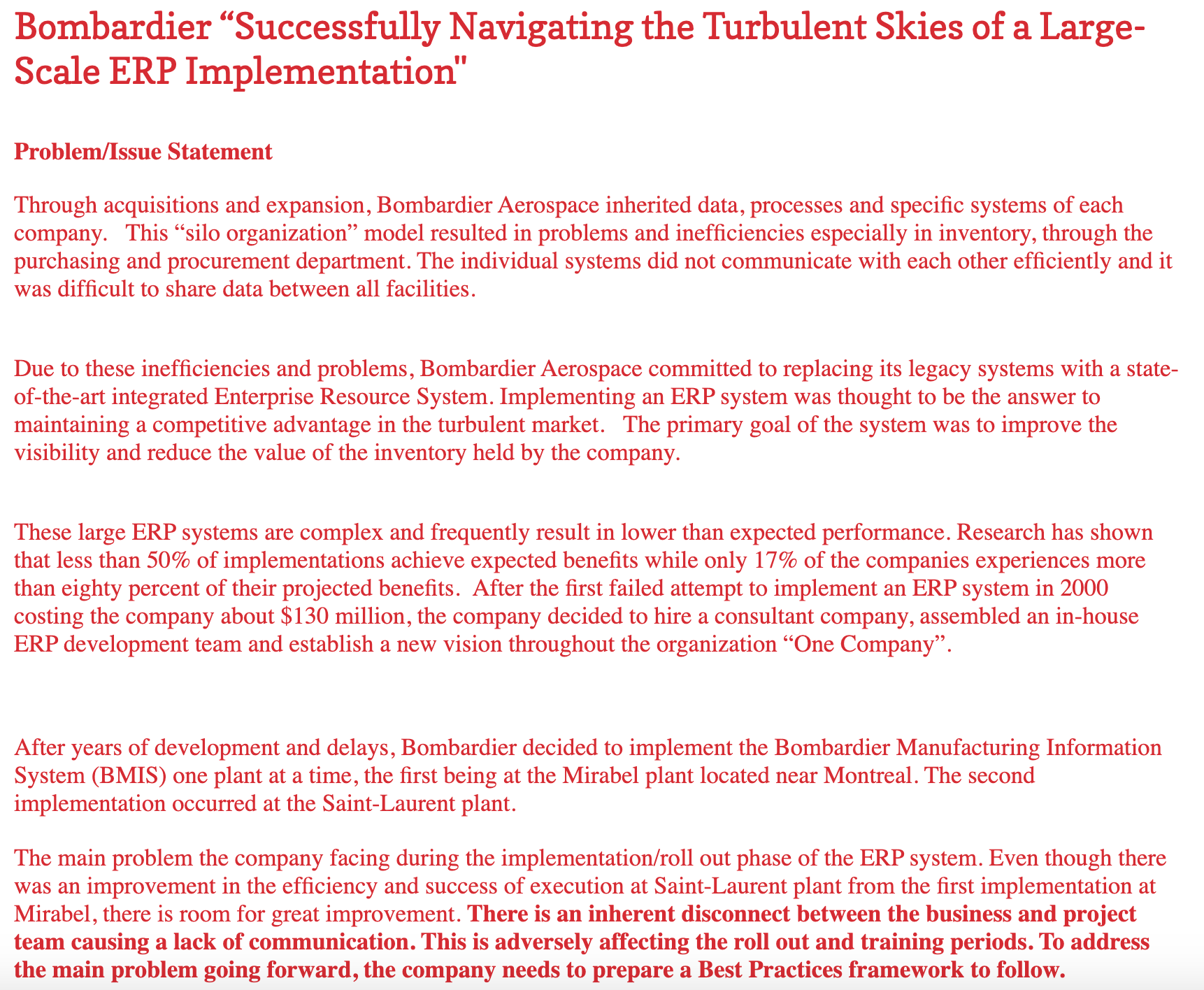
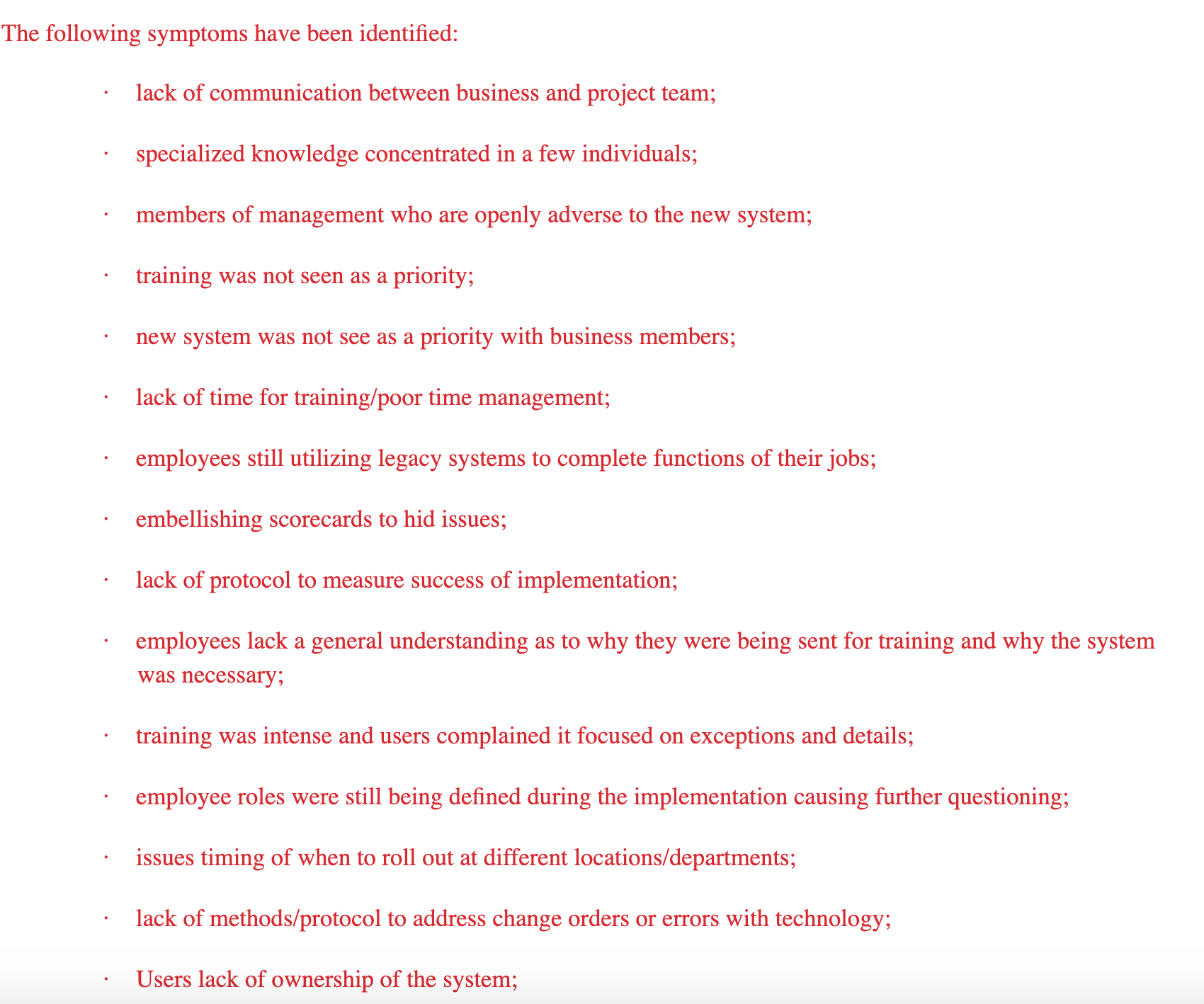
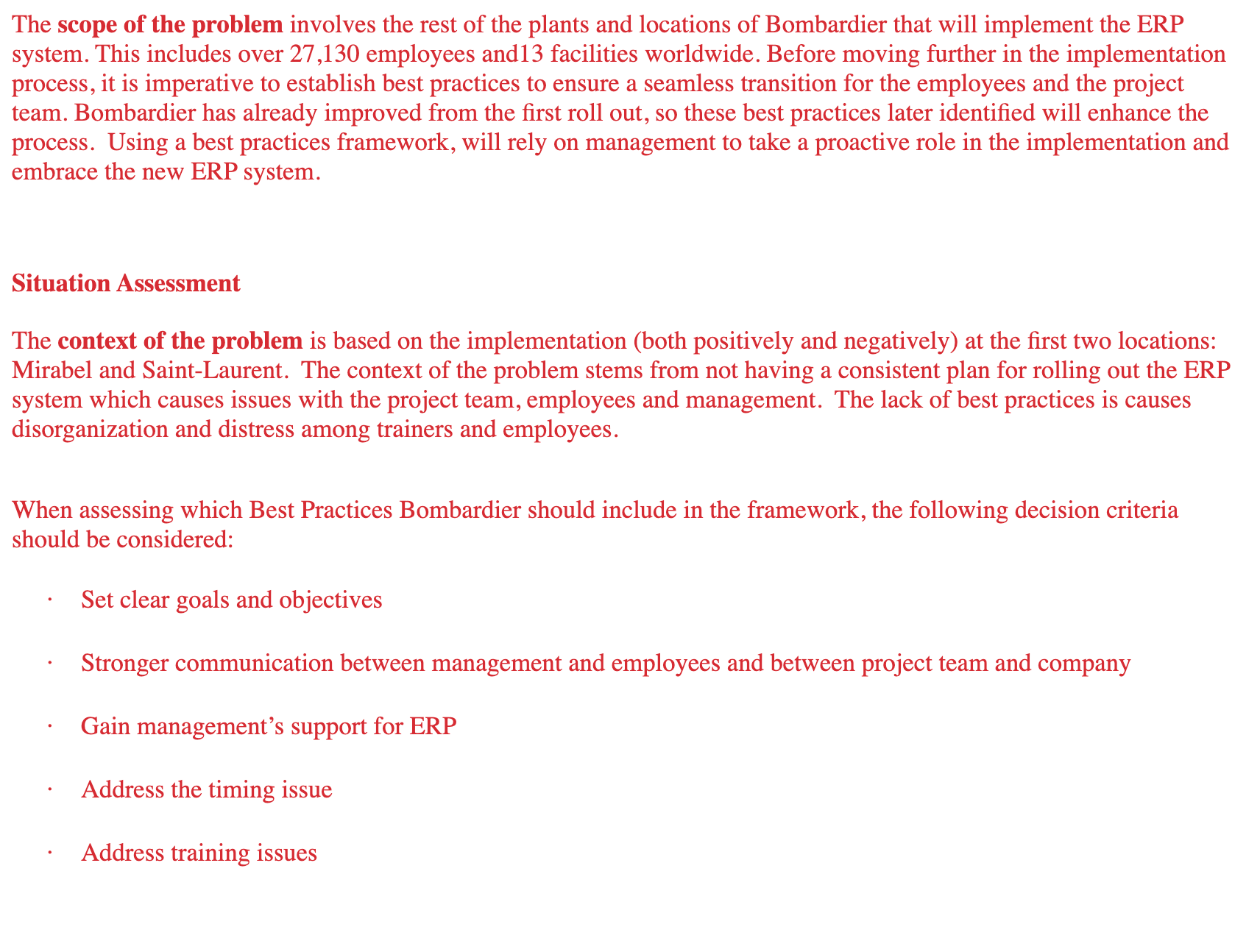
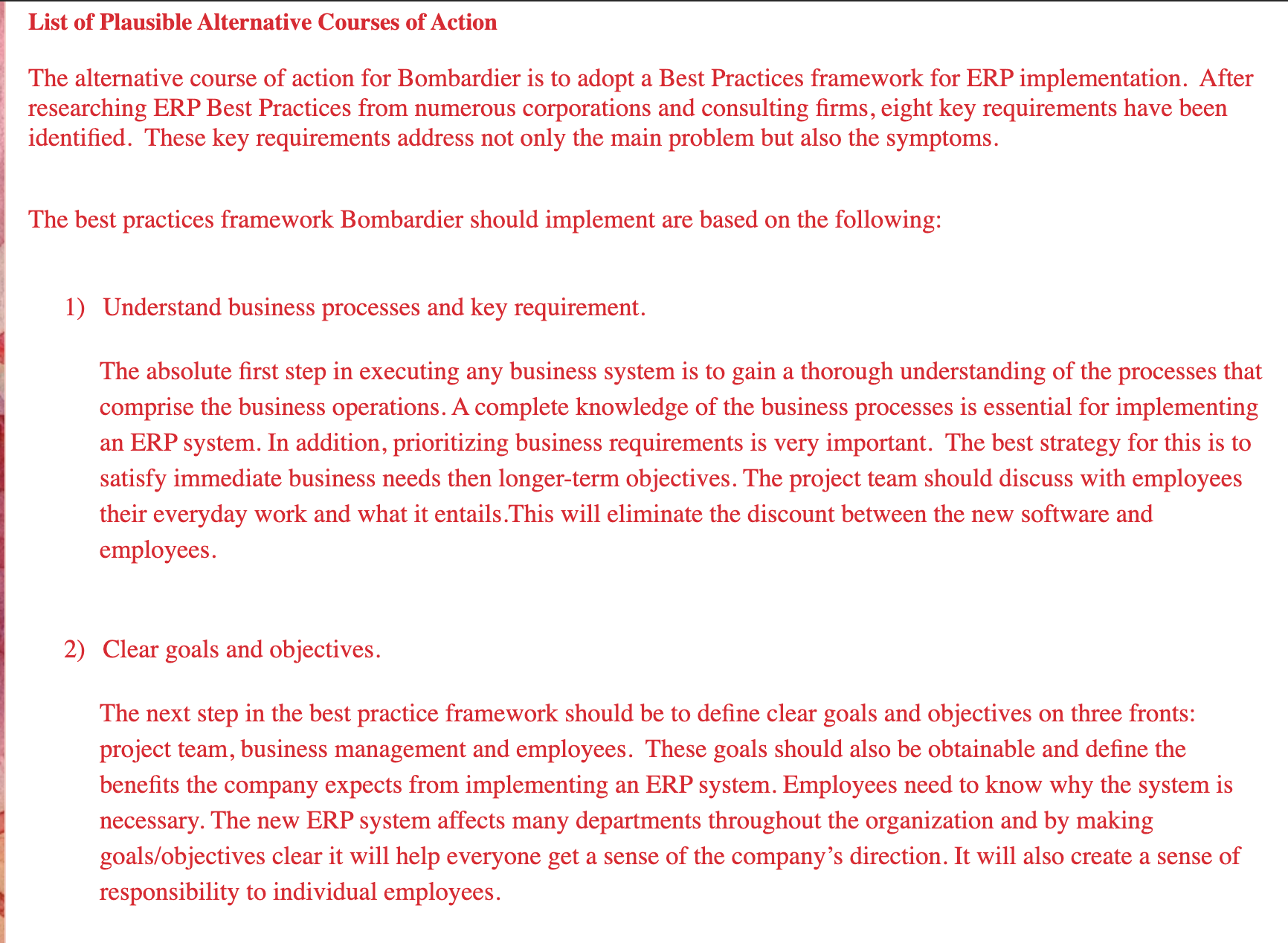
The following symptoms have been identified: lack of communication between business and project team; specialized knowledge concentrated in a few individuals; members of management who are openly adverse to the new system; training was not seen as a priority; new system was not see as a priority with business members; lack of time for training/poor time management; employees still utilizing legacy systems to complete functions of their jobs; embellishing scorecards to hid issues; lack of protocol to measure success of implementation; employees lack a general understanding as to why they were being sent for training and why the system was necessary; training was intense and users complained it focused on exceptions and details; employee roles were still being defined during the implementation causing further questioning; issues timing of when to roll out at different locations/departments; lack of methods/protocol to address change orders or errors with technology; Users lack of ownership of the system; List of Plausible Alternative Courses of Action The alternative course of action for Bombardier is to adopt a Best Practices framework for ERP implementation. After researching ERP Best Practices from numerous corporations and consulting firms, eight key requirements have been identified. These key requirements address not only the main problem but also the symptoms. The best practices framework Bombardier should implement are based on the following: 1) Understand business processes and key requirement. The absolute first step in executing any business system is to gain a thorough understanding of the processes that comprise the business operations. A complete knowledge of the business processes is essential for implementing an ERP system. In addition, prioritizing business requirements is very important. The best strategy for this is to satisfy immediate business needs then longer-term objectives. The project team should discuss with employees their everyday work and what it entails. This will eliminate the discount between the new software and employees. 2) Clear goals and objectives. The next step in the best practice framework should be to define clear goals and objectives on three fronts: project team, business management and employees. These goals should also be obtainable and define the benefits the company expects from implementing an ERP system. Employees need to know why the system is necessary. The new ERP system affects many departments throughout the organization and by making goals/objectives clear it will help everyone get a sense of the company's direction. It will also create a sense of responsibility to individual employees. 3) Choosing the right software. Bombardier needs to match the software to the organization's needs, business processes, functional requirements and normal business operations. For example, Bombardier chose to use SAP and implement the BMIS system for manufacturing facilities. 4) Ensure proper project management and resource commitment A dedicated project manager who is involved in both planning and ongoing management is essential to implementing an ERP system. In addition, Bombardier needs to commit resources to the project through all phases of implementation. This includes financial support, management support and end user support. Bombardier has shown a commitment to this project, however it should maintain this commitment until completion. 5) Gain executive and organizational commitment In order for the goals and objectives to be clearly communicated to the organization, executives and top management need to support the ERP system. Management should hold ramp up/roll out meetings to address the benefits of the system and why the company is choosing to implement it. In addition, this will foster a positive attitude toward changing to an ERP system since people are inherently adverse to change. The was seen at the Saint-Laurent location which positively helped implementation. 6) Plan early Bombardier should prepare a detailed plan outlining the implementation plan and timeline for each location. By pinpointing particular steps and addressing when and how they will be done will take the guess work out during the critical implementation phase. As seen in the first two roll outs, business personnel did not communicate in a timely manner to employees regarding training sessions. In addition, timing of implementation to consider the business functions it is affecting. For example, implementing the new financial/accounting system in the fourth quarter is not the best decision. Recommendation After reviewing the issues Bombardier experienced at the first two locations, it is clear that the company needs to incorporate a best practices framework. My recommendation is to use some or all of the key requirements identified above. By using a best practices framework, Bombardier will not only improve on the technical implementation but it will also address the negative feelings held by employees. The framework will generate commitment from management which in turn will help communicate the positive changes to employees. Bombardier also needs to set clear goals and objectives and communicate them to the entire business. This will help employees understand why the BMIS is being implemented. Bombardier should also plan early for the roll out at each location including proper notification, training schedules, and provide a detailed plan of how/when implementation will occur. Bombardier's business personnel should plan accordingly and change roles and responsibilities prior to implementation. This will alleviate employee frustration and distress. Training should be provided to all employees before, during and after implementation. The project team should prepare a detailed training plan for each location, including the training schedules, contact information and materials. Presentation If I were presenting as a consultant to the class, I would state that I have been commissioned to identify some of the Best Practice frameworks that exist and could be applied to Bombardier. I would discuss how each key requirement can be used during the BMIS implementation process. I would detail the main problem and issues faced during implementation. I would also address the decisions criteria and the needs of the company. I would discuss the eight Best Practices requirements identified. Visual aids to be used in presentation









 Study Help