







Question: PLEASE I NEED THIS SOLVED AS SOON AS POSSIBLE Objective: The purpose of this project is to provide you with experience in defining and testing
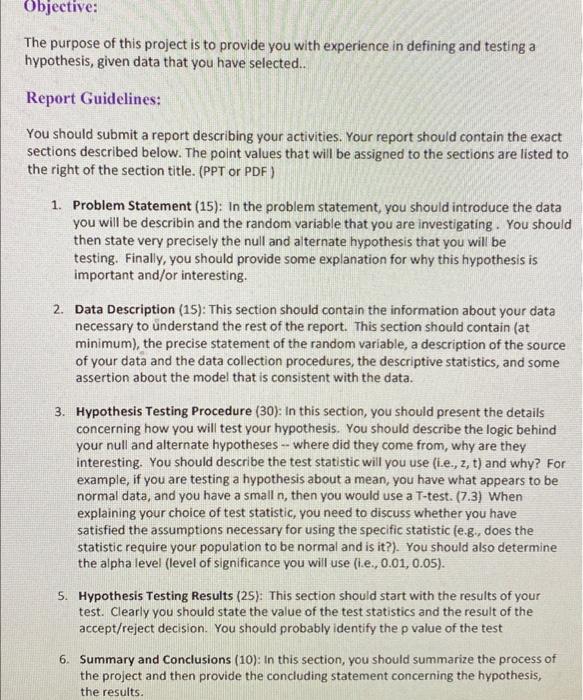
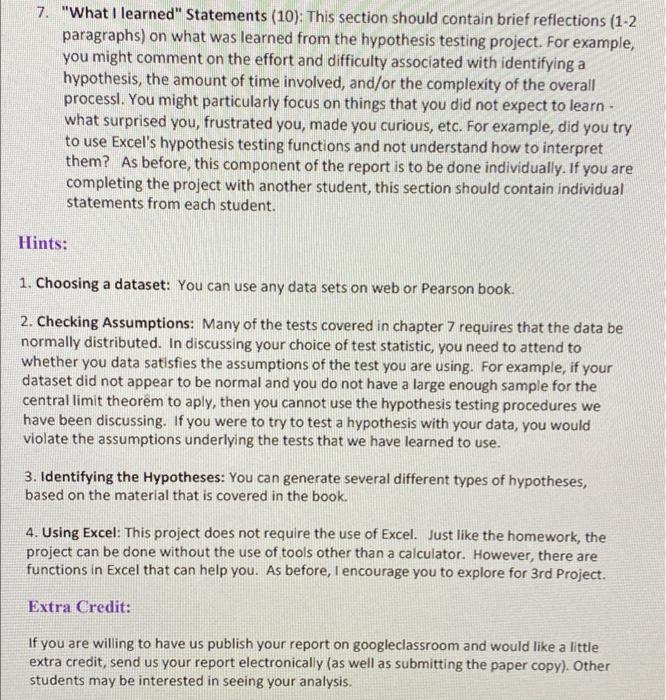
Objective: The purpose of this project is to provide you with experience in defining and testing a hypothesis, given data that you have selected.. Report Guidelines: You should submit a report describing your activities. Your report should contain the exact sections described below. The point values that will be assigned to the sections are listed to the right of the section title. (PPT or PDF) 1. Problem Statement (15): In the problem statement, you should introduce the data you will be describin and the random variable that you are investigating. You should then state very precisely the null and alternate hypothesis that you will be testing. Finally, you should provide some explanation for why this hypothesis is important and/or interesting. 2. Data Description (15): This section should contain the information about your data necessary to understand the rest of the report. This section should contain (at minimum), the precise statement of the random variable, a description of the source of your data and the data collection procedures, the descriptive statistics, and some assertion about the model that is consistent with the data. 3. Hypothesis Testing Procedure (30): In this section, you should present the details concerning how you will test your hypothesis. You should describe the logic behind your null and alternate hypotheses -- where did they come from, why are they interesting. You should describe the test statistic will you use (i.e., 2, t) and why? For example, if you are testing a hypothesis about a mean, you have what appears to be normal data, and you have a small n, then you would use a T-test. (7.3) When explaining your choice of test statistic, you need to discuss whether you have satisfied the assumptions necessary for using the specific statistic (e.g., does the statistic require your population to be normal and is it?). You should also determine the alpha level (level of significance you will use (.e., 0.01, 0.05). 5. Hypothesis Testing Results (25): This section should start with the results of your test. Clearly you should state the value of the test statistics and the result of the accept/reject decision. You should probably identify the p value of the test 6. Summary and Conclusions (10): In this section, you should summarize the process of the project and then provide the concluding statement concerning the hypothesis, the results. 7. "What I learned" Statements (10): This section should contain brief reflections (1-2 paragraphs) on what was learned from the hypothesis testing project. For example, you might comment on the effort and difficulty associated with identifying a hypothesis, the amount of time involved, and/or the complexity of the overall process. You might particularly focus on things that you did not expect to learn. what surprised you, frustrated you, made you curious, etc. For example, did you try to use Excel's hypothesis testing functions and not understand how to interpret them? As before, this component of the report is to be done individually. If you are completing the project with another student, this section should contain individual statements from each student. Hints: 1. Choosing a dataset: You can use any data sets on web or Pearson book. 2. Checking Assumptions: Many of the tests covered in chapter 7 requires that the data be normally distributed. In discussing your choice of test statistic, you need to attend to whether you data satisfies the assumptions of the test you are using. For example, if your dataset did not appear to be normal and you do not have a large enough sample for the central limit theorem to aply, then you cannot use the hypothesis testing procedures we have been discussing. If you were to try to test a hypothesis with your data, you would violate the assumptions underlying the tests that we have learned to use. 3. Identifying the Hypotheses: You can generate several different types of hypotheses, based on the material that is covered in the book. 4. Using Excel: This project does not require the use of Excel. Just like the homework, the project can be done without the use of tools other than a calculator. However, there are functions in Excel that can help you. As before, I encourage you to explore for 3rd Project. Extra Credit: If you are willing to have us publish your report on googleclassroom and would like a little extra credit, send us your report electronically (as well as submitting the paper copy). Other students may be interested in seeing your analysis
Step by Step Solution
There are 3 Steps involved in it

Get step-by-step solutions from verified subject matter experts
 Study Help