







Question: Please I really a matlab code for this. shift.txt file nos: -3,9,-17 caeser txt 1 nos: 80,68,87,79,68,69,76,86,73,88,81 caeser txt 2 nos: 76,74,86,75,89,86,87,70,73,84,86,67,76,66,86 caeser txt 3
Please I really a matlab code for this. 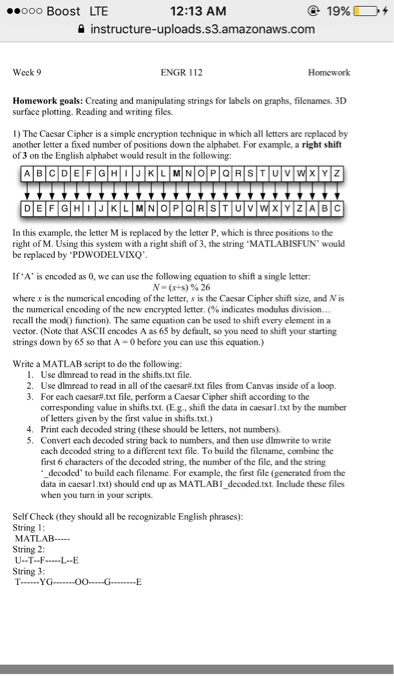
shift.txt file nos: -3,9,-17
caeser txt 1 nos: 80,68,87,79,68,69,76,86,73,88,81
caeser txt 2 nos: 76,74,86,75,89,86,87,70,73,84,86,67,76,66,86
caeser txt 3 no: 75,70,83,70,67,80,88,70,78,89,86,73,86,69,70,70,69,86,89,82,74,88,70,69,86,83,86,87,70,73,86
Homework goals: Creating and manipulating strings foe labels on graphs, filenames. 3D surface plotting, Reading and writing files. The Caesar Cipher is a simple encryption technique in which all letters are replaced by another letter a fixed number of positions down the alphabet For example, a right shift of 3 on the English alphabet would result in the following: In this example, the letter M is replaced by the letter P, which is three positions to the right of M. Using tins system with a right shift of 3, the string 'MATLABISFUN' would be replaced by 'PDWODELVIXQ'. If 'A' is encoded as 0, we can use the following equation to shift a single letter N = (x + s) % 26 where x is the numerical encoding of the letter, s is the Caesar Cipher shift size, and N is the numerical encoding of the new encrypted letter, (% indicates modulus division... recall the mod() function). The same equation can he used to shift every element in a sector. (Note that ASCII encodes A as 65 by default, so you need to shin your starting strings down by 65 so that A = 0 before you can use this equation.) Write a MATLAB script to do the following: Use to read in the shifts.txt file. Use to read in all of the cacsars.txt files from Canvas inside of a loop. For each cacsar#.txt file, perform a Caesar Cipher shift according to the corresponding value in shifts.txt. (E.g., shift the data in cacsarl.txt by the number of letters given by the first value in shifts.txt.) Print each decoded string (these should be letters, not numbers). Convert each decoded string back to numbers, and then use to write each decoded string to a different text file. To build the filename, combine the first 6 characters of the decoded string, the number of the file, and the string '_decoded' to build each filename. For example, the first file (generated from the data in caesarl.txt) should end up as MATLABI_decoded.txt. Include these files when you turn in your scripts. Self Cheek (they should all be recognizable English phrases): String 1: MATLAB------ String 2: U--T--F -----L--E String 3: T ------YG---------OO-----G---------E Homework goals: Creating and manipulating strings foe labels on graphs, filenames. 3D surface plotting, Reading and writing files. The Caesar Cipher is a simple encryption technique in which all letters are replaced by another letter a fixed number of positions down the alphabet For example, a right shift of 3 on the English alphabet would result in the following: In this example, the letter M is replaced by the letter P, which is three positions to the right of M. Using tins system with a right shift of 3, the string 'MATLABISFUN' would be replaced by 'PDWODELVIXQ'. If 'A' is encoded as 0, we can use the following equation to shift a single letter N = (x + s) % 26 where x is the numerical encoding of the letter, s is the Caesar Cipher shift size, and N is the numerical encoding of the new encrypted letter, (% indicates modulus division... recall the mod() function). The same equation can he used to shift every element in a sector. (Note that ASCII encodes A as 65 by default, so you need to shin your starting strings down by 65 so that A = 0 before you can use this equation.) Write a MATLAB script to do the following: Use to read in the shifts.txt file. Use to read in all of the cacsars.txt files from Canvas inside of a loop. For each cacsar#.txt file, perform a Caesar Cipher shift according to the corresponding value in shifts.txt. (E.g., shift the data in cacsarl.txt by the number of letters given by the first value in shifts.txt.) Print each decoded string (these should be letters, not numbers). Convert each decoded string back to numbers, and then use to write each decoded string to a different text file. To build the filename, combine the first 6 characters of the decoded string, the number of the file, and the string '_decoded' to build each filename. For example, the first file (generated from the data in caesarl.txt) should end up as MATLABI_decoded.txt. Include these files when you turn in your scripts. Self Cheek (they should all be recognizable English phrases): String 1: MATLAB------ String 2: U--T--F -----L--E String 3: T ------YG---------OO-----G---------E
Step by Step Solution
There are 3 Steps involved in it

Get step-by-step solutions from verified subject matter experts
 Study Help