







Question: Please include the work for all parts and draw a process flow diagram for part 1 rocess described in the case is an example of
Please include the work for all parts and draw a process flow diagram for part 1
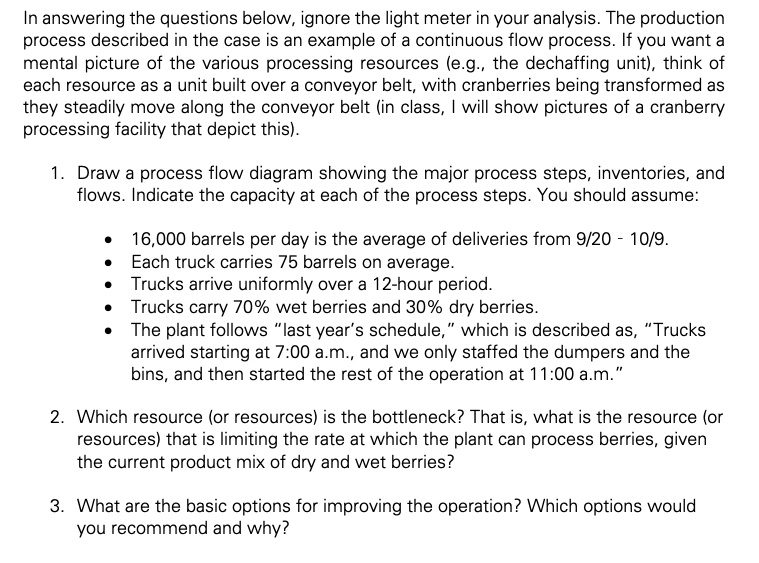
rocess described in the case is an example of a continuous flow process. If you want a hental picture of the various processing resources (e.g., the dechaffing unit), think of ach resource as a unit built over a conveyor belt, with cranberries being transformed as hey steadily move along the conveyor belt (in class, I will show pictures of a cranberry rocessing facility that depict this). 1. Draw a process flow diagram showing the major process steps, inventories, and flows. Indicate the capacity at each of the process steps. You should assume: - 16,000 barrels per day is the average of deliveries from 9/20-10/9. - Each truck carries 75 barrels on average. - Trucks arrive uniformly over a 12-hour period. - Trucks carry 70\% wet berries and 30% dry berries. - The plant follows "last year's schedule," which is described as, "Trucks arrived starting at 7:00 a.m., and we only staffed the dumpers and the bins, and then started the rest of the operation at 11:00 a.m." 2. Which resource (or resources) is the bottleneck? That is, what is the resource (or resources) that is limiting the rate at which the plant can process berries, given the current product mix of dry and wet berries? 3. What are the basic options for improving the operation? Which options would you recommend and why? rocess described in the case is an example of a continuous flow process. If you want a hental picture of the various processing resources (e.g., the dechaffing unit), think of ach resource as a unit built over a conveyor belt, with cranberries being transformed as hey steadily move along the conveyor belt (in class, I will show pictures of a cranberry rocessing facility that depict this). 1. Draw a process flow diagram showing the major process steps, inventories, and flows. Indicate the capacity at each of the process steps. You should assume: - 16,000 barrels per day is the average of deliveries from 9/20-10/9. - Each truck carries 75 barrels on average. - Trucks arrive uniformly over a 12-hour period. - Trucks carry 70\% wet berries and 30% dry berries. - The plant follows "last year's schedule," which is described as, "Trucks arrived starting at 7:00 a.m., and we only staffed the dumpers and the bins, and then started the rest of the operation at 11:00 a.m." 2. Which resource (or resources) is the bottleneck? That is, what is the resource (or resources) that is limiting the rate at which the plant can process berries, given the current product mix of dry and wet berries? 3. What are the basic options for improving the operation? Which options would you recommend and whyStep by Step Solution
There are 3 Steps involved in it
1 Expert Approved Answer
Step: 1 Unlock

Question Has Been Solved by an Expert!
Get step-by-step solutions from verified subject matter experts
Step: 2 Unlock
Step: 3 Unlock
 Study Help