







Question: Please just answer problem #2! 1. Did the furan reaction form the exo (114) or endo (8081) product? 2. Carefully explain why the product must
Please just answer problem #2!
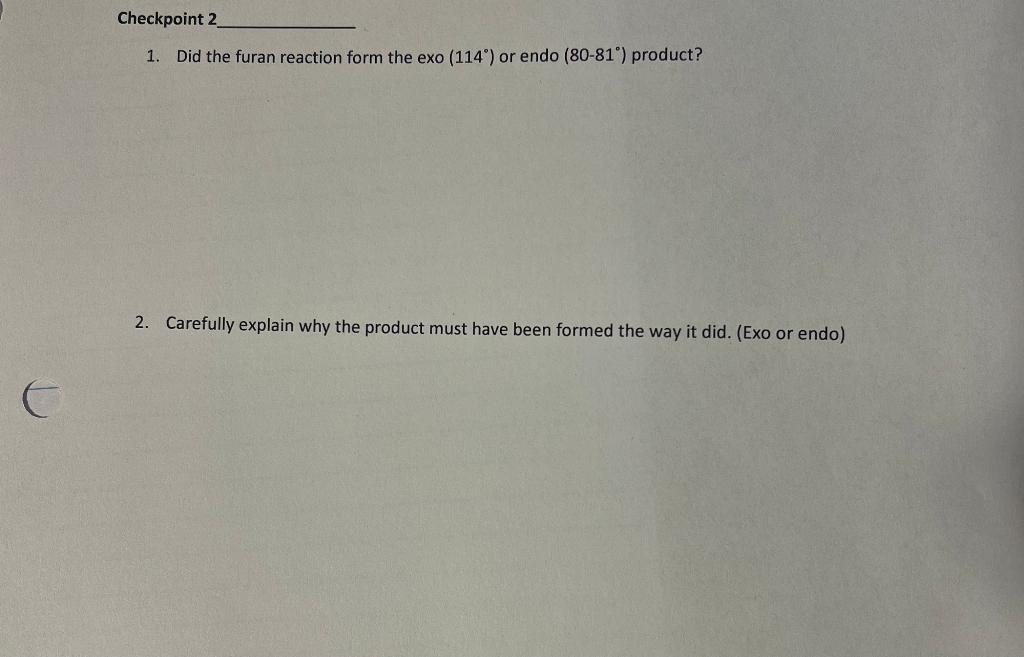
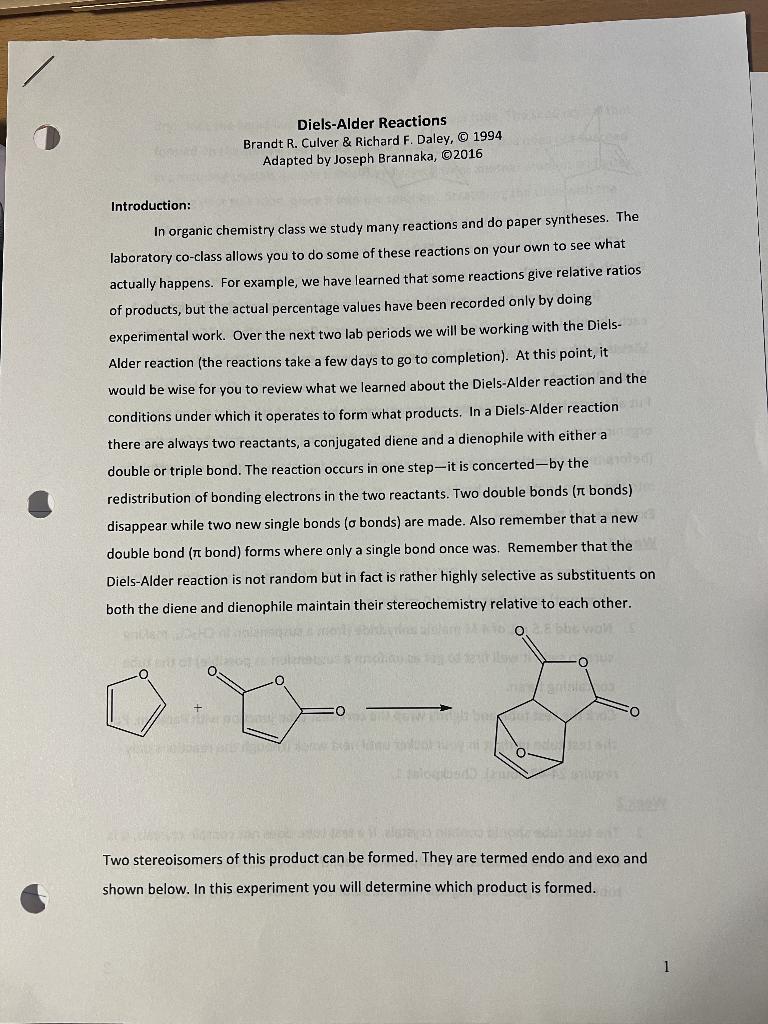
1. Did the furan reaction form the exo (114) or endo (8081) product? 2. Carefully explain why the product must have been formed the way it did. (Exo or endo) Introduction: In organic chemistry class we study many reactions and do paper syntheses. The laboratory co-class allows you to do some of these reactions on your own to see what actually happens. For example, we have learned that some reactions give relative ratios of products, but the actual percentage values have been recorded only by doing experimental work. Over the next two lab periods we will be working with the DielsAlder reaction (the reactions take a few days to go to completion). At this point, it would be wise for you to review what we learned about the Diels-Alder reaction and the conditions under which it operates to form what products. In a Diels-Alder reaction there are always two reactants, a conjugated diene and a dienophile with either a double or triple bond. The reaction occurs in one step - it is concerted-by the redistribution of bonding electrons in the two reactants. Two double bonds ( bonds) disappear while two new single bonds (o bonds) are made. Also remember that a new double bond ( bond) forms where only a single bond once was. Remember that the Diels-Alder reaction is not random but in fact is rather highly selective as substituents on both the diene and dienophile maintain their stereochemistry relative to each other. Two stereoisomers of this product can be formed. They are termed endo and exo and shown below. In this experiment you will determine which product is formed
Step by Step Solution
There are 3 Steps involved in it

Get step-by-step solutions from verified subject matter experts
 Study Help