







Question: Please just answer question 2 and show how the calculations were made (Very important). Thanks a lot! 2. Calculate the capacity and utilization of each
Please just answer question 2 and show how the calculations were made (Very important). Thanks a lot!
2. Calculate the capacity and utilization of each resource (people, rooms) and identify bottlenecks.
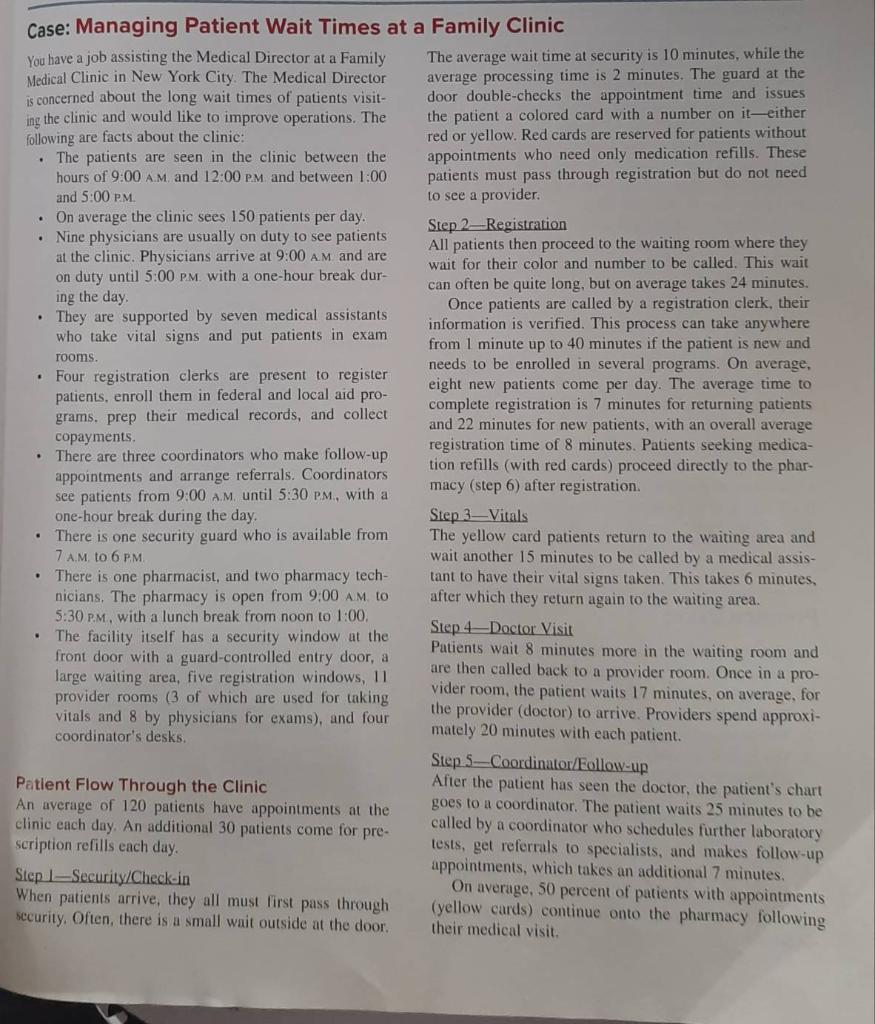
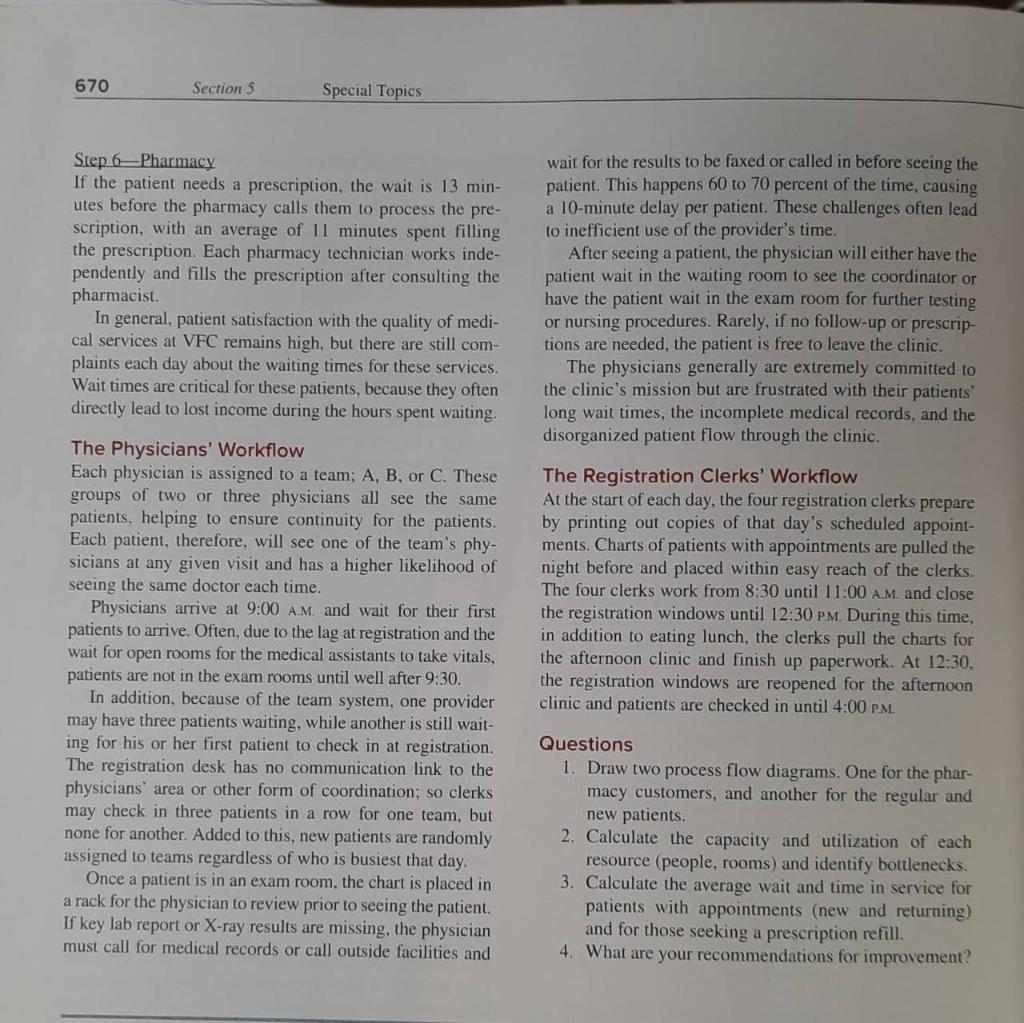
Case: Managing Patient Wait Times at a Family Clinic You have a job assisting the Medical Director at a Family The average wait time at security is 10 minutes, while the Medical Clinic in New York City. The Medical Director average processing time is 2 minutes. The guard at the is concerned about the long wait times of patients visit- door double-checks the appointment time and issues ing the clinic and would like to improve operations. The the patient a colored card with a number on it-either following are facts about the clinic: red or yellow. Red cards are reserved for patients without The patients are seen in the clinic between the appointments who need only medication refills. These hours of 9:00 AM and 12:00 PM and between 1:00 patients must pass through registration but do not need and 5:00 PM to see a provider. On average the clinic sees 150 patients per day. Step 2-Registration Nine physicians are usually on duty to see patients All patients then proceed to the waiting room where they at the clinic. Physicians arrive at 9:00 AM and are wait for their color and number to be called. This wait on duty until 5:00 PM with a one-hour break dur- can often be quite long, but on average takes 24 minutes. ing the day Once patients are called by a registration clerk, their They are supported by seven medical assistants information is verified. This process can take anywhere who take vital signs and put patients in exam from 1 minute up to 40 minutes if the patient is new and rooms needs to be enrolled in several programs. On average, Four registration clerks are present to register eight new patients come per day. The average time to patients, enroll them in federal and local aid pro- complete registration is 7 minutes for returning patients grams. prep their medical records, and collect and 22 minutes for new patients, with an overall average copayments registration time of 8 minutes. Patients seeking medica- There are three coordinators who make follow-up tion refills (with red cards) proceed directly to the phar- appointments and arrange referrals. Coordinators macy (step 6) after registration see patients from 9:00 AM until 5:30 PM, with a one-hour break during the day. Step 3-Vitals There is one security guard who is available from The yellow card patients return to the waiting area and 7 AM to 6 PM wait another 15 minutes to be called by a medical assis- There is one pharmacist, and two pharmacy tech- tant to have their vital signs taken. This takes 6 minutes. nicians. The pharmacy is open from 9:00 AM to after which they return again to the waiting area. 5:30 PM, with a lunch break from noon to 1:00 Step 4-Doctor Visit The facility itself has a security window at the Patients wait 8 minutes more in the waiting room and front door with a guard-controlled entry door, a are then called back to a provider room. Once in a pro- large waiting area, five registration windows, 11 provider rooms (3 of which are used for taking vider room, the patient waits 17 minutes, on average, for vitals and 8 by physicians for exams), and four the provider (doctor) to arrive. Providers spend approxi- coordinator's desks. mately 20 minutes with each patient. Step 5-Coordinator/Follow-up Patient Flow Through the Clinic After the patient has seen the doctor, the patient's chart An average of 120 patients have appointments at the goes to a coordinator. The patient waits 25 minutes to be clinic each day. An additional 30 patients come for pre- called by a coordinator who schedules further laboratory scription refills each day. tests, get referrals to specialists, and makes follow-up appointments, which takes an additional 7 minutes, Step 1-Security/Check-in When patients arrive, they all must first pass through On average, 50 percent of patients with appointments (yellow cards) continue onto the pharmacy following security. Often, there is a small wnit outside at the door. their medical visit . . 670 Section 5 Special Topics wait for the results to be faxed or called in before seeing the patient. This happens 60 to 70 percent of the time, causing a 10-minute delay per patient. These challenges often lead to inefficient use of the provider's time. After seeing a patient, the physician will either have the patient wait in the waiting room to see the coordinator or have the patient wait in the exam room for further testing or nursing procedures. Rarely, if no follow-up or prescrip- tions are needed, the patient is free to leave the clinic. The physicians generally are extremely committed to the clinic's mission but are frustrated with their patients' long wait times, the incomplete medical records, and the disorganized patient flow through the clinic. Step 6-Pharmacy If the patient needs a prescription, the wait is 13 min- utes before the pharmacy calls them to process the pre- scription, with an average of 11 minutes spent filling the prescription. Each pharmacy technician works inde- pendently and fills the prescription after consulting the pharmacist In general, patient satisfaction with the quality of medi- cal services at VFC remains high, but there are still com- plaints each day about the waiting times for these services. Wait times are critical for these patients, because they often directly lead to lost income during the hours spent waiting. The Physicians' Workflow Each physician is assigned to a team; A, B, or C. These groups of two or three physicians all see the same patients, helping to ensure continuity for the patients. Each patient, therefore, will see one of the team's phy- sicians at any given visit and has a higher likelihood of seeing the same doctor each time. Physicians arrive at 9:00 A.M. and wait for their first patients to arrive. Often, due to the lag at registration and the wait for open rooms for the medical assistants to take vitals, patients are not in the exam rooms until well after 9:30. In addition, because of the team system, one provider may have three patients waiting, while another is still wait- ing for his or her first patient to check in at registration. The registration desk has no communication link to the physicians' area or other form of coordination; so clerks may check in three patients in a row for one team, but none for another. Added to this, new patients are randomly assigned to teams regardless of who is busiest that day. Once a patient is in an exam room, the chart is placed in a rack for the physician to review prior to seeing the patient. If key lab report or X-ray results are missing, the physician must call for medical records or call outside facilities and The Registration Clerks' Workflow At the start of each day, the four registration clerks prepare by printing out copies of that day's scheduled appoint- ments. Charts of patients with appointments are pulled the night before and placed within easy reach of the clerks. The four clerks work from 8:30 until 11:00 AM and close the registration windows until 12:30 PM. During this time, in addition to eating lunch, the clerks pull the charts for the afternoon clinic and finish up paperwork. At 12:30, the registration windows are reopened for the afternoon clinic and patients are checked in until 4:00 PM Questions 1. Draw two process flow diagrams. One for the phar- macy customers, and another for the regular and new patients. 2. Calculate the capacity and utilization of each resource (people, rooms) and identify bottlenecks. 3. Calculate the average wait and time in service for patients with appointments (new and returning) and for those seeking a prescription refill. 4. What are your recommendations for improvementStep by Step Solution
There are 3 Steps involved in it
1 Expert Approved Answer
Step: 1 Unlock

Question Has Been Solved by an Expert!
Get step-by-step solutions from verified subject matter experts
Step: 2 Unlock
Step: 3 Unlock
 Study Help