



Question: Please let me know what information you need. If not please refund question. Thank you! Required information Elm Manufacturing Company (ELM) is a small manufacturer
Please let me know what information you need. If not please refund question. Thank you!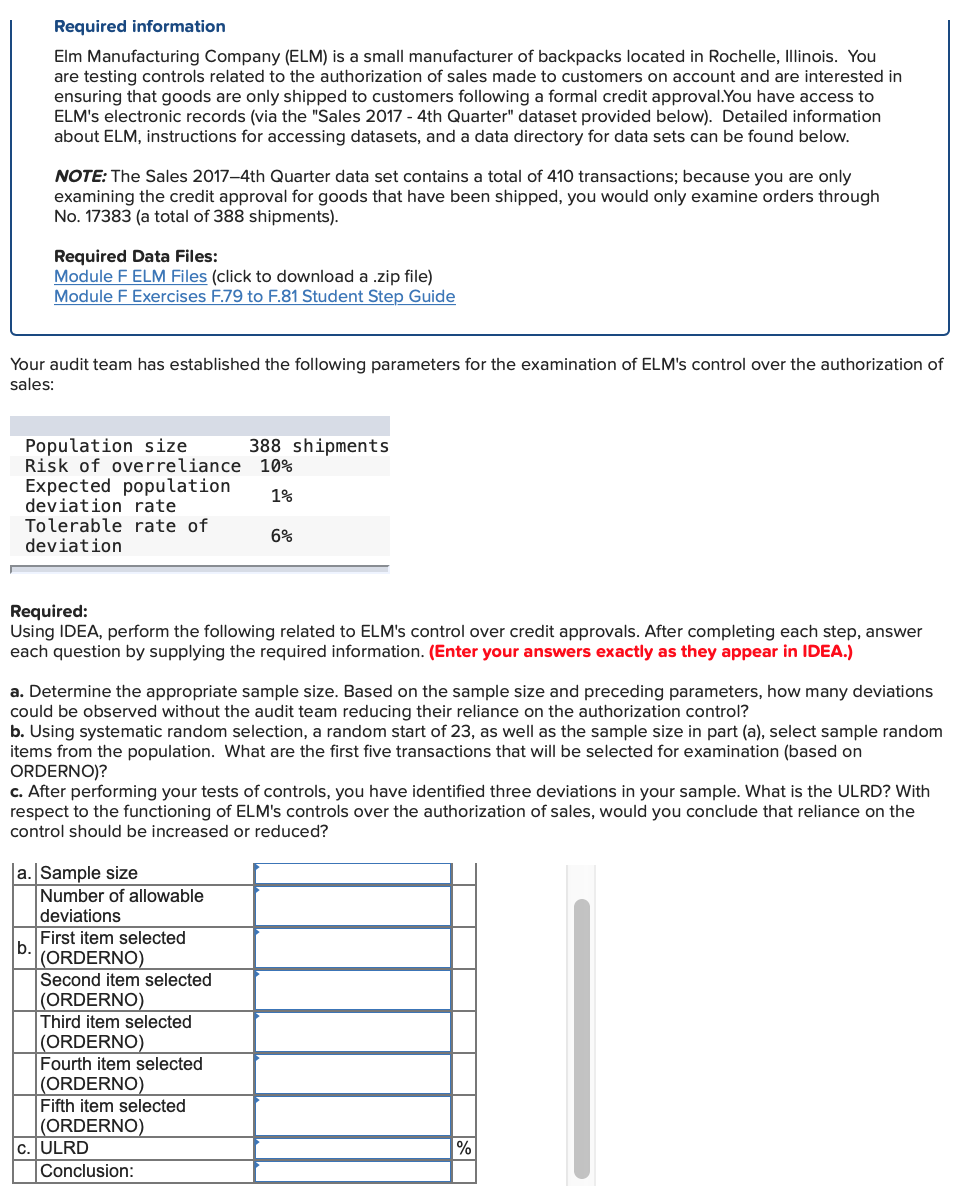
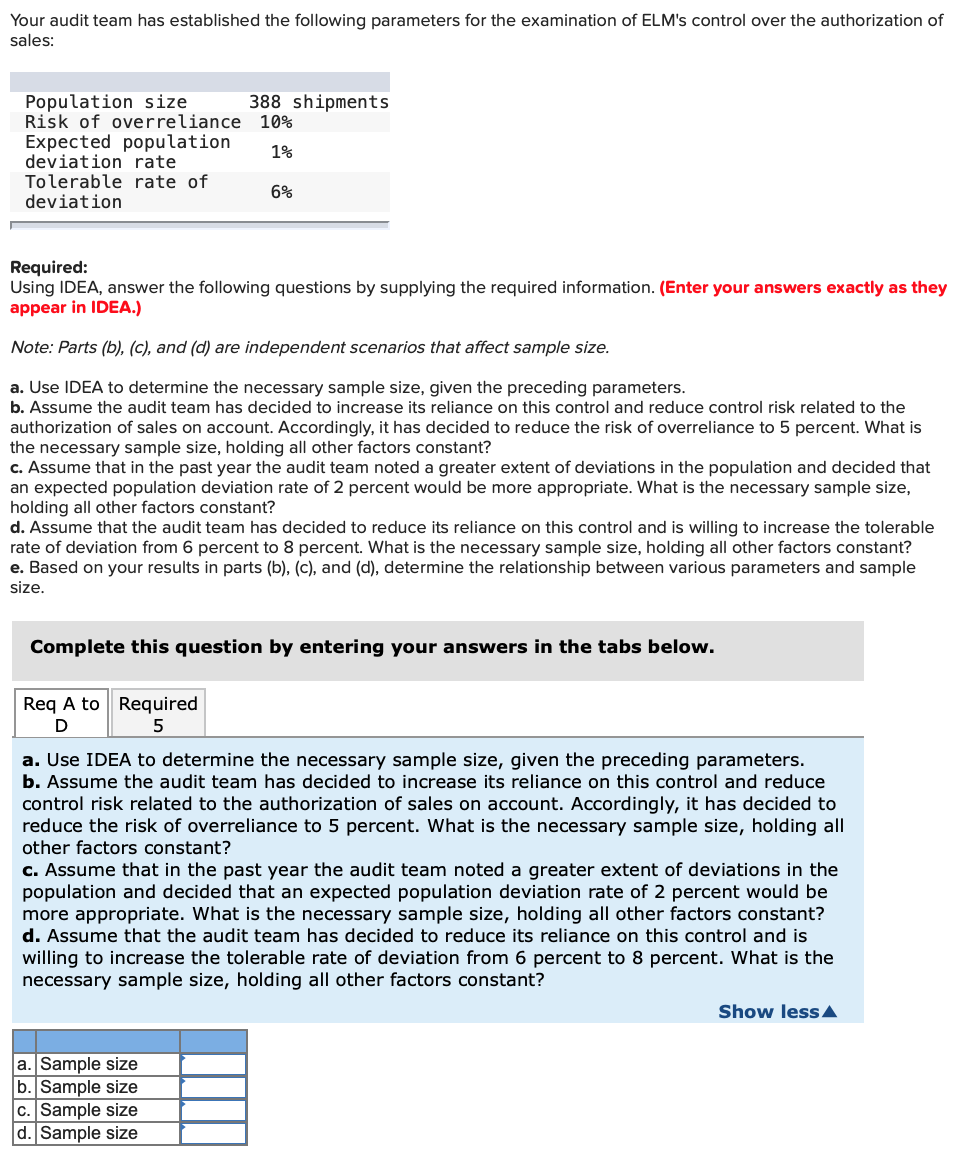
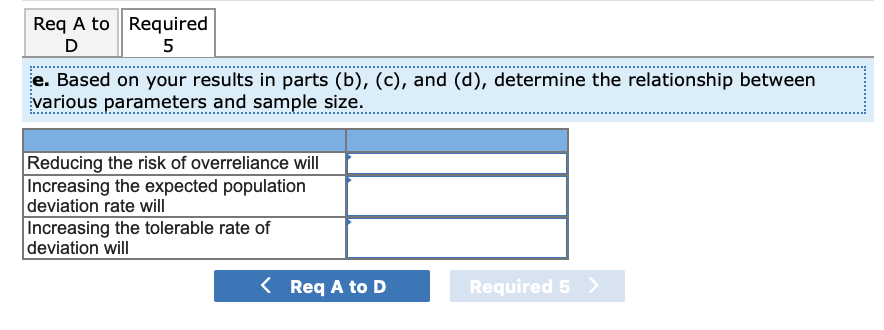
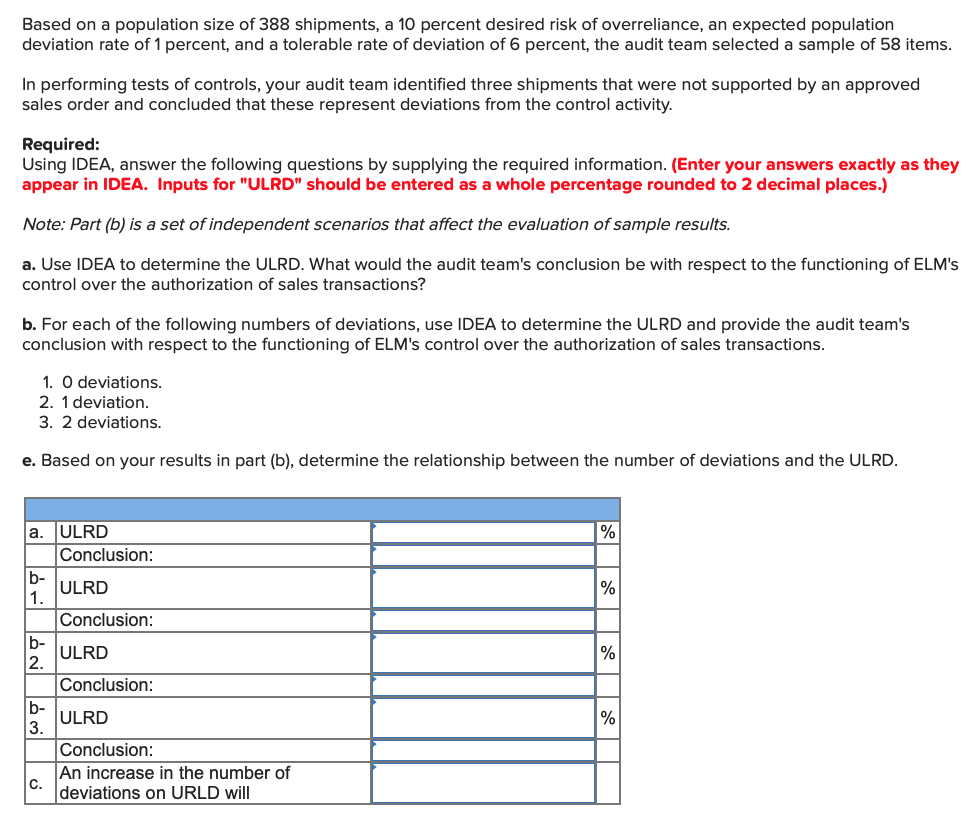
Required information Elm Manufacturing Company (ELM) is a small manufacturer of backpacks located in Rochelle, Illinois. You are testing controls related to the authorization of sales made to customers on account and are interested in ensuring that goods are only shipped to customers following a formal credit approval.You have access to ELM's electronic records (via the "Sales 2017 - 4th Quarter" dataset provided below). Detailed information about ELM, instructions for accessing datasets, and a data directory for data sets can be found below. NOTE: The Sales 2017-4th Quarter data set contains a total of 410 transactions; because you are only examining the credit approval for goods that have been shipped, you would only examine orders through No. 17383 (a total of 388 shipments). Required Data Files: Module F ELM Files (click to download a .zip file) Module F Exercises F.79 to F.81 Student Step Guide Your audit team has established the following parameters for the examination of ELM's control over the authorization of sales: Population size 388 shipments Risk of overreliance 10% Expected population 1% deviation rate Tolerable rate of 6% deviation Required: Using IDEA, perform the following related to ELM's control over credit approvals. After completing each step, answer each question by supplying the required information. (Enter your answers exactly as they appear in IDEA.) a. Determine the appropriate sample size. Based on the sample size and preceding parameters, how many deviations could be observed without the audit team reducing their reliance on the authorization control? b. Using systematic random selection, a random start of 23, as well as the sample size in part (a), select sample random items from the population. What are the first five transactions that will be selected for examination (based on ORDERNO)? c. After performing your tests of controls, you have identified three deviations in your sample. What is the ULRD? With respect to the functioning of ELM's controls over the authorization of sales, would you conclude that reliance on the control should be increased or reduced? a. Sample size Number of allowable deviations First item selected b. (ORDERNO) Second item selected (ORDERNO) Third item selected (ORDERNO) Fourth item selected (ORDERNO) Fifth item selected (ORDERNO) c. ULRD Conclusion: % Your audit team has established the following parameters for the examination of ELM's control over the authorization of sales: Population size 388 shipments Risk of overreliance 10% Expected population 1% deviation rate Tolerable rate of 6% deviation Required: Using IDEA, answer the following questions by supplying the required information. (Enter your answers exactly as they appear in IDEA.) Note: Parts (b), (c), and (d) are independent scenarios that affect sample size. a. Use IDEA to determine the necessary sample size, given the preceding parameters. b. Assume the audit team has decided to increase its reliance on this control and reduce control risk related to the authorization of sales on account. Accordingly, it has decided to reduce the risk of overreliance to 5 percent. What is the necessary sample size, holding all other factors constant? c. Assume that in the past year the audit team noted a greater extent of deviations in the population and decided that an expected population deviation rate of 2 percent would be more appropriate. What is the necessary sample size, holding all other factors constant? d. Assume that the audit team has decided to reduce its reliance on this control and is willing to increase the tolerable rate of deviation from 6 percent to 8 percent. What is the necessary sample size, holding all other factors constant? e. Based on your results in parts (b), (c), and (d), determine the relationship between various parameters and sample size. Complete this question by entering your answers in the tabs below. Req A to Required D 5 a. Use IDEA to determine the necessary sample size, given the preceding parameters. b. Assume the audit team has decided to increase its reliance on this control and reduce control risk related to the authorization of sales on account. Accordingly, it has decided to reduce the risk of overreliance to 5 percent. What is the necessary sample size, holding all other factors constant? c. Assume that in the past year the audit team noted a greater extent of deviations in the population and decided that an expected population deviation rate of 2 percent would be more appropriate. What is the necessary sample size, holding all other factors constant? d. Assume that the audit team has decided to reduce its reliance on this control and is willing to increase the tolerable rate of deviation from 6 percent to 8 percent. What is the necessary sample size, holding all other factors constant? Show less a. Sample size b. Sample size c. Sample size d. Sample size Req A to Required D 5 e. Based on your results in parts (b), (c), and (d), determine the relationship between various parameters and sample size. Reducing the risk of overreliance will Increasing the expected population deviation rate will Increasing the tolerable rate of deviation will
Step by Step Solution
There are 3 Steps involved in it

Get step-by-step solutions from verified subject matter experts