







Question: please make a code using sage math Problem 1: For a matrix M with integer values a, b, c, d, Ta M = (1) the
please make a code using sage math
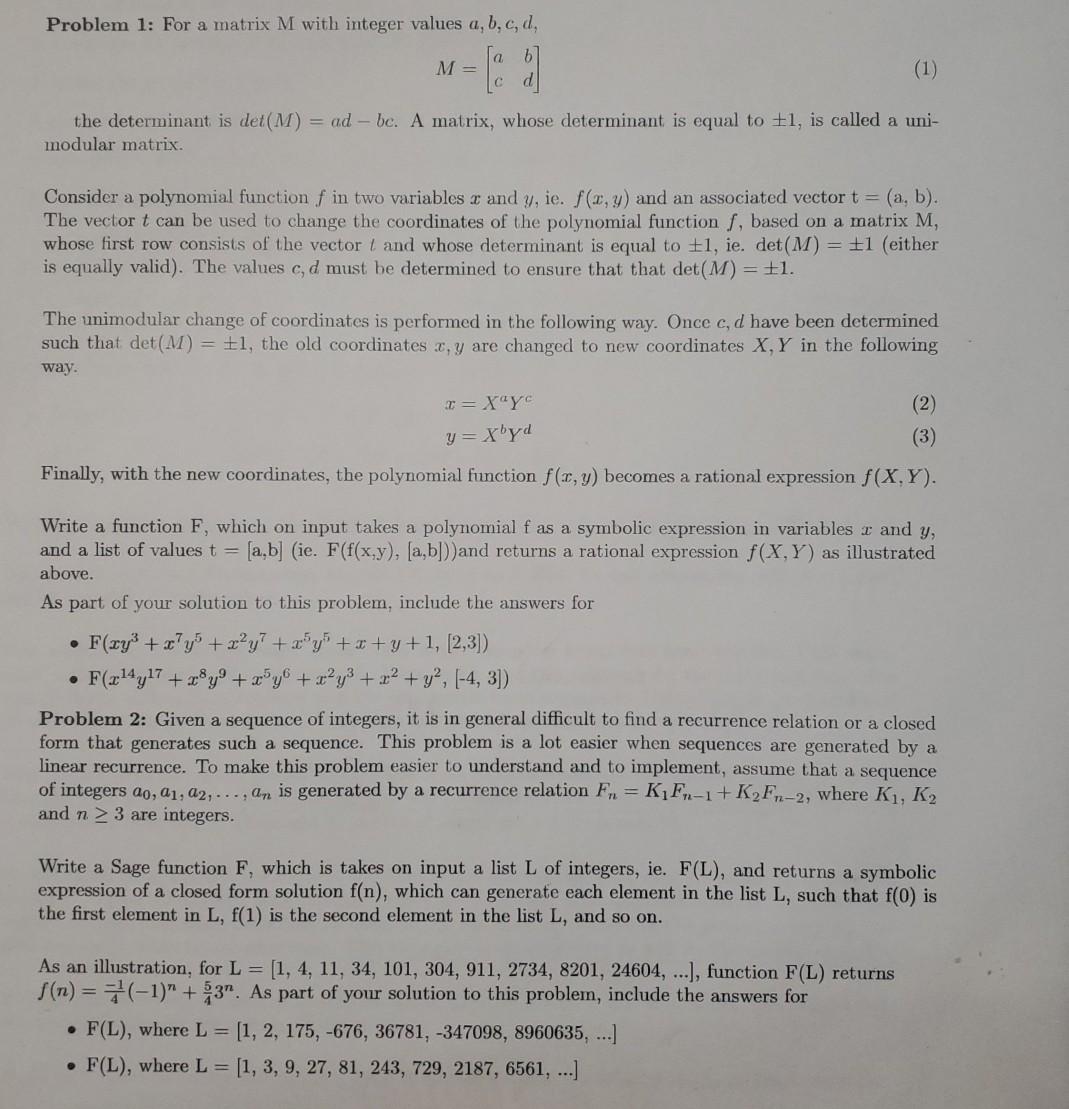
Problem 1: For a matrix M with integer values a, b, c, d, Ta M = (1) the determinant is det(M) = ad - be. A matrix, whose determinant is equal to +1, is called a uni- modular matrix Consider a polynomial function f in two variables x and y, ie. f(x,y) and an associated vector t = (a, b). The vector t can be used to change the coordinates of the polynomial function, based on a matrix M, whose first row consists of the vector I and whose determinant is equal to +1, ie. det(M) = +1 (either is equally valid). The values c, d must be determined to ensure that that det(M)= +1. The unimodular change of coordinates is performed in the following way. Once c, d have been determined such that det(M) = 1, the old coordinates 2, y are changed to new coordinates X, Y in the following way. (2) (3) Finally, with the new coordinates, the polynomial function f (C, y) becomes a rational expression f(X,Y). = XY y=xbyd Write a function F, which on input takes a polynomial f as a symbolic expression in variables and y, and a list of values t = [a,b] (ie. F(f(x,y), [a,b]))and returns a rational expression f(X,Y) as illustrated above. As part of your solution to this problem, include the answers for F(xy? +xy +x+y + xy + x +y +1, [2,3]) F(x14,17 + xy + xy + xy3 + x2 + y, [-4, 3]) Problem 2: Given a sequence of integers, it is in general difficult to find a recurrence relation or a closed form that generates such a sequence. This problem is a lot easier when sequences are generated by a linear recurrence. To make this problem easier to understand and to implement, assume that a sequence of integers 40, 41, a2,..., An is generated by a recurrence relation Fn = K F1-1+K2Fn-2, where K1, K2 and n > 3 are integers. Write a Sage function F, which is takes on input a list L of integers, ie. F(L), and returns a symbolic expression of a closed form solution f(n), which can generate each element in the list L, such that f(0) is the first element in L, f(1) is the second element in the list L, and so on. As an illustration, for L = [1, 4, 11, 34, 101, 304, 911, 2734, 8201, 24604, ...), function F(L) returns S(n) = (-1)" + 3". As part of your solution to this problem, include the answers for F(L), where L = [1, 2, 175, -676, 36781, -347098, 8960635, ...) . F(L), where L = [1, 3, 9, 27, 81, 243,729, 2187, 6561, ...)
Step by Step Solution
There are 3 Steps involved in it

Get step-by-step solutions from verified subject matter experts
 Study Help