



Question: please make answer clear, I have a hard time understanding 3. Bond price elasticity Suppose you want to compare the price sensitivity of two 10
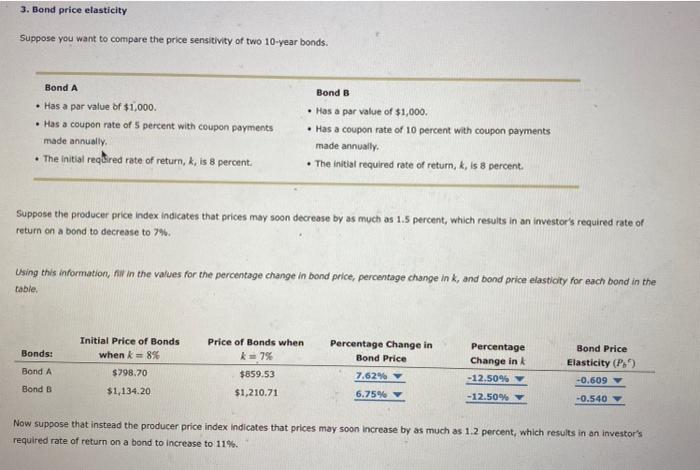
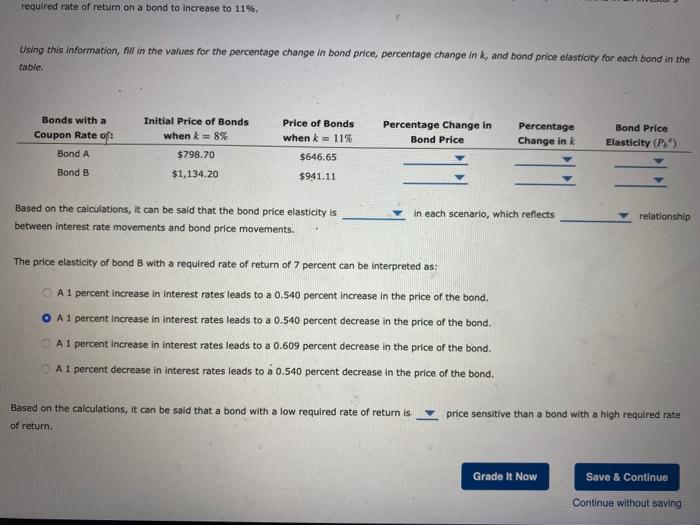
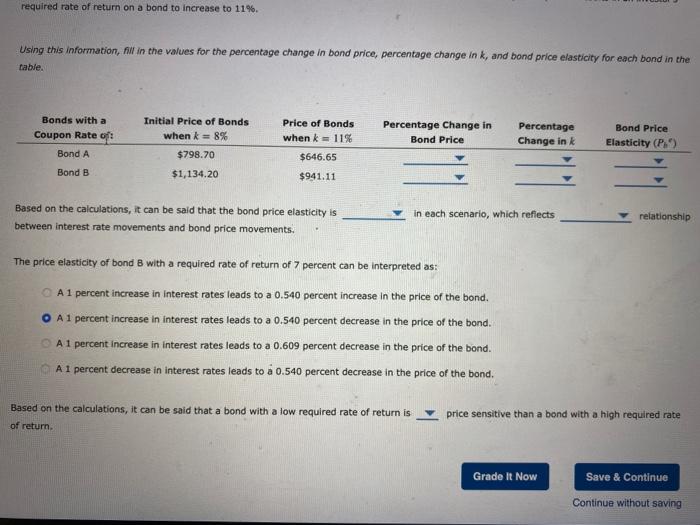
3. Bond price elasticity Suppose you want to compare the price sensitivity of two 10 -year bonds, Suppose the producer price index indicates that prices may soon decrease by as much as 1.5 percent, which results in an investor's required rate of return on a bond to decrease to 7%6. Using this information, fil in the values for the percentage change in bond price, percentage change in k, and band price elasticity for each bond in the tabie, Now suppose that instead the producer price index indicates that prices may soon increase by as much as 1.2 percent, which results in an investor's required rate of return on a bond to increase to 11%. required rate of return on a bond to increase to 11%. Using this information, fill in the values for the percentage change in bond price, percentage change in k, and bond price elasticity for each bond in the tabje. The price elasticity of bond B with a required rate of return of 7 percent can be interpreted as: A 1 percent increase in interest rates leads to a 0.540 percent increase in the price of the bond. A 1 percent increase in interest rates leads to a 0.540 percent decrease in the price of the bond. A 1 percent increase in interest rates leads to a 0.609 percent decrease in the price of the bond. A 1 percent decrease in interest rates leads to a 0.540 percent decrease in the price of the bond. Based on the calculations, it can be said that a bond with a low required rate of return is price sensitive than a bond with a high required rate of return. required rate of return on a bond to increase to 11%. Using this information, fill in the values for the percentage change in bond price, percentage change in k, and bond price elasticity for each bond in the tabje. The price elasticity of bond B with a required rate of return of 7 percent can be interpreted as: A 1 percent increase in interest rates leads to a 0.540 percent increase in the price of the bond. A 1 percent increase in interest rates leads to a 0.540 percent decrease in the price of the bond. A 1 percent increase in interest rates leads to a 0.609 percent decrease in the price of the bond. A 1 percent decrease in interest rates leads to a 0.540 percent decrease in the price of the bond. Based on the calculations, it can be said that a bond with a low required rate of return is price sensitive than a bond with a high required rate of return
Step by Step Solution
There are 3 Steps involved in it

Get step-by-step solutions from verified subject matter experts