







Question: Please need an answer asap Consider a conflict between two armies of z and y soldiers, respectively. During World War I, F. W. Lanchester assumed
Please need an answer asap
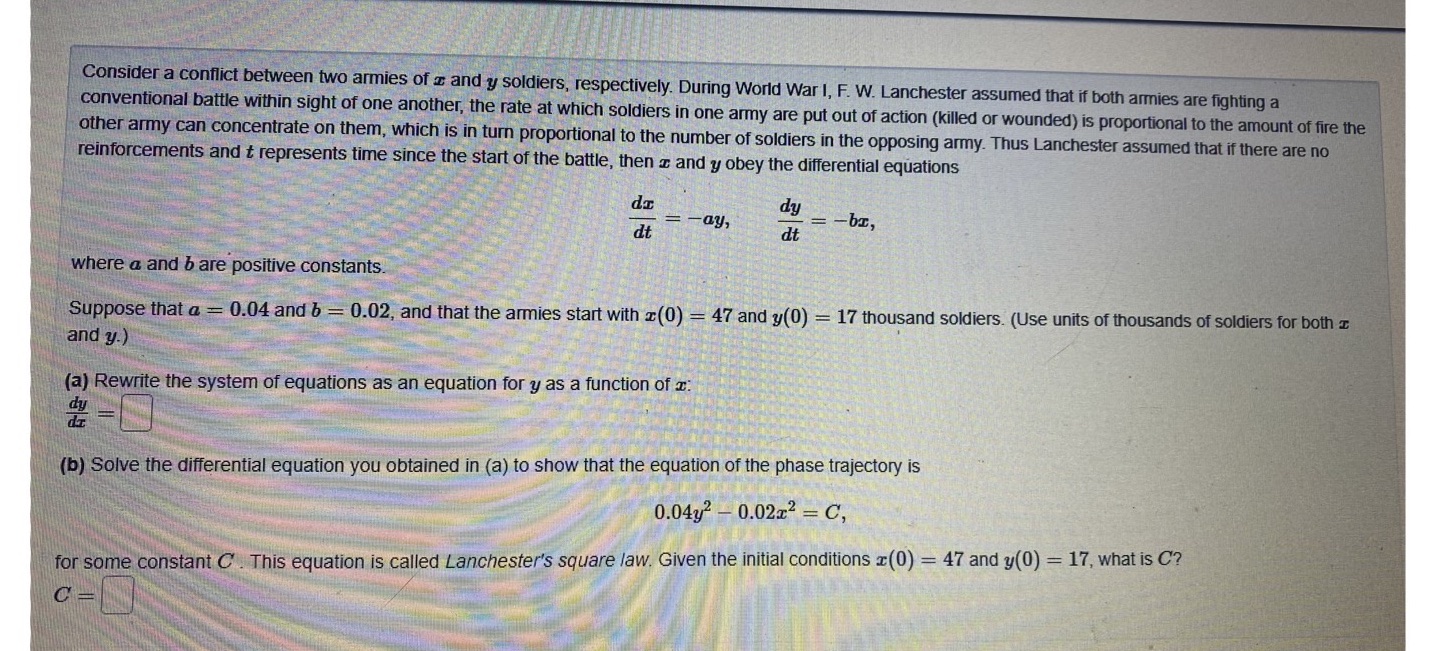
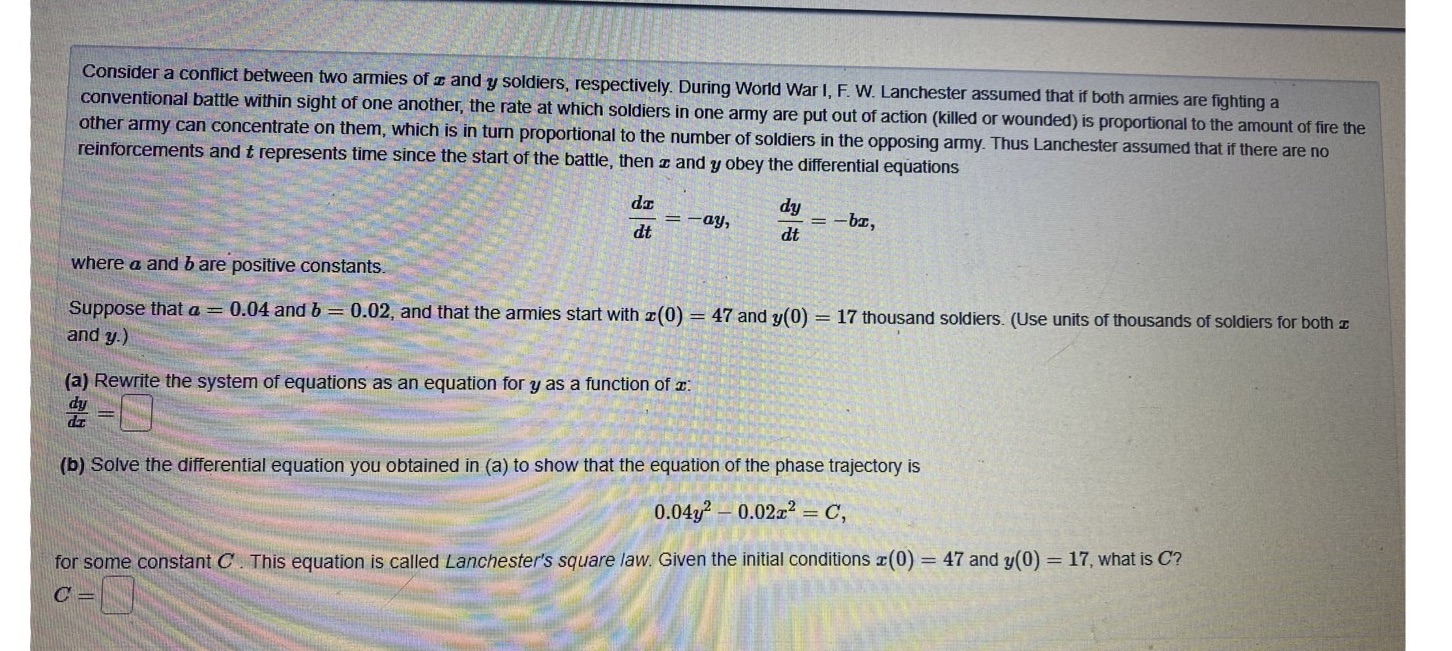
Consider a conflict between two armies of z and y soldiers, respectively. During World War I, F. W. Lanchester assumed that if both armies are fighting a conventional battle within sight of one another, the rate at which soldiers in one army are put out of action (killed or wounded) is proportional to the amount of fire the other army can concentrate on them, which is in turn proportional to the number of soldiers in the opposing army. Thus Lanchester assumed that if there are no reinforcements and t represents time since the start of the battle, then z and y obey the differential equations dy - -br, dt = -ay, dt where a and b are positive constants. Suppose that a = 0.04 and b = 0.02, and that the armies start with z(0) - 47 and y(0) = 17 thousand soldiers. (Use units of thousands of soldiers for both and y.) (a) Rewrite the system of equations as an equation for y as a function of I. dy di (b) Solve the differential equation you obtained in (a) to show that the equation of the phase trajectory is 0.04y - 0.0212 = C, for some constant C. This equation is called Lanchester's square law. Given the initial conditions r (0) = 47 and y(0) = 17, what is C? C
Step by Step Solution
There are 3 Steps involved in it

Get step-by-step solutions from verified subject matter experts
 Study Help