







Question: please need good answer ? Answer any two questions? e Bay Evolves T o unded in 1995 as an offbeat, quirky place to buy and
please need good answer ?
Answer any two questions?
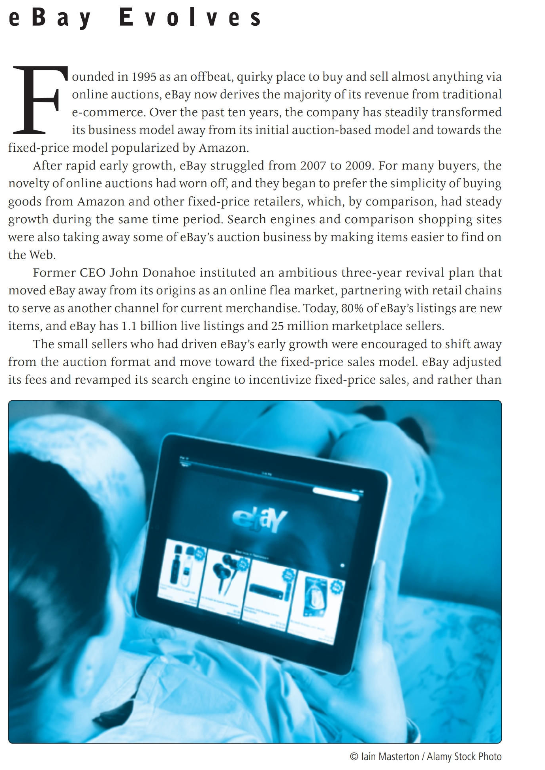
e Bay Evolves T o unded in 1995 as an offbeat, quirky place to buy and sell almost anything via online auctions, eBay now derives the majority of its revenue from traditional e-commerce. Over the past ten years, the company has steadily transformed its business model away from its initial auction-based model and towards the fixed-price model popularized by Amazon. After rapid early growth, eBay struggled from 2007 to 2009. For many buyers, the novelty of online auctions had worn off, and they began to prefer the simplicity of buying goods from Amazon and other fixed-price retailers, which, by comparison, had steady growth during the same time period. Search engines and comparison shopping sites were also taking away some of eBay's auction business by making items easier to find on the Web Former CEO John Donahoe instituted an ambitious three-year revival plan that moved eBay away from its origins as an online flea market, partnering with retail chains to serve as another channel for current merchandise. Today, 80% of eBay's listings are new items, and eBay has 1.1 billion live listings and 25 million marketplace sellers. The small sellers who had driven eBay's early growth were encouraged to shift away from the auction format and move toward the fixed-price sales model. eBay adjusted ils fees and revamped its search engine lo incentivize fixed-price sales, and rather than a lain Masterton/Alamy Stock Photo displaying auctions close to finishing at the top of search results, eBay tweaked its search tool to account for price and seller reputation so that highly rated merchants appeared first and received more exposure. The hundreds of thousands of people who supported themselves by selling on eBay and many millions more who used eBay to supplement their income were unhappy with the change, and analysts' faith in eBay's transition dwindled as its stock continued to drop. However, eBay's purchase of PayPal in 2002 helped it survive these lean years, with PayPal accounting for as much as 40% of eBay's revenues in some years. eBay also posi- tioned itself well for the future with its early embrace of the mobile platform, even before the iPhone hit the market. This prescience resulted in eBay achieving its 100 millionth app download and 100 millionth mobile listing very early, in 2012. eBay has also been quick to develop apps for wearable devices, including an app for the Apple Watch that allows users to see an overview of their notifications and bid statuses and a version of its Marketplace app for Android Wear devices. Over 50% of eBay's business now involves a mobile device, and the company continues to make improvements to the mobile experience on many platforms and across all of its different services. In 2018, eBay is integrating progressive app" features into its existing mobile infrastructure, which will make it function more like a native app, requiring less data to operate and allowing users to access many features even while offline. In 2018, the company has continued the process of modernizing its platform with analytical tools. Beginning in 2016, eBay has started to convert ils catalog of items from its traditional unstructured "listing" format, where two identical items can appear totally different to shoppers, to a structured data format. This will allow eBay to more easily gain information about different items and about purchasing trends, and also helps its product pages perform beller in Google searches. eBay is also using machine learning to customize, update, and generally improve its product pages, as well as to fine-tune ils search capability beyond simply matching search terms with keywords and lags. To support these efforts, the company purchased machine-learning startup Sales Predict, whose technology helps businesses predict consumer buying behavior and sales conver sion. The company's revamped Seller Hub will also offer many of these analytical tools and metrics to individual sellers, including inventory, order, and listing management, performance insights, and streamlined business process management In 2018, eBay launched its Interests feature, which allows customers to answer a quick questionnaire about their passions and hobbies, resulting in the complete transforma- tion of the eBay home page Shoppers can build a home page that reflects their eclectic interests in different areas, including gaming, technology, particular movie and TV series, music genres, sports teams, fashion, and outdoor activities. eBay has also redesigned its website's interface lo emphasize images over Lext and to allow users to perform visual searches for the items they are interested in. eBay offers two types of image search, one where you can take a picture or upload a picture from a smartphone to find items that match those seen in the photo, and the other, called Find it on eBay, which allows users to do the same type of search with images found online. Machine learning powers and improves both forms of visual search, and eBay expects that its image search capability will become more and more accurate as more shoppers use the service to find products. In 2018, eBay reported that improvements to both traditional and visual search spurred by machine learning were responsible for $1 billion in sales. eBay has also incorporated similar Al and machine learning techniques in other areas of its business, including its ShopBot, a personalized shopping assistant that allows customers to text, talk, or provide a picture of a desired item. ShopBot will ask users questions and then generate what eBay hopes will be highly accurate recommendations. Prospective buyers of an item can also ask questions that other purchasers of that item can answer, similarly Lo Amazon, eBay uses machine learning to algorithmically identify experienced buyers who are best able to answer the question, and as more questions are asked, the system will improve at prioritizing good questions and finding appropriate people to answer them. eBay has also dramatically improved the accessibility of its website, which can now be navigated without a mouse and is far easier to use with screen-reading software used by visually impaired shoppers. It has also added augmented reality features that allow customers to see how variations to a product would look, such as new wheels on a car, as well as to visualize the correct box size to package a product by overlaying a he image of an item. eBay has also opened up its API to developers so that they can better use eBay's back-end technology, including providing better access to its Image Search and Machine Translation tools. eBay has cracked down on fraud on the part of both buyers and sellers, one of the most common concerns about using eBay. To limit seller fraud, eBay is now authenticat ing items that are commonly counterfeited, such as handbags, footwear, and jewelry Sellers can pay for the authentication service to increase their appeal to buyers, and buyers can pay to guarantee that their purchase will be voided if the product turns out to be counterfeit. Sellers are also hoping that the company will do more to prevent buyer fraud in the near future. In 2015, eBay elected to spin off PayPal as its own separate company, leaving eBay with its Marketplaces segment, ils StubHub ticket sales segment, and a handful of o business units. Although eBay's leadership had resisted a spinoff for years, the move was prompted by PayPal's desire to become more agile within the rapidly developing marketplace of online payments. Donahoe also stepped down as CEO of eBay to mark the move, with the former head of its Global Marketplaces unit, Devin Wenig, Laking his place. As part of the split, eBay agreed to initially route 80% of its sales through PayPal, and continue to use PayPal as its back-end payment provider. However, eBay announced in 2018 that it would end that agreement, instead using Dutch payments company Adyen for its back-end payment service. While PayPal will still be a payment option for eBay cus- tomers, eBay will now have far more control over the checkout process, the way Amazon and Chinese e-commerce giant Alibaba do, and eBay will be able to charge seller fees that have traditionally been collected by PayPal, which is expected to add $2 billion in revenue to eBay's bottom line. eBay also added Apple Pay as a payment option for its customers in 2018, its first new payment service since spinning off PayPal. Although Amazon owns an incredible 49% share of U.S. e-commerce compared to eBay's second-best 6.6% share, eBay remains one of the most trusted online brands and e-commerce leaders, and it has worked hard to offer services that compete with Amazon, such as its eBay Plus program in Germany, which functions similarly to Amazon Prime, as well as its Guaranteed Delivery program, which ensures that 20 million of its top Case Study 769 selling products will be delivered in 3 days or less or the buyer will receive coupons or full refunds. eBay also announced its owil version of Amazon's Prime Day, a weeklong sale in July advertised as being available to all customers without needing to sign up for a subscription like Amazon Prime, and instituted a price match guarantee program for 100,000 products that will allow shoppers to receive a refund equal to the difference between eBay's price and a competitor's price, plus an additional 10%, if they can find a mazon, Walmart, Target, or other leading e-commerce retailers. Many investors believed that PayPal had been the true driver of eBay's bottom line; in 2018, PayPal is worth $102 billion, and eBay $12 billion. But while analysts had prepared themselves for disappointing earnings after the spin-off, the company instead posted several straight quarters of sales growth under CEO Wenig in 2016 and 2017. eBay earned approximately $9.5 billion in revenue in 2017, up from $9 billion in 2016. Although this isn't the type of explosive sales growth that gets investors excited, it's impressive from a company that some analysts weren't sure would survive a decade ago. However, in 2018, eBay's growth slowed slightly even from these modest levels, with its second quarter sales in 2018 increasing only 9% over the previous year, and only a 4% increase in active buyers to 175 million. This news, along with positive reports from Walmart's e-commerce efforts and unexpected struggles from eBay's Stubhub unit, caused eBay's biggest stock drop in two years. In response, eBay announced job cuts, sold its stake in Indian e-commerce platform Flipkart, and Wenig unveiled a plan to increase its market- ing spending to grow ils active buyers from 175 million lo 500 million in several years. The company plans to use social media influencers with devoted followings to lure more women and millennials to eBay; currently, Amazon performs better than eBay in both of these demographics. While eBay is very unlikely to measure up to Amazon in sheer size, the company continues to market itself as a quirky alternative to Amazon, and despite some ups and downs, the company appears to have found its niche. How eBay Offers a Personalized Mobile Experience with Al, by Daniela Forte, Multichannel merchant.com, August 22, 2017 eBay to Launch Visual Search Tools for Finding Products Using Photos from Your Phone or Web, by Sarah Perez, Techcrunch.com, July 26, 2017; "For eBay, Alis Ride Or Die "Venturebeat.com, July 8, 2017; "Ebay's Homepage is for Everyone, Ehayirc.com, June 28 2017; "Ebay Accused of Failing its Sellers As Fraudulent Buyers Manipulate the system," by Anna Tims, The Guardian, May 21, 2017; eBay's New High-End Furniture Shop, eBay Collective, Includes a Visual Search Engine," by Sarah Perez, Techcrunch.com, October 17, 2016, eBay Acquires Visual Search Engine Corrigontor Less Than $30M," by Ingrid Lunden, Tech- cunccom, October 5, 2016, "What eBay's Machine Learning Advances Can Teach IT Profes- sionals by Charles Baucock, information Week, September 6, 2016; "At Bay, Machine Learning Is Driving Innovative New Approaches to Search Experi- ences by Sebastian Ruplex Ebayinc.com, August 22, 2016; "EBay Completes the Acquisition of SalesPredict," Ebayinc.com, July 22, 2016: "One Year Ini, Building eBay for the Future,' by Devin Wenig. Ebeyinc.com, July 20, 2016: "Replatforming eBay: How We Are Delivering the Shopping Destina- Lion of Choice by Steve Fisher Ebayinc.com, July 14, 2015; "Here's Why eBay is Acquiring SalesPredict Forbes, July 14, 2016; "Hon eBay is Advancing New Shapning, Browsing Models, by Sebastian Rupley, Ebeyinc.com, March 28, 2016; eBay Hits 100m Mobile Apo Download Mark" by Dervedia Thomas, Dailydealmedia. com, September 29, 2012; eBay We Need to Behave More Like a Retailer" by Sarah Shearman, Tamebay.com, September 25, 2012, "Behind eBay's Comeback, by James B. Stewart, New York Times, luly 27, 2012 Case Study Questions 1. Contrast eBay's original business model with its current business model. 2. What are the problems that eBay is currently facing? How is eBay trying to solve these problems? 3. Are the solutions eBay is seeking to implement good solutions? Why or why not? Are there any other solutions that eBay should consider? 4. Who are eBay's top competitors online, and how will eBay's strategy help it compete
Step by Step Solution
There are 3 Steps involved in it
1 Expert Approved Answer
Step: 1 Unlock

Question Has Been Solved by an Expert!
Get step-by-step solutions from verified subject matter experts
Step: 2 Unlock
Step: 3 Unlock
 Study Help