



Question: Please ONLY answer 4.5 - 4.7 Problem 4. Heptahydrate of MgSo, is to be crystallized batch-wise from a seeded aqueous solution. Low supersaturation is to
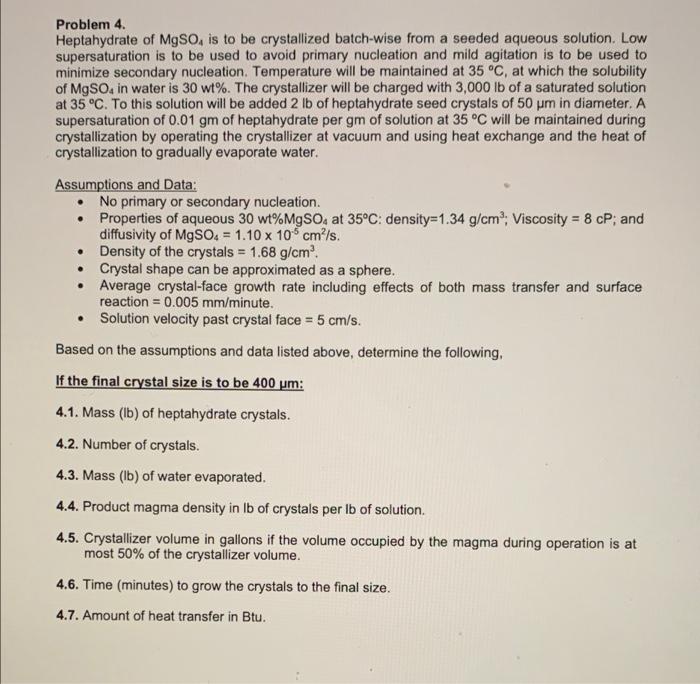
Problem 4. Heptahydrate of MgSo, is to be crystallized batch-wise from a seeded aqueous solution. Low supersaturation is to be used to avoid primary nucleation and mild agitation is to be used to minimize secondary nucleation. Temperature will be maintained at 35 C, at which the solubility of MgSO, in water is 30 wt%. The crystallizer will be charged with 3,000 lb of a saturated solution at 35 C. To this solution will be added 2 lb of heptahydrate seed crystals of 50 pm in diameter. A supersaturation of 0.01 gm of heptahydrate per gm of solution at 35 C will be maintained during crystallization by operating the crystallizer at vacuum and using heat exchange and the heat of crystallization to gradually evaporate water. - Assumptions and Data: No primary or secondary nucleation. Properties of aqueous 30 wt%MgSO. at 35C: density=1.34 g/cm; Viscosity = 8 cP; and diffusivity of MgSO4 = 1.10 x 10 cm/s. Density of the crystals = 1.68 g/cm'. Crystal shape can be approximated as a sphere. Average crystal-face growth rate including effects of both mass transfer and surface reaction = 0.005 mm/minute. Solution velocity past crystal face = 5 cm/s. Based on the assumptions and data listed above, determine the following, If the final crystal size is to be 400 pm: 4.1. Mass (lb) of heptahydrate crystals. 4.2. Number of crystals. 4.3. Mass (lb) of water evaporated. 4.4. Product magma density in lb of crystals per lb of solution 4.5. Crystallizer volume in gallons if the volume occupied by the magma during operation is at most 50% of the crystallizer volume. 4.6. Time (minutes) to grow the crystals to the final size. 4.7. Amount of heat transfer in Btu. Problem 4. Heptahydrate of MgSo, is to be crystallized batch-wise from a seeded aqueous solution. Low supersaturation is to be used to avoid primary nucleation and mild agitation is to be used to minimize secondary nucleation. Temperature will be maintained at 35 C, at which the solubility of MgSO, in water is 30 wt%. The crystallizer will be charged with 3,000 lb of a saturated solution at 35 C. To this solution will be added 2 lb of heptahydrate seed crystals of 50 pm in diameter. A supersaturation of 0.01 gm of heptahydrate per gm of solution at 35 C will be maintained during crystallization by operating the crystallizer at vacuum and using heat exchange and the heat of crystallization to gradually evaporate water. - Assumptions and Data: No primary or secondary nucleation. Properties of aqueous 30 wt%MgSO. at 35C: density=1.34 g/cm; Viscosity = 8 cP; and diffusivity of MgSO4 = 1.10 x 10 cm/s. Density of the crystals = 1.68 g/cm'. Crystal shape can be approximated as a sphere. Average crystal-face growth rate including effects of both mass transfer and surface reaction = 0.005 mm/minute. Solution velocity past crystal face = 5 cm/s. Based on the assumptions and data listed above, determine the following, If the final crystal size is to be 400 pm: 4.1. Mass (lb) of heptahydrate crystals. 4.2. Number of crystals. 4.3. Mass (lb) of water evaporated. 4.4. Product magma density in lb of crystals per lb of solution 4.5. Crystallizer volume in gallons if the volume occupied by the magma during operation is at most 50% of the crystallizer volume. 4.6. Time (minutes) to grow the crystals to the final size. 4.7. Amount of heat transfer in Btu
Step by Step Solution
There are 3 Steps involved in it

Get step-by-step solutions from verified subject matter experts