



Question: please only answer if you can solve all 4 parts of one question thank you! 1a) Insert the keys LO G A R I T
please only answer if you can solve all 4 parts of one question thank you!
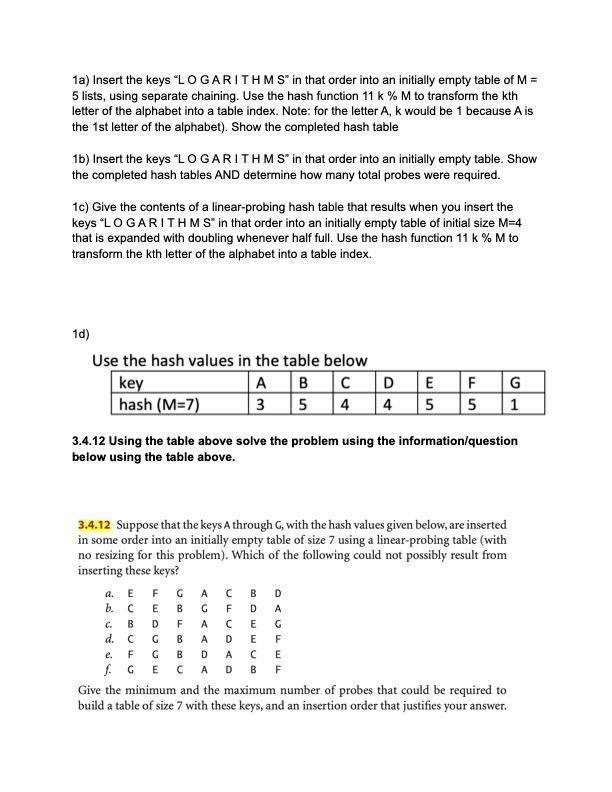
1a) Insert the keys LO G A R I T HM S" in that order into an initially empty table of M= 5 lists, using separate chaining. Use the hash function 11k%M to transform the kth letter of the alphabet into a table index. Note: for the letter A, k would be 1 because A is the 1 st letter of the alphabet). Show the completed hash table 1b) Insert the keys "L O GARIT HM S" in that order into an initially empty table. Show the completed hash tables AND determine how many total probes were required. 1c) Give the contents of a linear-probing hash table that results when you insert the keys "LO GARIT H M S" in that order into an initially empty table of initial size M=4 that is expanded with doubling whenever half full. Use the hash function 11k%M to transform the kth letter of the alphabet into a table index. 1d) Use the hash values in the table below 3.4.12 Using the table above solve the problem using the information/question below using the table above. 3.4.12 Suppose that the keys A through G, with the hash values given below, are inserted in some order into an initially empty table of size 7 using a linear-probing table (with no resizing for this problem). Which of the following could not possibly result from inserting these keys? Give the minimum and the maximum number of probes that could be required to build a table of size 7 with these keys, and an insertion order that justifies your answer. 1a) Insert the keys LO G A R I T HM S" in that order into an initially empty table of M= 5 lists, using separate chaining. Use the hash function 11k%M to transform the kth letter of the alphabet into a table index. Note: for the letter A, k would be 1 because A is the 1 st letter of the alphabet). Show the completed hash table 1b) Insert the keys "L O GARIT HM S" in that order into an initially empty table. Show the completed hash tables AND determine how many total probes were required. 1c) Give the contents of a linear-probing hash table that results when you insert the keys "LO GARIT H M S" in that order into an initially empty table of initial size M=4 that is expanded with doubling whenever half full. Use the hash function 11k%M to transform the kth letter of the alphabet into a table index. 1d) Use the hash values in the table below 3.4.12 Using the table above solve the problem using the information/question below using the table above. 3.4.12 Suppose that the keys A through G, with the hash values given below, are inserted in some order into an initially empty table of size 7 using a linear-probing table (with no resizing for this problem). Which of the following could not possibly result from inserting these keys? Give the minimum and the maximum number of probes that could be required to build a table of size 7 with these keys, and an insertion order that justifies your
Step by Step Solution
There are 3 Steps involved in it

Get step-by-step solutions from verified subject matter experts