



Question: Please only do part 3!!! a. List the specifications of a cell phone. (This can be your cell phone or another cell phone. Show any
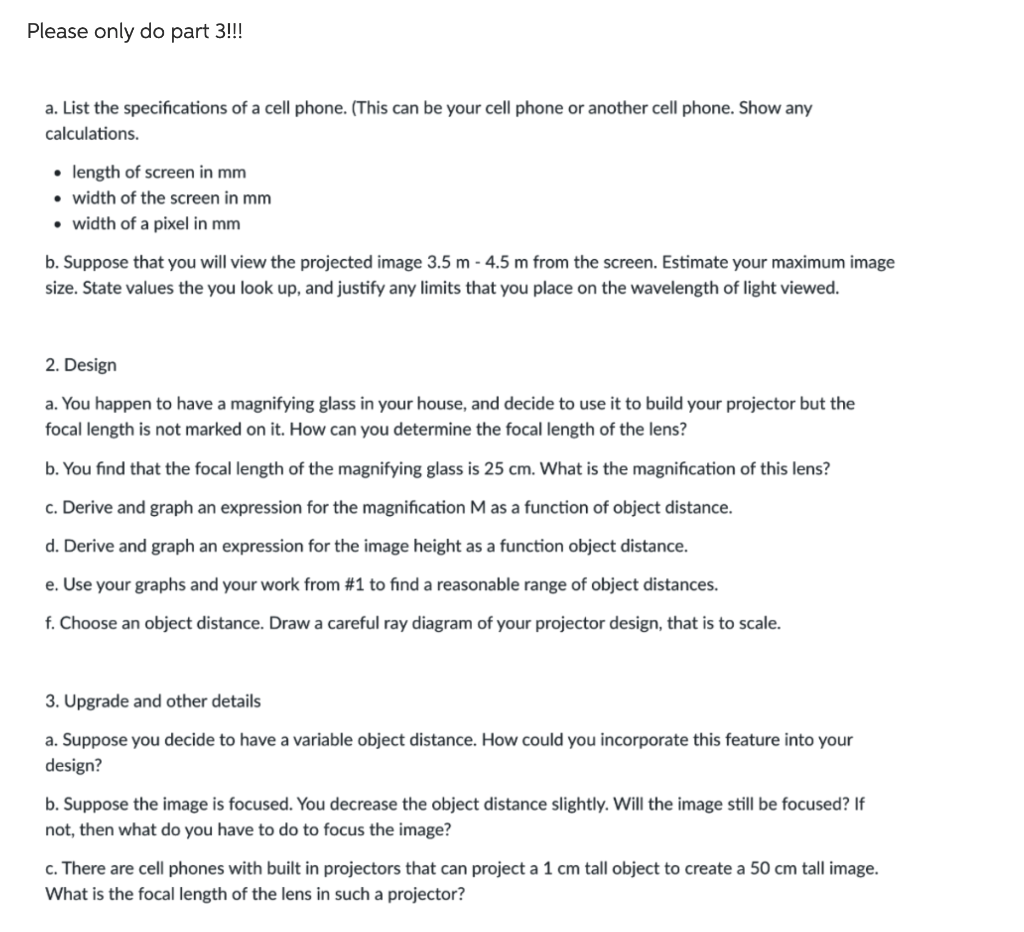
Please only do part 3!!! a. List the specifications of a cell phone. (This can be your cell phone or another cell phone. Show any calculations. length of screen in mm width of the screen in mm width of a pixel in mm b. Suppose that you will view the projected image 3.5 m - 4.5 m from the screen. Estimate your maximum image size. State values the you look up, and justify any limits that you place on the wavelength of light viewed. 2. Design a. You happen to have a magnifying glass in your house, and decide to use it to build your projector but the focal length is not marked on it. How can you determine the focal length of the lens? b. You find that the focal length of the magnifying glass is 25 cm. What is the magnification of this lens? c. Derive and graph an expression for the magnification M as a function of object distance. d. Derive and graph an expression for the image height as a function object distance. e. Use your graphs and your work from #1 to find a reasonable range of object distances. f. Choose an object distance. Draw a careful ray diagram of your projector design, that is to scale. 3. Upgrade and other details a. Suppose you decide to have a variable object distance. How could you incorporate this feature into your design? b. Suppose the image is focused. You decrease the object distance slightly. Will the image still be focused? If not, then what do you have to do to focus the image? c. There are cell phones with built in projectors that can project a 1 cm tall object to create a 50 cm tall image. What is the focal length of the lens in such a projector? Please only do part 3!!! a. List the specifications of a cell phone. (This can be your cell phone or another cell phone. Show any calculations. length of screen in mm width of the screen in mm width of a pixel in mm b. Suppose that you will view the projected image 3.5 m - 4.5 m from the screen. Estimate your maximum image size. State values the you look up, and justify any limits that you place on the wavelength of light viewed. 2. Design a. You happen to have a magnifying glass in your house, and decide to use it to build your projector but the focal length is not marked on it. How can you determine the focal length of the lens? b. You find that the focal length of the magnifying glass is 25 cm. What is the magnification of this lens? c. Derive and graph an expression for the magnification M as a function of object distance. d. Derive and graph an expression for the image height as a function object distance. e. Use your graphs and your work from #1 to find a reasonable range of object distances. f. Choose an object distance. Draw a careful ray diagram of your projector design, that is to scale. 3. Upgrade and other details a. Suppose you decide to have a variable object distance. How could you incorporate this feature into your design? b. Suppose the image is focused. You decrease the object distance slightly. Will the image still be focused? If not, then what do you have to do to focus the image? c. There are cell phones with built in projectors that can project a 1 cm tall object to create a 50 cm tall image. What is the focal length of the lens in such a projector
Step by Step Solution
There are 3 Steps involved in it

Get step-by-step solutions from verified subject matter experts