







Question: Please please answer all questions with full solutions for an upvote. Thank you Question 1. Consider the second order partial differential equation (1) 212 32
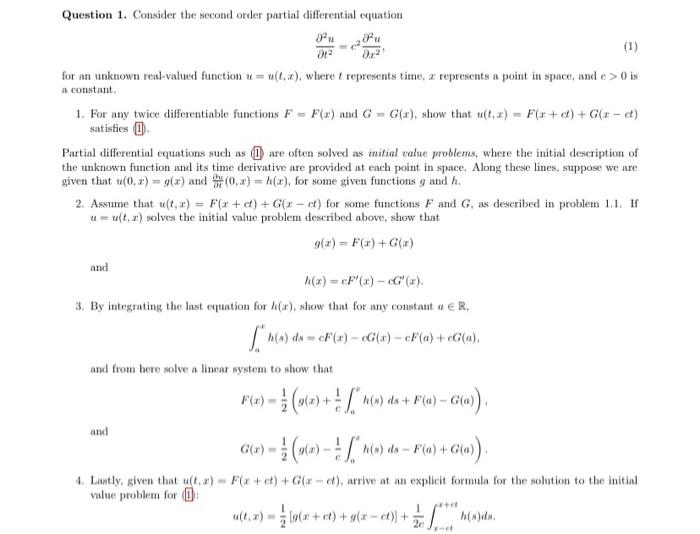
Question 1. Consider the second order partial differential equation (1) 212 32 for an unknown real-valued function u= u(t, x), where I represents time, z represents a point in space, and e > 0 is a constant. 1. For any twice differentiable functions F = F(x) and G = G(x), show that u(t, x) = F(x + d) + (-) satisfies 1 Partial differential equations such as are often solved as initial value problems, where the initial description of the unknown function and its time derivative are provided at each point in space. Along these lines, suppose we are given that (0,r) = g(x) and (0,x) = h(x), for some given functions g and h. 2. Assume that ut, I) - F(x + c) + G- ct) for some functions F and G, as described in problem 1.1. If u= ut. x) solves the initial value problem described above, show that 9(x) = F() + (x) and h(x) = F"(x) - "(.). 3. By integrating the last equation for h(x), show that for any constant a ER Lo) dx = cf(x) C(2) F(a) + C(M), and from here solve a linear system to show that F(x) = } (() + + (0) dx + F(a) Clu) G() } (s(e) -+ / * now) do --F(a) + G()) ) w. 4. Lastly, given that ult.a) - F(x + ct) + Gla-c), arrive at an explicit formula for the solution to the initial value problem for : ult, x) - (+1)+(x - 1) + h()s and * " 26
Step by Step Solution
There are 3 Steps involved in it

Get step-by-step solutions from verified subject matter experts
 Study Help