







Question: PLEASE PLEASE JUST GIVE ME THE CODE THAT I NEED TO PLUG INTO MATLAB. FOR PART A PLEASE DONT USE SYMS CODE BECUASE I DONT
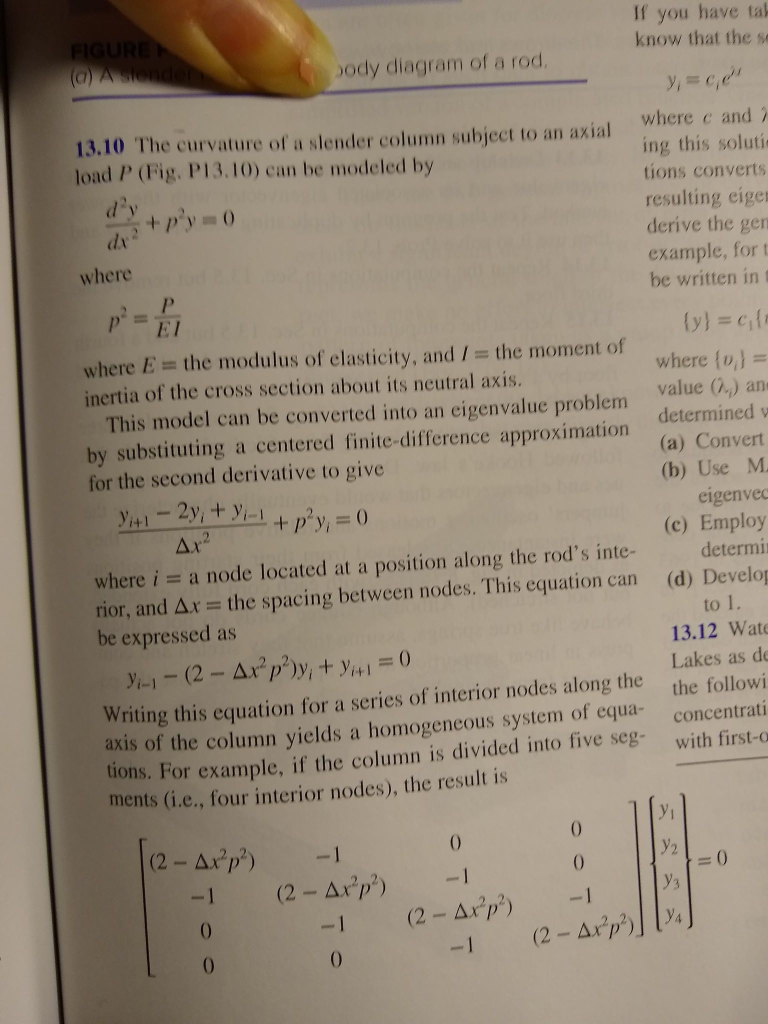
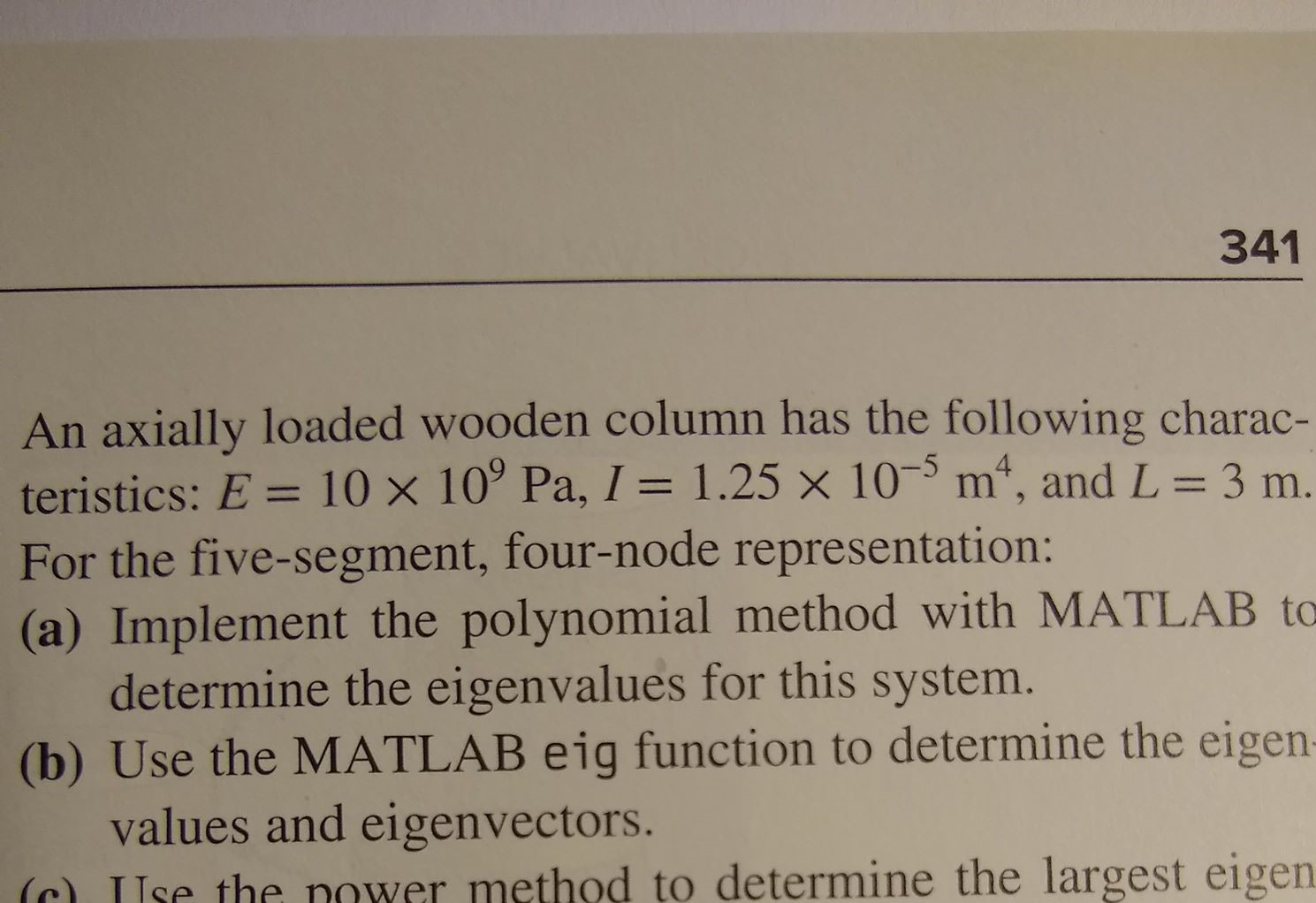
PLEASE PLEASE JUST GIVE ME THE CODE THAT I NEED TO PLUG INTO MATLAB. FOR PART A PLEASE DONT USE SYMS CODE BECUASE I DONT HAVE THE ADD ON IN MATLAB. PLEASE SHOW AN ALTERNATIVE WAY. THANK YOU SO MUCH! PLEASE JUST THE CODE FOR MATLAB
If you have tal know that these FIGURE Body diagram of a rod, 13.10 The curvature of a slender column subject to an axial load P (Fig. P13.10) can be modeled by y= " where c and 2 ing this soluti tions converts resulting eiger derive the gen example, fort be written in d'P' yo where where E = the modulus of elasticity, and I = the moment of inertia of the cross section about its neutral axis. This model can be converted into an eigenvalue problem by substituting a centered finite difference approximation for the second derivative to give Yui - 2y + y + py, = 0 (y) = c; where {v} = value (m) an determined (a) Convert (b) Use M. eigenvec (c) Employ determi (d) Develop to l. 13.12 Wate Lakes as de the followi concentrati with first Ax2 where i = a node located at a position along the rod's inte- rior, and Ax = the spacing between nodes. This equation can be expressed as Y-1 - (2 - Ax?p?)y, + 1 = 0) Writing this equation for a series of interior nodes along the axis of the column yields a homogeneous system of equa- tions. For example, if the column is divided into five seg ments (i.e., four interior nodes), the result is 0 0 [12 - Axp) - 1920 0 -1 (2 - Ax?p) -1 (2 - 4xp) - 1 -1 (2 - 4xp] [34] 0 341 An axially loaded wooden column has the following charac- teristics: E = 10 X 109 Pa, I = 1.25 x 10- m4, and L = 3 m. For the five-segment, four-node representation: (a) Implement the polynomial method with MATLAB te determine the eigenvalues for this system. (b) Use the MATLAB eig function to determine the eigen values and eigenvectors. ( Ise the nower method to determine the largest eigen If you have tal know that these FIGURE Body diagram of a rod, 13.10 The curvature of a slender column subject to an axial load P (Fig. P13.10) can be modeled by y= " where c and 2 ing this soluti tions converts resulting eiger derive the gen example, fort be written in d'P' yo where where E = the modulus of elasticity, and I = the moment of inertia of the cross section about its neutral axis. This model can be converted into an eigenvalue problem by substituting a centered finite difference approximation for the second derivative to give Yui - 2y + y + py, = 0 (y) = c; where {v} = value (m) an determined (a) Convert (b) Use M. eigenvec (c) Employ determi (d) Develop to l. 13.12 Wate Lakes as de the followi concentrati with first Ax2 where i = a node located at a position along the rod's inte- rior, and Ax = the spacing between nodes. This equation can be expressed as Y-1 - (2 - Ax?p?)y, + 1 = 0) Writing this equation for a series of interior nodes along the axis of the column yields a homogeneous system of equa- tions. For example, if the column is divided into five seg ments (i.e., four interior nodes), the result is 0 0 [12 - Axp) - 1920 0 -1 (2 - Ax?p) -1 (2 - 4xp) - 1 -1 (2 - 4xp] [34] 0 341 An axially loaded wooden column has the following charac- teristics: E = 10 X 109 Pa, I = 1.25 x 10- m4, and L = 3 m. For the five-segment, four-node representation: (a) Implement the polynomial method with MATLAB te determine the eigenvalues for this system. (b) Use the MATLAB eig function to determine the eigen values and eigenvectors. ( Ise the nower method to determine the largest eigen
Step by Step Solution
There are 3 Steps involved in it

Get step-by-step solutions from verified subject matter experts
 Study Help