







Question: PLEASE PLEASE PLEASE HELP ME THANK YOU FOR YOUR HELP! I am sorry for the longer question, but I have no way of inputting all
PLEASE PLEASE PLEASE HELP ME
THANK YOU FOR YOUR HELP! I am sorry for the longer question, but I have no way of inputting all of the information needed across several different questions.
Clifford Clark is a recent retiree who is interested in investing some of his savings in corporate bonds. His financial planner has suggested the following bonds:
Bond A has a 12% annual coupon, matures in 12 years, and has a $1,000 face value.
Bond B has an 11% annual coupon, matures in 12 years, and has a $1,000 face value.
Bond C has a 10% annual coupon, matures in 12 years, and has a $1,000 face value.
Each bond has a yield to maturity of 11%.
The data has been collected in the Microsoft Excel file below. Download the spreadsheet and perform the required analysis to answer the questions below. Do not round intermediate calculations. Use a minus sign to enter negative values, if any. If an answer is zero, enter "0".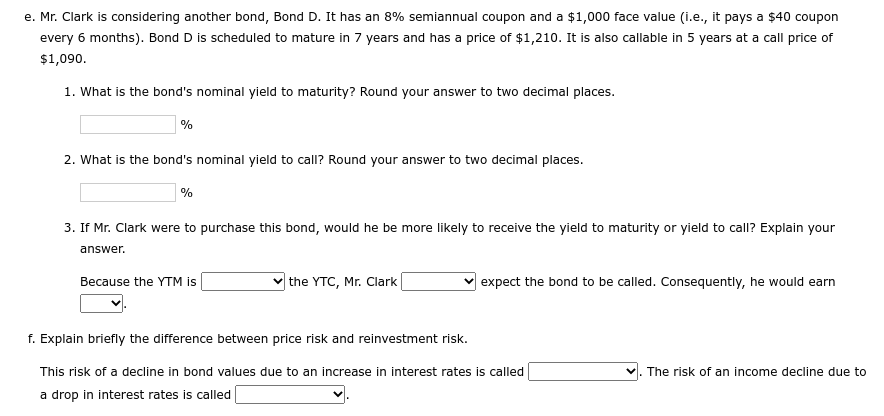
What is the expected current yield for each bond in each year? Round your answers to two decimal places.
THANK YOU!!!!
| Years Remaining | ||||
| Until Maturity | Bond A | Bond B | Bond C | |
| 12 | fill in the blank 72 % | fill in the blank 73 % | fill in the blank 74 % | |
| 11 | fill in the blank 75 % | fill in the blank 76 % | fill in the blank 77 % | |
| 10 | fill in the blank 78 % | fill in the blank 79 % | fill in the blank 80 % | |
| 9 | fill in the blank 81 % | fill in the blank 82 % | fill in the blank 83 % | |
| 8 | fill in the blank 84 % | fill in the blank 85 % | fill in the blank 86 % | |
| 7 | fill in the blank 87 % | fill in the blank 88 % | fill in the blank 89 % | |
| 6 | fill in the blank 90 % | fill in the blank 91 % | fill in the blank 92 % | |
| 5 | fill in the blank 93 % | fill in the blank 94 % | fill in the blank 95 % | |
| 4 | fill in the blank 96 % | fill in the blank 97 % | fill in the blank 98 % | |
| 3 | fill in the blank 99 % | fill in the blank 100 % | fill in the blank 101 % | |
| 2 | fill in the blank 102 % | fill in the blank 103 % | fill in the blank 104 % | |
| 1 | fill in the blank 105 % | fill in the blank 106 % | fill in the blank 107 % | |
What is the expected capital gains yield for each bond in each year? Round your answers to two decimal places.
| Years Remaining | ||||
| Until Maturity | Bond A | Bond B | Bond C | |
| 12 | fill in the blank 108 % | fill in the blank 109 % | fill in the blank 110 % | |
| 11 | fill in the blank 111 % | fill in the blank 112 % | fill in the blank 113 % | |
| 10 | fill in the blank 114 % | fill in the blank 115 % | fill in the blank 116 % | |
| 9 | fill in the blank 117 % | fill in the blank 118 % | fill in the blank 119 % | |
| 8 | fill in the blank 120 % | fill in the blank 121 % | fill in the blank 122 % | |
| 7 | fill in the blank 123 % | fill in the blank 124 % | fill in the blank 125 % | |
| 6 | fill in the blank 126 % | fill in the blank 127 % | fill in the blank 128 % | |
| 5 | fill in the blank 129 % | fill in the blank 130 % | fill in the blank 131 % | |
| 4 | fill in the blank 132 % | fill in the blank 133 % | fill in the blank 134 % | |
| 3 | fill in the blank 135 % | fill in the blank 136 % | fill in the blank 137 % | |
| 2 | fill in the blank 138 % | fill in the blank 139 % | fill in the blank 140 % | |
| 1 | fill in the blank 141 % | fill in the blank 142 % | fill in the blank 143 % | |
What is the total return for each bond in each year? Round your answers to two decimal places.
| Years Remaining | ||||
| Until Maturity | Bond A | Bond B | Bond C | |
| 12 | fill in the blank 144 % | fill in the blank 145 % | fill in the blank 146 % | |
| 11 | fill in the blank 147 % | fill in the blank 148 % | fill in the blank 149 % | |
| 10 | fill in the blank 150 % | fill in the blank 151 % | fill in the blank 152 % | |
| 9 | fill in the blank 153 % | fill in the blank 154 % | fill in the blank 155 % | |
| 8 | fill in the blank 156 % | fill in the blank 157 % | fill in the blank 158 % | |
| 7 | fill in the blank 159 % | fill in the blank 160 % | fill in the blank 161 % | |
| 6 | fill in the blank 162 % | fill in the blank 163 % | fill in the blank 164 % | |
| 5 | fill in the blank 165 % | fill in the blank 166 % | fill in the blank 167 % | |
| 4 | fill in the blank 168 % | fill in the blank 169 % | fill in the blank 170 % | |
| 3 | fill in the blank 171 % | fill in the blank 172 % | fill in the blank 173 % | |
| 2 | fill in the blank 174 % | fill in the blank 175 % | fill in the blank 176 % | |
| 1 | fill in the blank 177 % | fill in the blank 178 % | fill in the blank 179 % | |
Show transcribed data
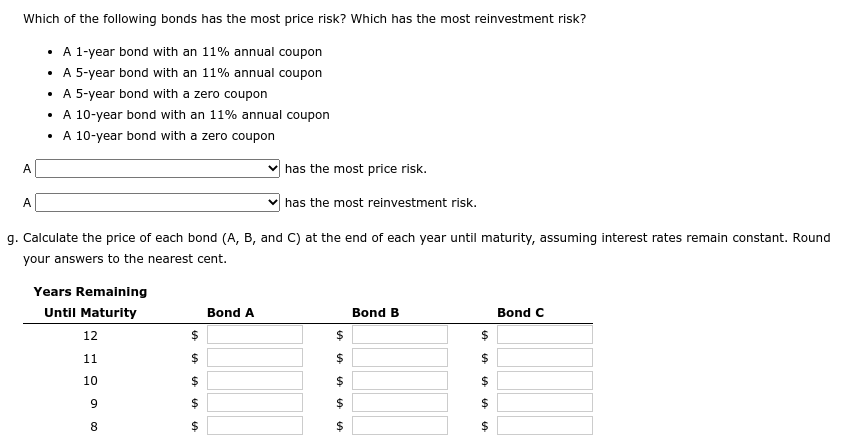
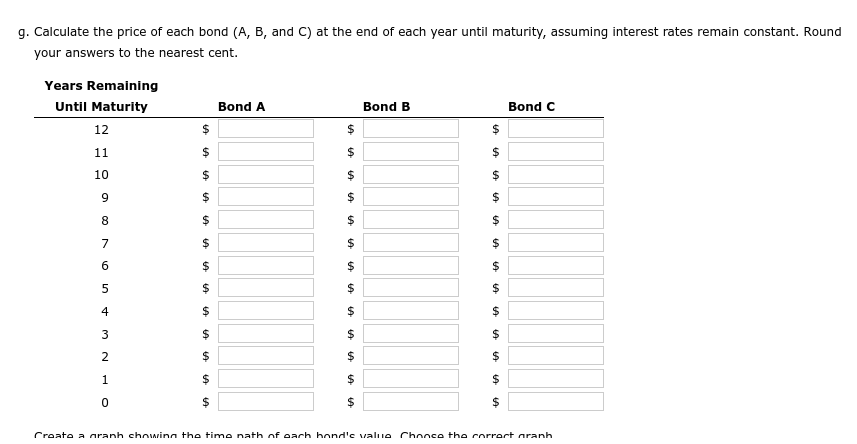
e. Mr. Clark is considering another bond, Bond D. It has an 8% semiannual coupon and a $1,000 face value (i.e., it pays a $40 coupon every 6 months). Bond D is scheduled to mature in 7 years and has a price of $1,210. It is also callable in 5 years at a call price of $1,090. 1. What is the bond's nominal yield to maturity? Round your answer to two decimal places. % 2. What is the bond's nominal yield to call? Round your answer to two decimal places. % 3. If Mr. Clark were to purchase this bond, would he be more likely to receive the yield to maturity or yield to call? Explain your answer. Because the YTM is the YTC, Mr. Clark_expect the bond to be called. Consequently, he would earn f. Explain briefly the difference between price risk and reinvestment risk. This risk of a decline in bond values due to an increase in interest rates is called . The risk of an income decline due tc a drop in interest rates is called Which of the following bonds has the most price risk? Which has the most reinvestment risk? - A 1 -year bond with an 11% annual coupon - A 5-year bond with an 11% annual coupon - A 5-year bond with a zero coupon - A 10-year bond with an 11% annual coupon - A 10-year bond with a zero coupon A has the most price risk. A has the most reinvestment risk. g. Calculate the price of each bond (A, B, and C) at the end of each year until maturity, assuming interest rates remain constant. Round your answers to the nearest cent. g. Calculate the price of each bond (A,B, and C ) at the end of each year until maturity, assuming interest rates remain constant. Round your answers to the nearest cent. e. Mr. Clark is considering another bond, Bond D. It has an 8% semiannual coupon and a $1,000 face value (i.e., it pays a $40 coupon every 6 months). Bond D is scheduled to mature in 7 years and has a price of $1,210. It is also callable in 5 years at a call price of $1,090. 1. What is the bond's nominal yield to maturity? Round your answer to two decimal places. % 2. What is the bond's nominal yield to call? Round your answer to two decimal places. % 3. If Mr. Clark were to purchase this bond, would he be more likely to receive the yield to maturity or yield to call? Explain your answer. Because the YTM is the YTC, Mr. Clark_expect the bond to be called. Consequently, he would earn f. Explain briefly the difference between price risk and reinvestment risk. This risk of a decline in bond values due to an increase in interest rates is called . The risk of an income decline due tc a drop in interest rates is called Which of the following bonds has the most price risk? Which has the most reinvestment risk? - A 1 -year bond with an 11% annual coupon - A 5-year bond with an 11% annual coupon - A 5-year bond with a zero coupon - A 10-year bond with an 11% annual coupon - A 10-year bond with a zero coupon A has the most price risk. A has the most reinvestment risk. g. Calculate the price of each bond (A, B, and C) at the end of each year until maturity, assuming interest rates remain constant. Round your answers to the nearest cent. g. Calculate the price of each bond (A,B, and C ) at the end of each year until maturity, assuming interest rates remain constant. Round your answers to the nearest cent
Step by Step Solution
There are 3 Steps involved in it

Get step-by-step solutions from verified subject matter experts
 Study Help