







Question: Please Please Please someone help me with this question and answer ALL parts. I would appreciate very very much I'm so lost. Please have good
 Please Please Please someone help me with this question and answer ALL parts. I would appreciate very very much I'm so lost. Please have good handwriting too. Thank you!!
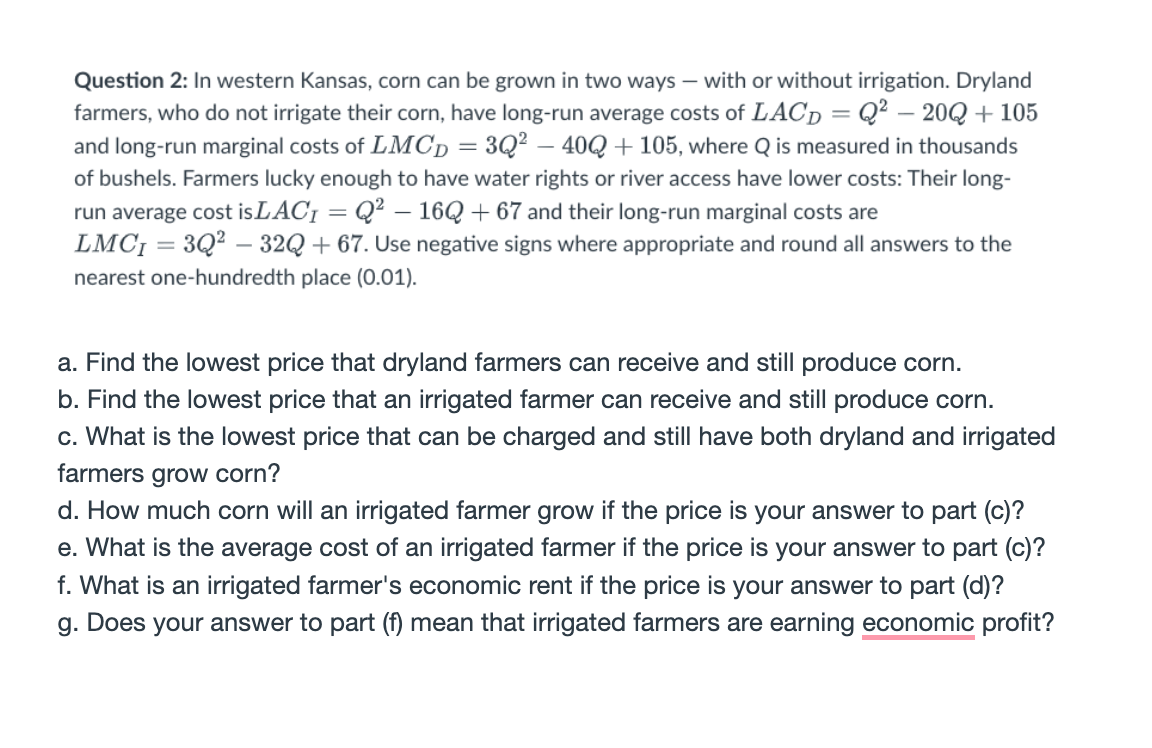
Question 2: In western Kansas, corn can be grown in two ways - with or without irrigation. Dryland farmers, who do not irrigate their corn, have long-run average costs of LACD=Q220Q+105 and long-run marginal costs of LMCD=3Q240Q+105, where Q is measured in thousands of bushels. Farmers lucky enough to have water rights or river access have lower costs: Their longrun average cost is LACI=Q216Q+67 and their long-run marginal costs are LMCI=3Q232Q+67. Use negative signs where appropriate and round all answers to the nearest one-hundredth place (0.01). a. Find the lowest price that dryland farmers can receive and still produce corn. b. Find the lowest price that an irrigated farmer can receive and still produce corn. c. What is the lowest price that can be charged and still have both dryland and irrigated farmers grow corn? d. How much corn will an irrigated farmer grow if the price is your answer to part (c)? e. What is the average cost of an irrigated farmer if the price is your answer to part (c)? f. What is an irrigated farmer's economic rent if the price is your answer to part (d)? g. Does your answer to part (f) mean that irrigated farmers are earning economic profit? Question 2: In western Kansas, corn can be grown in two ways - with or without irrigation. Dryland farmers, who do not irrigate their corn, have long-run average costs of LACD=Q220Q+105 and long-run marginal costs of LMCD=3Q240Q+105, where Q is measured in thousands of bushels. Farmers lucky enough to have water rights or river access have lower costs: Their longrun average cost is LACI=Q216Q+67 and their long-run marginal costs are LMCI=3Q232Q+67. Use negative signs where appropriate and round all answers to the nearest one-hundredth place (0.01). a. Find the lowest price that dryland farmers can receive and still produce corn. b. Find the lowest price that an irrigated farmer can receive and still produce corn. c. What is the lowest price that can be charged and still have both dryland and irrigated farmers grow corn? d. How much corn will an irrigated farmer grow if the price is your answer to part (c)? e. What is the average cost of an irrigated farmer if the price is your answer to part (c)? f. What is an irrigated farmer's economic rent if the price is your answer to part (d)? g. Does your answer to part (f) mean that irrigated farmers are earning economic profit
Step by Step Solution
There are 3 Steps involved in it

Get step-by-step solutions from verified subject matter experts
 Study Help