



Question: Please post a screenshot of your work from words document. Company description The (fictitious) company PPC currently is a 100% subsidiary of an Australian company
Please post a screenshot of your work from words document. 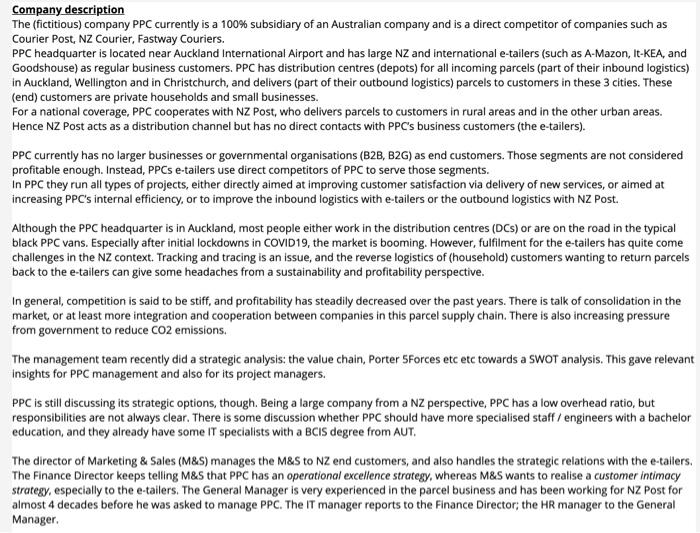
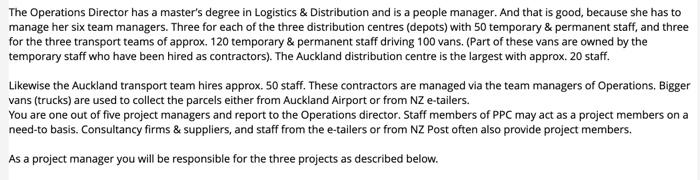
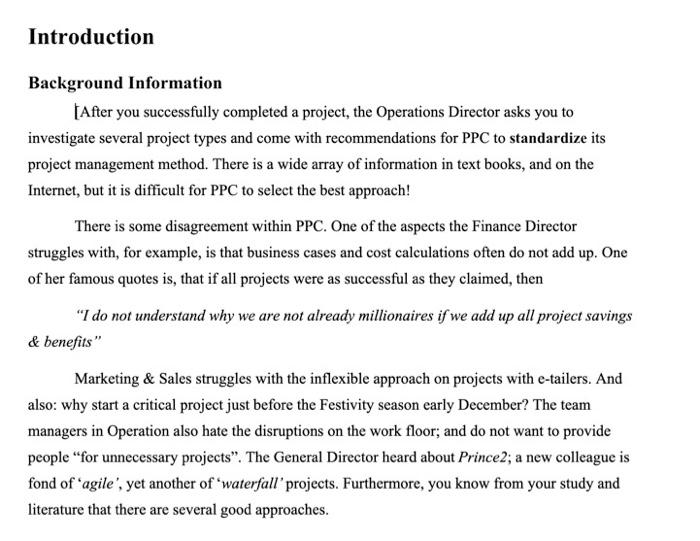
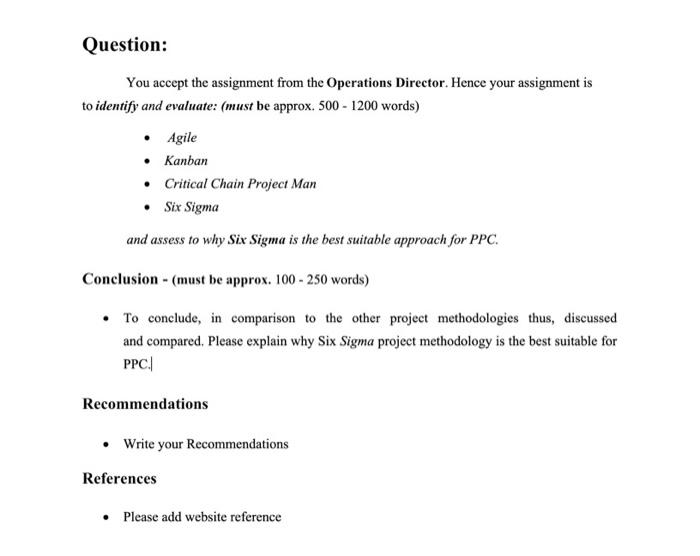
Company description The (fictitious) company PPC currently is a 100% subsidiary of an Australian company and is a direct competitor of companies such as Courier Post, NZ Courier, Fastway Couriers. PPC headquarter is located near Auckland International Airport and has large NZ and international e-tailers (such as A-Mazon, It-KEA, and Goodshouse) as regular business customers. PPC has distribution centres (depots) for all incoming parcels (part of their inbound logistics) in Auckland, Wellington and in Christchurch, and delivers (part of their outbound logistics) parcels to customers in these 3 cities. These (end) customers are private households and small businesses. For a national coverage, PPC cooperates with NZ Post, who delivers parcels to customers in rural areas and in the other urban areas. Hence NZ Post acts as a distribution channel but has no direct contacts with PPC's business customers (the e-tailers). PPC currently has no larger businesses or governmental organisations (B2B, B2G) as end customers. Those segments are not considered profitable enough. Instead, PPCs e-tailers use direct competitors of PPC to serve those segments. In PPC they run all types of projects, either directly aimed at improving customer satisfaction via delivery of new services, or aimed at increasing PPC's internal efficiency. or to improve the inbound logistics with e-tailers or the outbound logistics with NZ Post. Although the PPC headquarter is in Auckland, most people either work in the distribution centres (DCs) or are on the road in the typical black PPC vans. Especially after initial lockdowns in COVID19, the market is booming. However, fulfilment for the e-tailers has quite come challenges in the NZ context. Tracking and tracing is an issue, and the reverse logistics of household) customers wanting to return parcels back to the e-tailers can give some headaches from a sustainability and profitability perspective. In general, competition is said to be stiff, and profitability has steadily decreased over the past years. There is talk of consolidation in the market, or at least more integration and cooperation between companies in this parcel supply chain. There is also increasing pressure from government to reduce CO2 emissions. The management team recently did a strategic analysis: the value chain, Porter SForces etc etc towards a SWOT analysis. This gave relevant Insights for PPC management and also for its project managers. PPC is still discussing its strategic options, though. Being a large company from a NZ perspective, PPC has a low overhead ratio, but responsibilities are not always clear. There is some discussion whether PPC should have more specialised staff/engineers with a bachelor education, and they already have some IT specialists with a BCIS degree from AUT. The director of Marketing & Sales (M&S) manages the M&S to NZ end customers, and also handles the strategic relations with the e-tallers. The Finance Director keeps telling M&S that PPC has an operational excellence strategy, whereas M&S wants to realise a customer intimacy strategy, especially to the e-tailers. The General Manager is very experienced in the parcel business and has been working for NZ Post for almost 4 decades before he was asked to manage PPC. The IT manager reports to the Finance Director, the HR manager to the General Manager. The Operations Director has a master's degree in Logistics & Distribution and is a people manager. And that is good, because she has to manage her six team managers. Three for each of the three distribution centres (depots) with 50 temporary & permanent staff, and three for the three transport teams of approx. 120 temporary & permanent staff driving 100 vans. (Part of these vans are owned by the temporary staff who have been hired as contractors). The Auckland distribution centre is the largest with approx. 20 staff. Likewise the Auckland transport team hires approx. 50 staff. These contractors are managed via the team managers of Operations, Bigger vans (trucks) are used to collect the parcels either from Auckland Airport or from NZ e-tailers. You are one out of five project managers and report to the Operations director. Staff members of PPC may act as a project members on a need-to basis. Consultancy firms & suppliers, and staff from the e-tailers or from NZ Post often also provide project members. As a project manager you will be responsible for the three projects as described below. Introduction Background Information After you successfully completed a project, the Operations Director asks you to investigate several project types and come with recommendations for PPC to standardize its project management method. There is a wide array of information in text books, and on the Internet, but it is difficult for PPC to select the best approach! There is some disagreement within PPC. One of the aspects the Finance Director struggles with, for example, is that business cases and cost calculations often do not add up. One of her famous quotes is, that if all projects were as successful as they claimed, then "I do not understand why we are not already millionaires if we add up all project savings & benefits" Marketing & Sales struggles with the inflexible approach on projects with e-tailers. And also: why start a critical project just before the Festivity season early December? The team managers in Operation also hate the disruptions on the work floor; and do not want to provide people for unnecessary projects. The General Director heard about Prince2; a new colleague is fond of 'agile', yet another of waterfall projects. Furthermore, you know from your study and literature that there are several good approaches. Question: You accept the assignment from the Operations Director. Hence your assignment is to identify and evaluate: (must be approx. 500 - 1200 words) Agile Kanban Critical Chain Project Man Six Sigma and assess to why Six Sigma is the best suitable approach for PPC. Conclusion - (must be approx. 100 - 250 words) To conclude, in comparison to the other project methodologies thus, discussed and compared, Please explain why Six Sigma project methodology is the best suitable for PPC. Recommendations Write your Recommendations References Please add website reference Company description The (fictitious) company PPC currently is a 100% subsidiary of an Australian company and is a direct competitor of companies such as Courier Post, NZ Courier, Fastway Couriers. PPC headquarter is located near Auckland International Airport and has large NZ and international e-tailers (such as A-Mazon, It-KEA, and Goodshouse) as regular business customers. PPC has distribution centres (depots) for all incoming parcels (part of their inbound logistics) in Auckland, Wellington and in Christchurch, and delivers (part of their outbound logistics) parcels to customers in these 3 cities. These (end) customers are private households and small businesses. For a national coverage, PPC cooperates with NZ Post, who delivers parcels to customers in rural areas and in the other urban areas. Hence NZ Post acts as a distribution channel but has no direct contacts with PPC's business customers (the e-tailers). PPC currently has no larger businesses or governmental organisations (B2B, B2G) as end customers. Those segments are not considered profitable enough. Instead, PPCs e-tailers use direct competitors of PPC to serve those segments. In PPC they run all types of projects, either directly aimed at improving customer satisfaction via delivery of new services, or aimed at increasing PPC's internal efficiency. or to improve the inbound logistics with e-tailers or the outbound logistics with NZ Post. Although the PPC headquarter is in Auckland, most people either work in the distribution centres (DCs) or are on the road in the typical black PPC vans. Especially after initial lockdowns in COVID19, the market is booming. However, fulfilment for the e-tailers has quite come challenges in the NZ context. Tracking and tracing is an issue, and the reverse logistics of household) customers wanting to return parcels back to the e-tailers can give some headaches from a sustainability and profitability perspective. In general, competition is said to be stiff, and profitability has steadily decreased over the past years. There is talk of consolidation in the market, or at least more integration and cooperation between companies in this parcel supply chain. There is also increasing pressure from government to reduce CO2 emissions. The management team recently did a strategic analysis: the value chain, Porter SForces etc etc towards a SWOT analysis. This gave relevant Insights for PPC management and also for its project managers. PPC is still discussing its strategic options, though. Being a large company from a NZ perspective, PPC has a low overhead ratio, but responsibilities are not always clear. There is some discussion whether PPC should have more specialised staff/engineers with a bachelor education, and they already have some IT specialists with a BCIS degree from AUT. The director of Marketing & Sales (M&S) manages the M&S to NZ end customers, and also handles the strategic relations with the e-tallers. The Finance Director keeps telling M&S that PPC has an operational excellence strategy, whereas M&S wants to realise a customer intimacy strategy, especially to the e-tailers. The General Manager is very experienced in the parcel business and has been working for NZ Post for almost 4 decades before he was asked to manage PPC. The IT manager reports to the Finance Director, the HR manager to the General Manager. The Operations Director has a master's degree in Logistics & Distribution and is a people manager. And that is good, because she has to manage her six team managers. Three for each of the three distribution centres (depots) with 50 temporary & permanent staff, and three for the three transport teams of approx. 120 temporary & permanent staff driving 100 vans. (Part of these vans are owned by the temporary staff who have been hired as contractors). The Auckland distribution centre is the largest with approx. 20 staff. Likewise the Auckland transport team hires approx. 50 staff. These contractors are managed via the team managers of Operations, Bigger vans (trucks) are used to collect the parcels either from Auckland Airport or from NZ e-tailers. You are one out of five project managers and report to the Operations director. Staff members of PPC may act as a project members on a need-to basis. Consultancy firms & suppliers, and staff from the e-tailers or from NZ Post often also provide project members. As a project manager you will be responsible for the three projects as described below. Introduction Background Information After you successfully completed a project, the Operations Director asks you to investigate several project types and come with recommendations for PPC to standardize its project management method. There is a wide array of information in text books, and on the Internet, but it is difficult for PPC to select the best approach! There is some disagreement within PPC. One of the aspects the Finance Director struggles with, for example, is that business cases and cost calculations often do not add up. One of her famous quotes is, that if all projects were as successful as they claimed, then "I do not understand why we are not already millionaires if we add up all project savings & benefits" Marketing & Sales struggles with the inflexible approach on projects with e-tailers. And also: why start a critical project just before the Festivity season early December? The team managers in Operation also hate the disruptions on the work floor; and do not want to provide people for unnecessary projects. The General Director heard about Prince2; a new colleague is fond of 'agile', yet another of waterfall projects. Furthermore, you know from your study and literature that there are several good approaches. Question: You accept the assignment from the Operations Director. Hence your assignment is to identify and evaluate: (must be approx. 500 - 1200 words) Agile Kanban Critical Chain Project Man Six Sigma and assess to why Six Sigma is the best suitable approach for PPC. Conclusion - (must be approx. 100 - 250 words) To conclude, in comparison to the other project methodologies thus, discussed and compared, Please explain why Six Sigma project methodology is the best suitable for PPC. Recommendations Write your Recommendations References Please add website reference Step by Step Solution
There are 3 Steps involved in it
1 Expert Approved Answer
Step: 1 Unlock

Question Has Been Solved by an Expert!
Get step-by-step solutions from verified subject matter experts
Step: 2 Unlock
Step: 3 Unlock