Please provide a detailed answer with explanation . Thank you
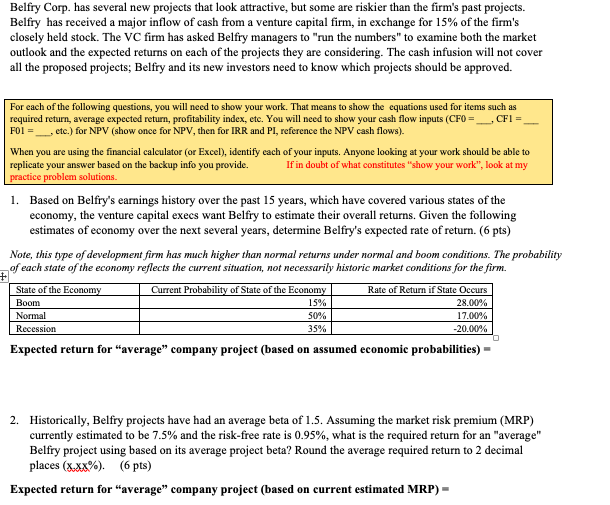
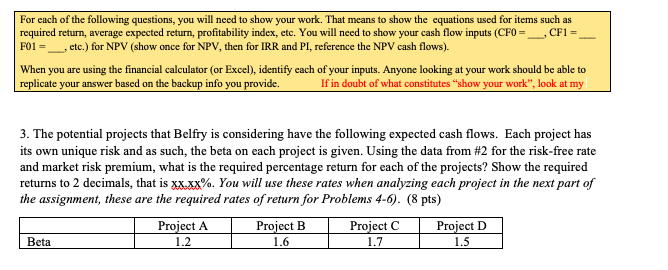
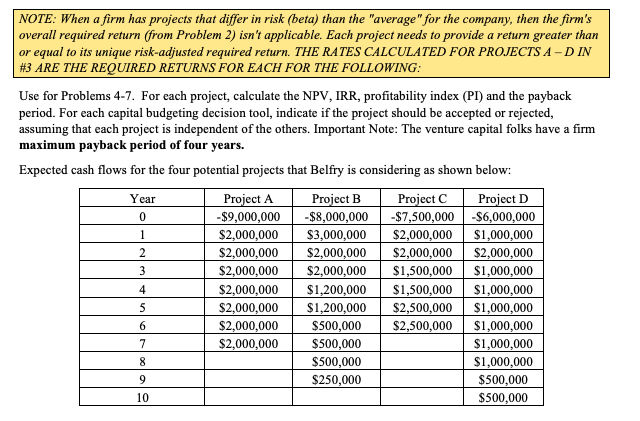
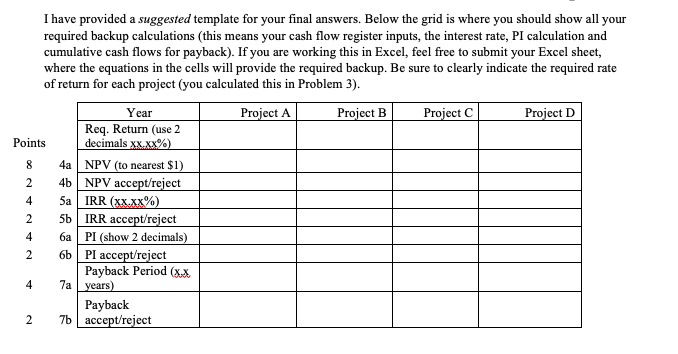
Belfry Corp. has several new projects that look attractive, but some are riskier than the firm's past projects. Belfry has received a major inflow of cash from a venture capital firm, in exchange for 15% of the firm's closely held stock. The VC firm has asked Belfry managers to "run the numbers" to examine both the market outlook and the expected returns on each of the projects they are considering. The cash infusion will not cover all the proposed projects; Belfry and its new investors need to know which projects should be approved. For each of the following questions, you will need to show your work. That means to show the equations used for items such as required return, average expected return, profitability index, etc. You will need to show your cash flow inputs (CFO = _, CFI = FOl = , cte.) for NPV (show once for NPV, then for IRR and PI, reference the NPV cash flows). When you are using the financial calculator (or Excel), identify each of your inputs. Anyone looking at your work should be able to replicate your answer based on the backup info you provide. If in doubt of what constitutes "show your work", look at my practice problem solutions. 1. Based on Belfry's earnings history over the past 15 years, which have covered various states of the economy, the venture capital execs want Belfry to estimate their overall returns. Given the following estimates of economy over the next several years, determine Belfry's expected rate of return. (6 pts) Note, this type of development firm has much higher than normal returns under normal and boom conditions. The probability of each state of the economy reflects the current situation, not necessarily historic market conditions for the firm. State of the Economy Current Probability of State of the Economy Rate of Return if State Occurs Boom 15% 28.00% Normal 50% 17.00% Recession 15% 20.0 0% Expected return for "average" company project (based on assumed economic probabilities) = 2. Historically, Belfry projects have had an average beta of 1.5. Assuming the market risk premium (MRP) currently estimated to be 7.5% and the risk-free rate is 0.95%, what is the required return for an "average" Belfry project using based on its average project beta? Round the average required return to 2 decimal places (xxx%). (6 pts) Expected return for "average" company project (based on current estimated MRP) =For each of the following questions, you will need to show your work. That means to show the equations used for items such as required return, average expected return, profitability index, etc. You will need to show your cash flow inputs (CFO = , CF1 = F01 = , etc.) for NPV (show once for NPV, then for IRR and PI, reference the NPV cash flows). When you are using the financial calculator (or Excel), identify each of your inputs. Anyone looking at your work should be able to replicate your answer based on the backup info you provide. If in doubt of what constitutes "show your work", look at my 3. The potential projects that Belfry is considering have the following expected cash flows. Each project has its own unique risk and as such, the beta on each project is given. Using the data from #2 for the risk-free rate and market risk premium, what is the required percentage return for each of the projects? Show the required returns to 2 decimals, that is xxxx%. You will use these rates when analyzing each project in the next part of the assignment, these are the required rates of return for Problems 4-6). (8 pts) Project A Project B Project C Project D Beta 1.2 1.6 1.7 1.5NOTE: When a firm has projects that differ in risk (beta) than the "average" for the company, then the firm's overall required return (from Problem 2) isn't applicable. Each project needs to provide a return greater than or equal to its unique risk-adjusted required return. THE RATES CALCULATED FOR PROJECTS A - D IN #3 ARE THE REQUIRED RETURNS FOR EACH FOR THE FOLLOWING: Use for Problems 4-7. For each project, calculate the NPV, IRR, profitability index (PI) and the payback period. For each capital budgeting decision tool, indicate if the project should be accepted or rejected, assuming that each project is independent of the others. Important Note: The venture capital folks have a firm maximum payback period of four years. Expected cash flows for the four potential projects that Belfry is considering as shown below: Year Project A Project B Project C Project D 0 -$9,000,000 -$8,000,000 -$7,500,000 -$6,000,000 $2,000,000 $3,000,000 $2,000,000 $1,000,000 $2,000,000 $2,000,000 $2,000,000 $2,000,000 $2,000,000 $2,000,000 $1,500,000 $1,000.000 $2,000,000 $1,200,000 $1,500,000 $1,000,000 $2,000,000 $1,200,000 $2,500,000 $1,000,000 $2,000.000 $500,000 $2,500.000 $1,000.000 $2,000,000 $500,000 $1,000.000 $500,000 $1,000.000 $250,000 $500.000 10 $500.000I have provided a suggested template for your final answers. Below the grid is where you should show all your required backup calculations (this means your cash flow register inputs, the interest rate, PI calculation and cumulative cash flows for payback). If you are working this in Excel, feel free to submit your Excel sheet, where the equations in the cells will provide the required backup. Be sure to clearly indicate the required rate of return for each project (you calculated this in Problem 3). Year Project A Project B Project C Project D Req. Return (use 2 Points decimals xx xx%) 8 4a NPV ( to nearest $1) 2 4b NPV accept/reject 4 5a IRR (Xx xx%) NA 5b IRR accept/reject Ga PI (show 2 decimals) 6b PI accept/reject Payback Period (XX. 4 7a years) Payback 2 7b accept/reject