







Question: Please provide a step-by-step solution to this problem so that I can teach myself how to solve it. #2.19 MICRO PS 4 (10-17-20) PROBLEM 2.19Axiom
Please provide a step-by-step solution to this problem so that I can teach myself how to solve it.
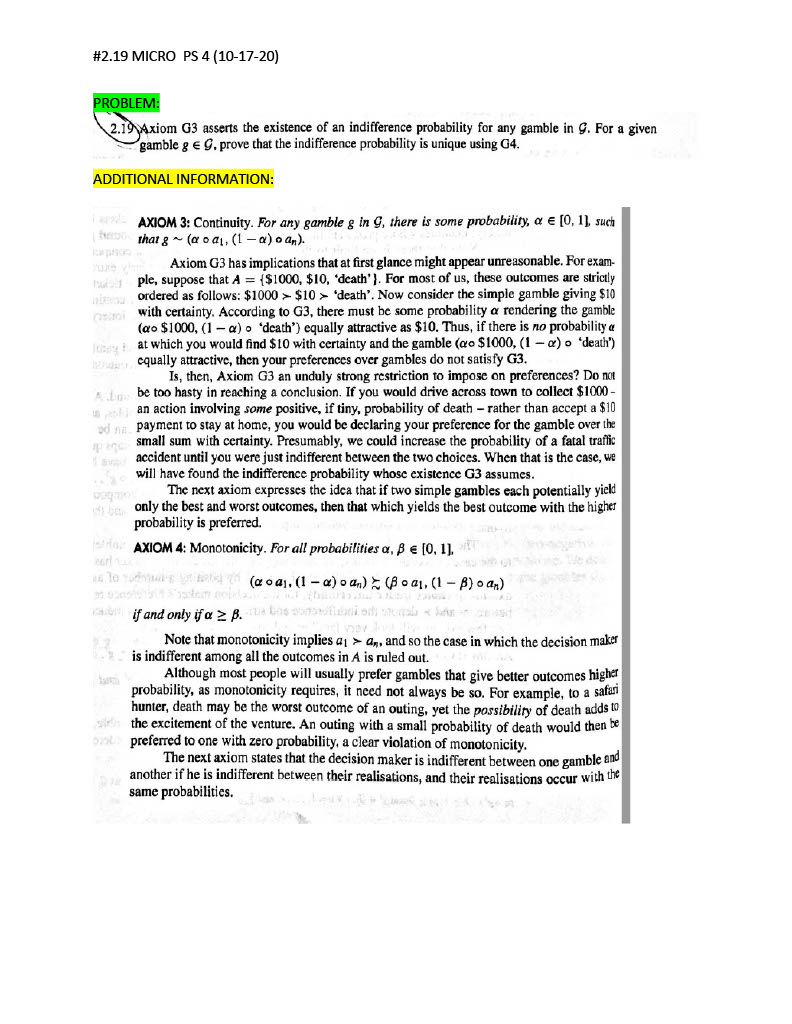
#2.19 MICRO PS 4 (10-17-20) PROBLEM 2.19\\Axiom G3 asserts the existence of an indifference probability for any gamble in 9. For a given gamble g E G. prove that the indifference probability is unique using G4. ADDITIONAL INFORMATION: AXIOM 3: Continuity. For any gamble g in 9, there is some probability, a = [0, 1], such how that g - (coal, (1 -a) .a,). Axiom G3 has implications that at first glance might appear unreasonable. For exam- holy ple, suppose that A = ($1000, $10, 'death' ). For most of us, these outcomes are strictly ordered as follows: $1000 > $10 > 'death". Now consider the simple gamble giving $10 with certainty. According to G3, there must be some probability a rendering the gamble (wo $1000, (1 - @) . 'death") equally attractive as $10. Thus, if there is no probability a way at which you would find $10 with certainty and the gamble (@ $1000, (1 - a) o "death") wywho equally attractive, then your preferences over gambles do not satisfy G3. Is, then, Axiom G3 an unduly strong restriction to impose on preferences? Do not A.bin: be too hasty in reaching a conclusion. If you would drive across town to collect $1000- is jan action involving some positive, if tiny, probability of death - rather than accept a $10 ud na payment to stay at home, you would be declaring your preference for the gamble over the small sum with certainty. Presumably, we could increase the probability of a fatal traffic accident until you were just indifferent between the two choices. When that is the case, we will have found the indifference probability whose existence G3 assumes. The next axiom expresses the idea that if two simple gambles each potentially yield only the best and worst outcomes, then that which yields the best outcome with the higher probability is preferred. AXIOM 4: Monotonicity. For all probabilities a, Be [0, 1], earl non as lo dows (com. (1 -a) oa,) & (Boa, (1 - B) oan) if and only if a 2 B. " bos consulitali only somah a han . at Note that monotonicity implies a1 > a,, and so the case in which the decision maker is indifferent among all the outcomes in A is ruled out. Although most people will usually prefer gambles that give better outcomes higher probability, as monotonicity requires, it need not always be so. For example, to a safari hunter, death may be the worst outcome of an outing, yet the possibility of death adds to the excitement of the venture. An outing with a small probability of death would then be preferred to one with zero probability, a clear violation of monotonicity. The next axiom states that the decision maker is indifferent between one gamble and another if he is indifferent between their realisations, and their realisations occur with the same probabilities
Step by Step Solution
There are 3 Steps involved in it

Get step-by-step solutions from verified subject matter experts
 Study Help