







Question: please provide conclusion different hierarchical level. 2. RESEARCH METHODOLOGY 2.1. Subject and problems of research This paper analyses one segment of management within specific type
please provide conclusion
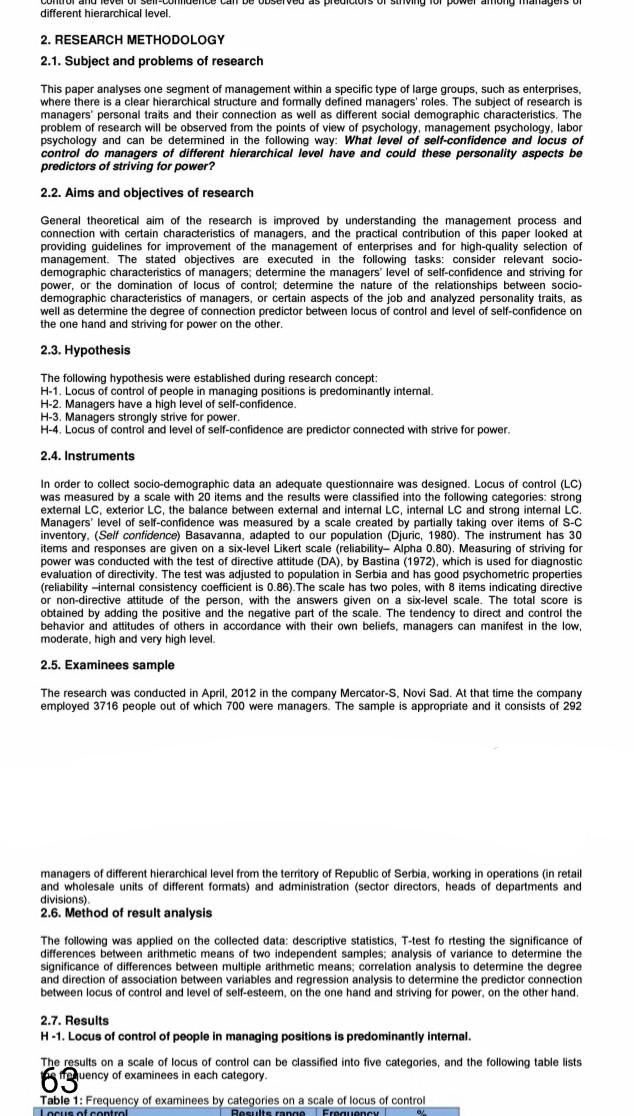
different hierarchical level. 2. RESEARCH METHODOLOGY 2.1. Subject and problems of research This paper analyses one segment of management within specific type of large groups, such as enterprises where there is a clear hierarchical structure and formally defined managers' roles. The subject of research is managers' personal traits and their connection as well as different social demographic characteristics. The problem of research will be observed from the points of view of psychology, management psychology, labor psychology and can be determined in the following way: What level of self-confidence and locus of control do managers of different hierarchical level have and could these personality aspects be predictors of striving for power? 2.2. Aims and objectives of research General theoretical aim of the research is improved by understanding the management process and connection with certain characteristics of managers, and the practical contribution of this paper looked at providing guidelines for improvement of the management of enterprises and for high-quality selection of management. The stated objectives are executed in the following tasks: consider relevant socio- demographic characteristics of managers, determine the managers' level of self-confidence and striving for power, or the domination of focus of control determine the nature of the relationships between socio- demographic characteristics of managers, or certain aspects of the job and analyzed personality traits, as well as determine the degree of connection predictor between locus of control and level of self-confidence on the one hand and striving for power on the other. 2.3. Hypothesis The following hypothesis were established during research concept: H-1. Locus of control of people in managing positions is predominantly internal H-2. Managers have a high level of self-confidence. H-3. Managers strongly strive for power. H-4. Locus of control and level of self-confidence are predictor connected with strive for power. 2.4. Instruments In order to collect socio-demographic data an adequate questionnaire was designed. Locus of control (LC) was measured by a scale with 20 items and the results were classified into the following categories: strong external LC, exterior LC, the balance between external and internal LC, internal LC and strong internal LC Managers' level of self-confidence was measured by a scale created by partially taking over items of S-C inventory, (Self confidence) Basavanna, adapted to our population (Djuric, 1980). The instrument has 30 items and responses are given on a six-level Likert scale (reliability-Alpha 0.80). Measuring of striving for power was conducted with the test of directive attitude (DA), by Bastina (1972), which is used for diagnostic evaluation of directivity. The test was adjusted to population in Serbia and has good psychometric properties (reliability-internal consistency coefficient is 0.86).The scale has two poles, with 8 items indicating directive or non-directive attitude of the person, with the answers given on a six-level scale. The total score is obtained by adding the positive and the negative part of the scale. The tendency to direct and control the behavior and attitudes of others in accordance with their own beliefs, managers can manifest in the low, moderate, high and very high level. 2.5. Examinees sample The research was conducted in April, 2012 in the company Mercator-S, Novi Sad. At that time the company employed 3716 people out of which 700 were managers. The sample is appropriate and it consists of 292 managers of different hierarchical level from the ritory of Republic of Serbia, working in operations (in retail and wholesale units of different formats) and administration (sector directors, heads of departments and divisions) 2.6. Method of result analysis The following was applied on the collected data: descriptive statistics, T-test fortesting the significance of differences between arithmetic means of two independent samples: analysis of variance to determine the significance of differences between multiple arithmetic means; correlation analysis to determine the degree and direction of association between variables and regression analysis to determine the predictor connection between locus of control and level of self-esteem, on the one hand and striving for power, on the other hand, 2.7. Results H-1. Locus of control of people in managing positions is predominantly internal. The results on a scale of locus of control can be classified into five categories, and the following table lists uency of examinees in each category. 63" Table 1: Frequency of examinees by categories on a scale of locus of control Tug of control Results rango FrequOnCVStep by Step Solution
There are 3 Steps involved in it
1 Expert Approved Answer
Step: 1 Unlock

Question Has Been Solved by an Expert!
Get step-by-step solutions from verified subject matter experts
Step: 2 Unlock
Step: 3 Unlock
 Study Help