







Question: *Please provide solution in C++ or Python (C++ Preferred)* *Sample Input is small, but test case files will have a list of 1000 values* Input
*Please provide solution in C++ or Python (C++ Preferred)*
*Sample Input is small, but test case files will have a list of 1000 values*
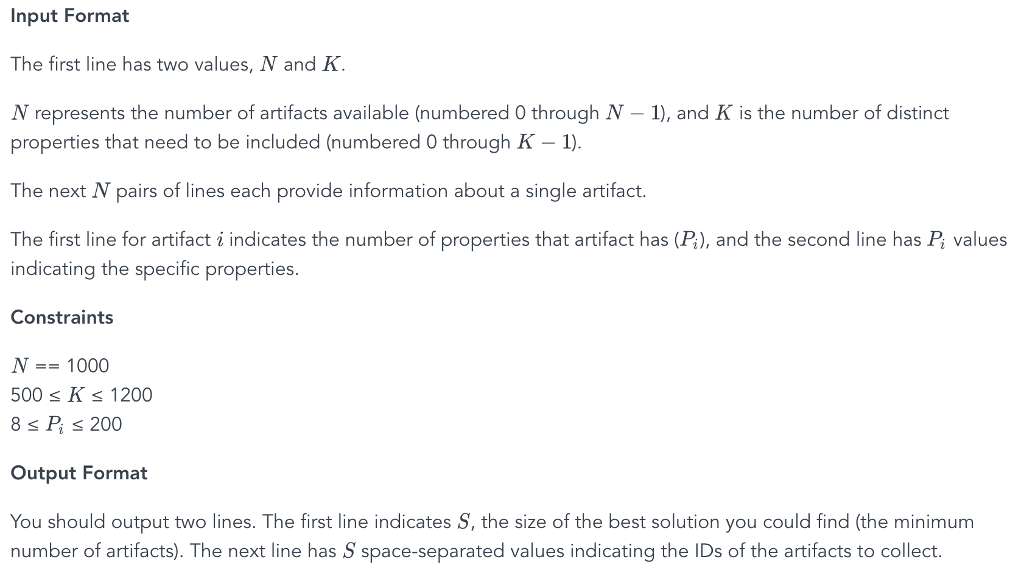
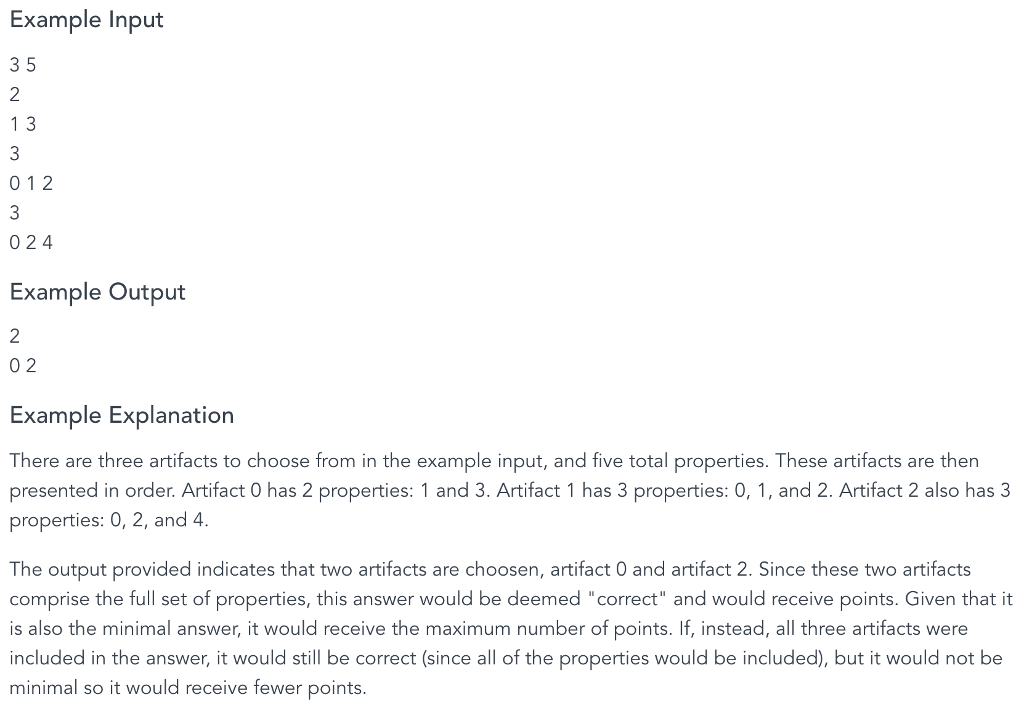
Input Format The first line has two values, N and K N represents the number of artifacts available (numbered 0 through N-1), and K is the number of distinct properties that need to be included (numbered 0 through K-1 The next N pairs of lines each provide information about a single artifact The first line for artifact i indicates the number of properties that artifact has (P), and the second line has P values indicating the specific properties. Constraints 1000 500 s K s 1200 8 s Pi s200 Output Format You should output two lines. The first line indicates S, the size of the best solution you could find (the minimum number of artifacts). The next line has S space-separated values indicating the IDs of the artifacts to collect Input Format The first line has two values, N and K N represents the number of artifacts available (numbered 0 through N-1), and K is the number of distinct properties that need to be included (numbered 0 through K-1 The next N pairs of lines each provide information about a single artifact The first line for artifact i indicates the number of properties that artifact has (P), and the second line has P values indicating the specific properties. Constraints 1000 500 s K s 1200 8 s Pi s200 Output Format You should output two lines. The first line indicates S, the size of the best solution you could find (the minimum number of artifacts). The next line has S space-separated values indicating the IDs of the artifacts to collect
Step by Step Solution
There are 3 Steps involved in it

Get step-by-step solutions from verified subject matter experts
 Study Help