







Question: Please provide step by step explanations and clear explanations on how to make the graph For your project you will pick some initial velocity (between
Please provide step by step explanations and clear explanations on how to make the graph
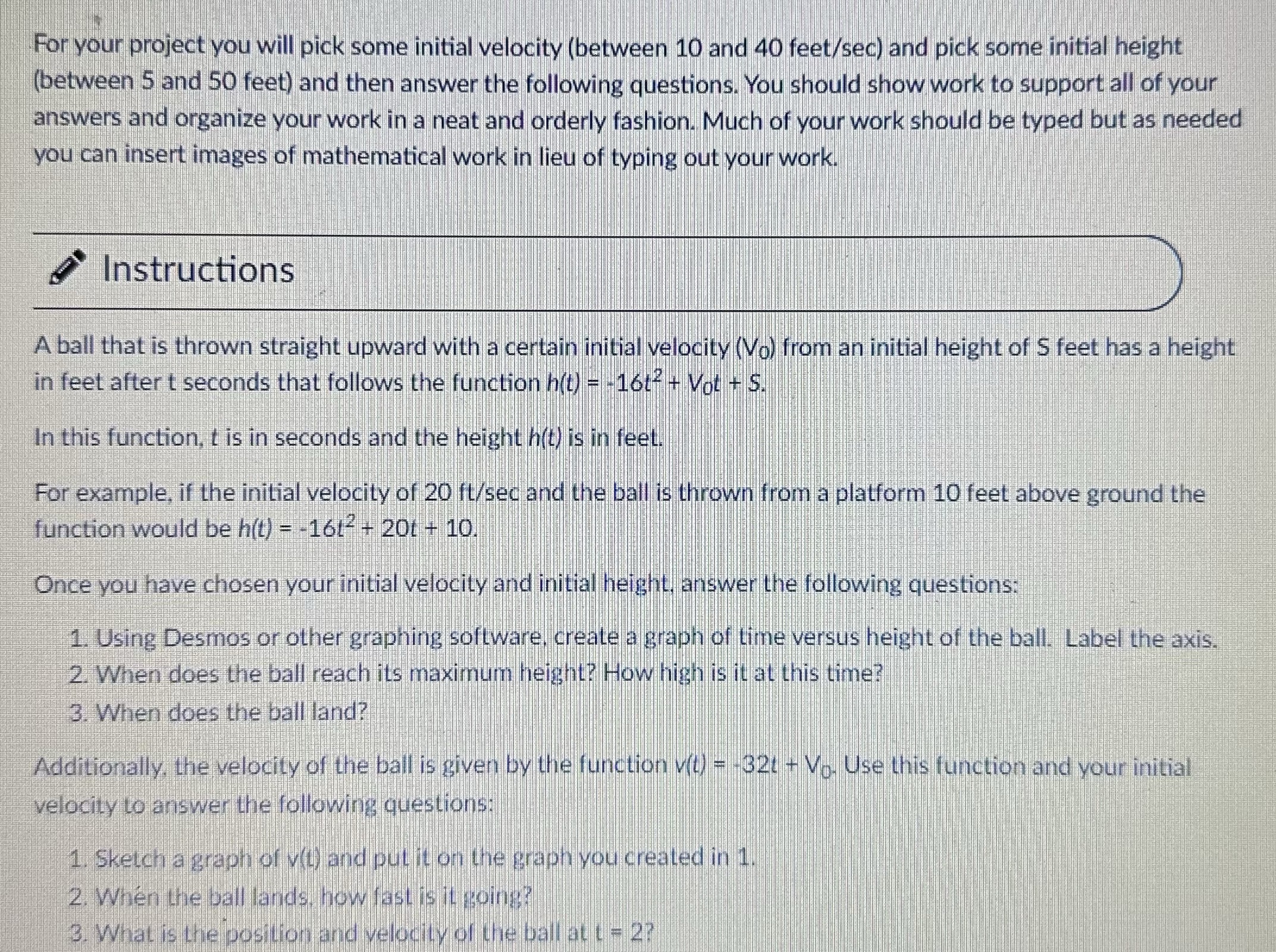
For your project you will pick some initial velocity (between 10 and 40 feet/sec) and pick some initial height (between 5 and 50 feet) and then answer the following questions. You should show work to support all of your answers and organize your work in a neat and orderly fashion. Much of your work should be typed but as needed you can insert images of mathematical work in lieu of typing out your work. Instructions A ball that is thrown straight upward with a certain initial velocity (Vo) from an initial height of S feet has a height in feet after t seconds that follows the function h(t) - -164 + Vot + s. In this function, t is in seconds and the height h(t) is in feet. For example, if the initial velocity of 20 ft/sec and the ball is thrown from a platform 10 feet above ground the function would be h(t) = -16t-+ 20t + 10. Once you have chosen your initial velocity and initial height, answer the following questions: 1. Using Desmos or other graphing software, create a graph of time versus height of the ball. Label the axis. 2. When does the ball reach its maximum height? How high is it at this time? 3. When does the ball land? Additionally, the velocity of the ball is given by the function v(t) = -32t + Vo. Use this function and your initial velocity to answer the following questions; 1. Sketch a graph of v(t) and put it on the graph you created in 1 2. When the ball lands, how fast is it going? 3. What is the position and velocity of the ball at t = 2
Step by Step Solution
There are 3 Steps involved in it

Get step-by-step solutions from verified subject matter experts
 Study Help