







Question: Please provide the answers and the code. Perform an error analysis to compare ( a ) vs . ( c ) , and ( b
Please provide the answers and the code.
Perform an error analysis to compare a vsc and b vsd
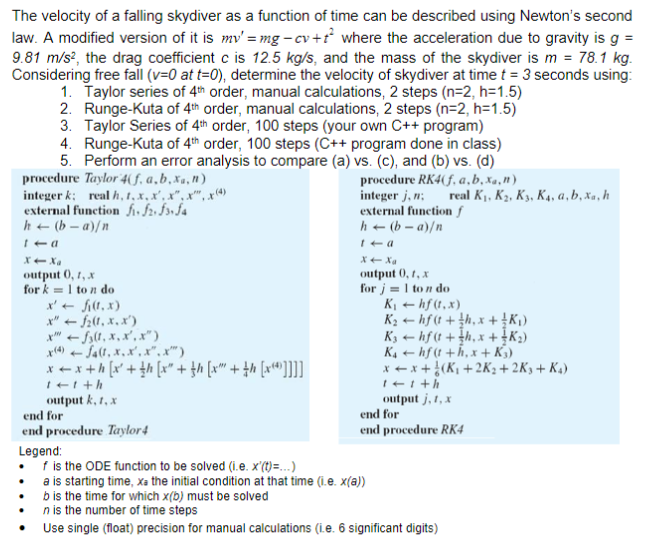
procedure Taylor
integer ; real
external function
hlarr
tlarra
output
for to do
xlarrx
tlarrt
output
end for
procedure
integer : real
external function
hlarr
tlarra
output
for to do
larrhf
larrhf
larrhf
larrhf
xlarrx
tlarrt
output
end for
end procedure
Legend:
is the ODE function to be solved iedots
is starting time, the initial condition at that time ie
is the time for which must be solved
is the number of time steps
Use single float precision for manual calculations ie significant digits
Step by Step Solution
There are 3 Steps involved in it
1 Expert Approved Answer
Step: 1 Unlock

Question Has Been Solved by an Expert!
Get step-by-step solutions from verified subject matter experts
Step: 2 Unlock
Step: 3 Unlock
 Study Help