







Question: Please provide the MATLAB code for this with comments on the functions. 3A. General Background. Now that you have learned how to find Fourier transforms
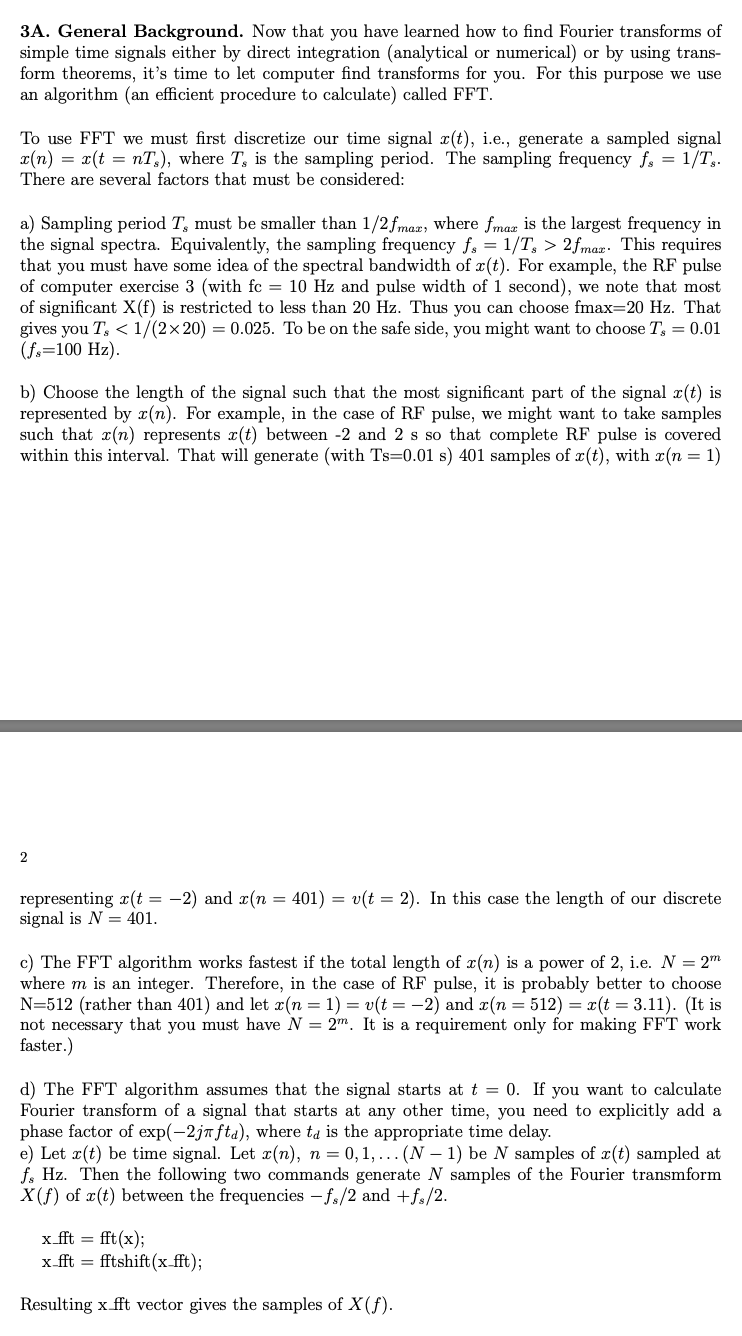
Please provide the MATLAB code for this with comments on the functions.
3A. General Background. Now that you have learned how to find Fourier transforms of simple time signals either by direct integration (analytical or numerical) or by using trans- form theorems, it's time to let computer find transforms for you. For this purpose we use an algorithm (an efficient procedure to calculate) called FFT. To use FFT we must first discretize our time signal z(t), i.e., generate a sampled signal (n) = x(t = nts), where T, is the sampling period. The sampling frequency fs = 1/T.. There are several factors that must be considered: a) Sampling period T, must be smaller than 1/2fmar, where [max is the largest frequency in the signal spectra. Equivalently, the sampling frequency fs = 1/T, > 2 fmar. This requires that you must have some idea of the spectral bandwidth of x(t). For example, the RF pulse of computer exercise 3 (with fc = 10 Hz and pulse width of 1 second), we note that most of significant X(f) is restricted to less than 20 Hz. Thus you can choose fmax=20 Hz. That gives you T, 2 fmar. This requires that you must have some idea of the spectral bandwidth of x(t). For example, the RF pulse of computer exercise 3 (with fc = 10 Hz and pulse width of 1 second), we note that most of significant X(f) is restricted to less than 20 Hz. Thus you can choose fmax=20 Hz. That gives you T,
Step by Step Solution
There are 3 Steps involved in it

Get step-by-step solutions from verified subject matter experts
 Study Help