







Question: Please provide the work process, appreciate. Mr Robert, an equity analyst, is considering the valuation of Dex Computer (DEX), which closed on 10 April 2017
Please provide the work process, appreciate.
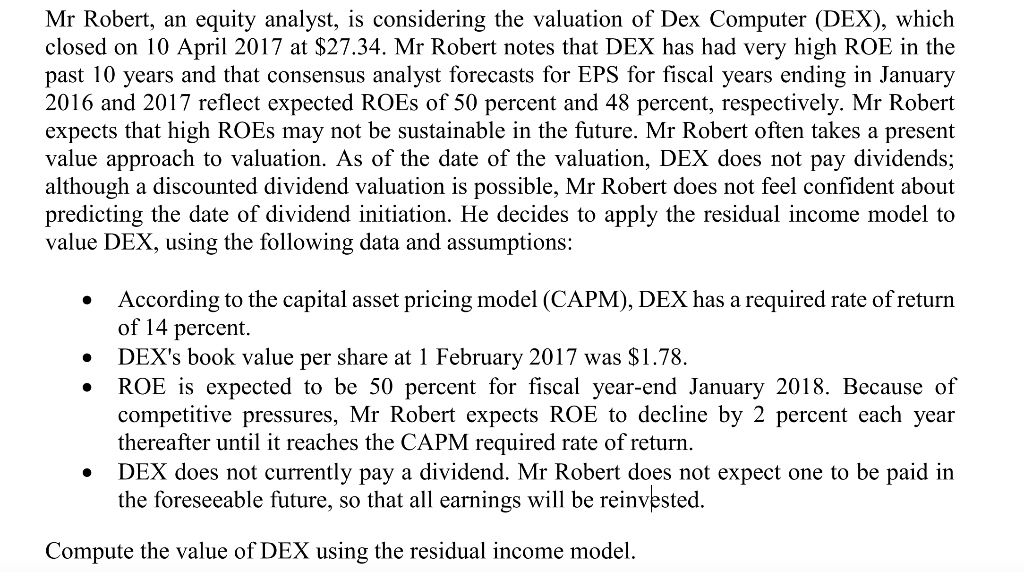
Mr Robert, an equity analyst, is considering the valuation of Dex Computer (DEX), which closed on 10 April 2017 at $27.34. Mr Robert notes that DEX has had very high ROE in the past 10 years and that consensus analyst forecasts for EPS for fiscal years ending in January 2016 and 2017 reflect expected ROEs of 50 percent and 48 percent, respectively. Mr Robert expects that high ROEs may not be sustainable in the future. Mr Robert often takes a present value approach to valuation. As of the date of the valuation, DEX does not pay dividends; although a discounted dividend valuation is possible, Mr Robert does not feel confident about predicting the date of dividend initiation. He decides to apply the residual income model to value DEX, using the following data and assumptions: . According to the capital asset pricing model (CAPM), DEX has a required rate of return of 14 percent. DEX's book value per share at 1 February 2017 was $1.78. ROE is expected to be 50 percent for fiscal year-end January 2018. Because of competitive pressures, Mr Robert expects ROE to decline by 2 percent each year thereafter until it reaches the CAPM required rate of return. DEX does not currently pay a dividend. Mr Robert does not expect one to be paid in the foreseeable future, so that all earnings will be reinvested. Compute the value of DEX using the residual income model. Mr Robert, an equity analyst, is considering the valuation of Dex Computer (DEX), which closed on 10 April 2017 at $27.34. Mr Robert notes that DEX has had very high ROE in the past 10 years and that consensus analyst forecasts for EPS for fiscal years ending in January 2016 and 2017 reflect expected ROEs of 50 percent and 48 percent, respectively. Mr Robert expects that high ROEs may not be sustainable in the future. Mr Robert often takes a present value approach to valuation. As of the date of the valuation, DEX does not pay dividends; although a discounted dividend valuation is possible, Mr Robert does not feel confident about predicting the date of dividend initiation. He decides to apply the residual income model to value DEX, using the following data and assumptions: . According to the capital asset pricing model (CAPM), DEX has a required rate of return of 14 percent. DEX's book value per share at 1 February 2017 was $1.78. ROE is expected to be 50 percent for fiscal year-end January 2018. Because of competitive pressures, Mr Robert expects ROE to decline by 2 percent each year thereafter until it reaches the CAPM required rate of return. DEX does not currently pay a dividend. Mr Robert does not expect one to be paid in the foreseeable future, so that all earnings will be reinvested. Compute the value of DEX using the residual income model
Step by Step Solution
There are 3 Steps involved in it

Get step-by-step solutions from verified subject matter experts
 Study Help