







Question: please put the letter for the question that you answer H. Describe formal partnering. Does mandatory partnering affect your position on any of the above

please put the letter for the question that you answer 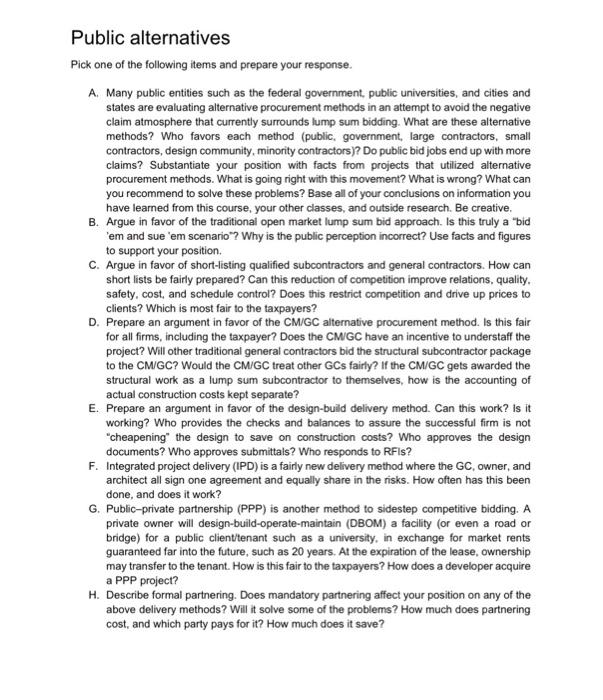
H. Describe formal partnering. Does mandatory partnering affect your position on any of the above delivery methods? Will it solve some of the problems? How much does partnering cost, and which party pays for it? How much does it save? Public alternatives Pick one of the following items and prepare your response. A. Many public entities such as the federal government, public universities, and cities and states are evaluating alternative procurement methods in an attempt to avoid the negative claim atmosphere that currently surrounds lump sum bidding. What are these alternative methods? Who favors each method (public, government, large contractors, small contractors, design community, minority contractors)? Do public bid jobs end up with more claims? Substantiate your position with facts from projects that utilized alternative procurement methods. What is going right with this movement? What is wrong? What can you recommend to solve these problems? Base all of your conclusions on information you have learned from this course, your other classes, and outside research. Be creative, B. Argue in favor of the traditional open market lump sum bid approach. Is this truly a "bid 'em and sue 'em scenario? Why is the public perception incorrect? Use facts and figures to support your position C. Argue in favor of short-listing qualified subcontractors and general contractors. How can short lists be fairly prepared? Can this reduction of competition improve relations, quality. safety, cost, and schedule control? Does this restrict competition and drive up prices to clients? Which is most fair to the taxpayers? D. Prepare an argument in favor of the CM/GC alternative procurement method. Is this fair for all firms, including the taxpayer? Does the CMGC have an incentive to understaff the project? Will other traditional general contractors bid the structural subcontractor package to the CM/GC? Would the CM/GC treat other GCs fairly? If the CM/GC gets awarded the structural work as a lump sum subcontractor to themselves, how is the accounting of actual construction costs kept separate? E. Prepare an argument in favor of the design-build delivery method. Can this work? Is it working? Who provides the checks and balances to assure the successful firm is not "cheapening the design to save on construction costs? Who approves the design documents? Who approves submittals? Who responds to RFIS? F. Integrated project delivery (IPD) is a fairly new delivery method where the GC, owner, and architect all sign one agreement and equally share in the risks. How often has this been done, and does it work? G. Public-private partnership (PPP) is another method to sidestep competitive bidding. A private owner will design-build-operate-maintain (DBOM) a facility (or even a road or bridge) for a public client'tenant such as a university, in exchange for market rents guaranteed far into the future, such as 20 years. At the expiration of the lease, ownership may transfer to the tenant. How is this fair to the taxpayers? How does a developer acquire a PPP project? H. Describe formal partnering. Does mandatory partnering affect your position on any of the above delivery methods? Will it solve some of the problems? How much does partnering cost, and which party pays for it? How much does it save Step by Step Solution
There are 3 Steps involved in it
1 Expert Approved Answer
Step: 1 Unlock

Question Has Been Solved by an Expert!
Get step-by-step solutions from verified subject matter experts
Step: 2 Unlock
Step: 3 Unlock
 Study Help