







Question: Please question in the image below. Below that, there are two more images with the equations that are referenced. PLEASE help!! THankyou!!!!! First, consider one-step-ahead
Please question in the image below. Below that, there are two more images with the equations that are referenced. PLEASE help!! THankyou!!!!!
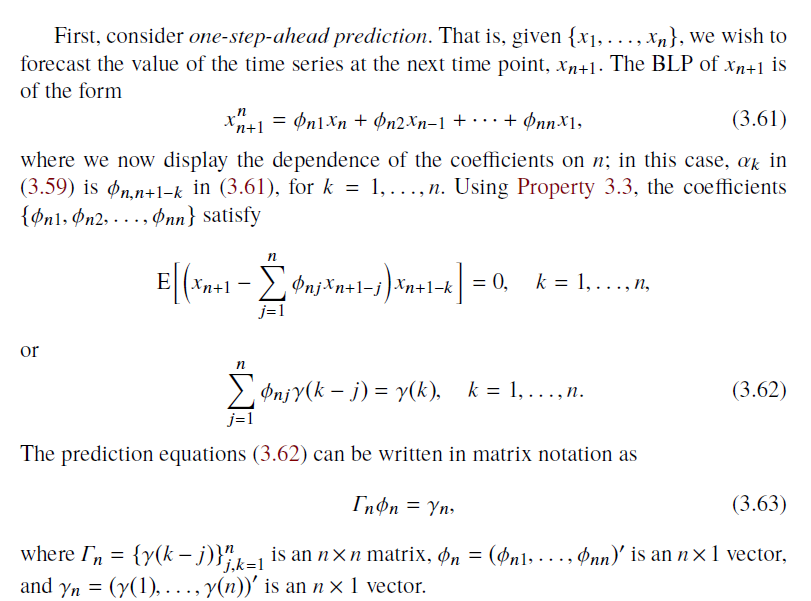
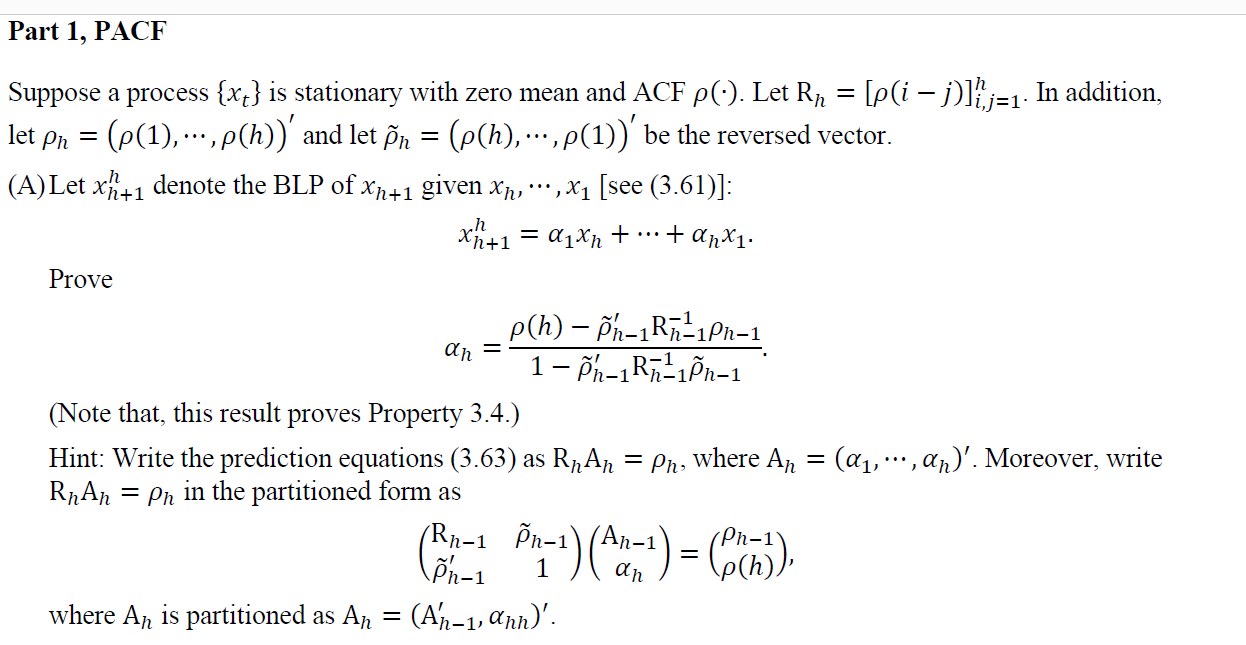
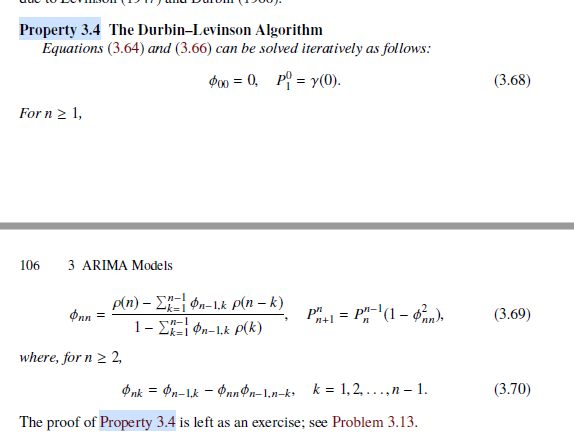
First, consider one-step-ahead prediction. That is, given {x1, . .., Xn), we wish to forecast the value of the time series at the next time point, Xn+1. The BLP of Xn+1 is of the form *n+1 = OnlXn + Pn2Xn-1+ . . . + pan*1, (3.61) where we now display the dependence of the coefficients on n; in this case, ax in (3.59) is on,n+1-k in (3.61), for k = 1, ..., n. Using Property 3.3, the coefficients {on1, pn2, . . ., dnn } satisfy E| ( In+ 1 - _ Dnj *n+1-j ) In+1-k = 0, k = 1,..., n, j=1 or n onjy ( k - j) = y(k), k = 1,...,n. (3.62) 1=1 The prediction equations (3.62) can be written in matrix notation as Inon = Vn, (3.63) where I'm = {y(k - j) )" is an nxn matrix, on = (Pal, . . ., Inn)' is an n x 1 vector, and yn = (y(1). . . ., y(n))' is an n X 1 vector.Part 1, PACF Suppose a process {x } is stationary with zero mean and ACF p(.). Let Rn = [p(i - ))],j=1. In addition, let Ph = (p(1), ..., p(h) ) and let pn = (p(h), ..., p(1) ) be the reversed vector. (A) Let x7+ 1 denote the BLP of *n+ 1 given Xn, ."., X1 [see (3.61)]: Xh+1 = a1Xnt ... + anx1. Prove p(h) - Ph-1R7-1Pn-1 an 1 - Ph-1RR-1Pn-1 (Note that, this result proves Property 3.4.) Hint: Write the prediction equations (3.63) as RnAn = Pn, where An = (a1, ..., an)'. Moreover, write RnAn = Pn in the partitioned form as Rn-1 Pn-1 'Ph-1 Ph-1 1 ( An-1 ) = (p(h)) an where An is partitioned as An = (An-1, ann)'.Property 3.4 The Durbin-Levinson Algorithm Equations (3.64) and (3.66) can be solved iteratively as follows: doo = 0. P. = y(0). (3.68) For n 2 1, 106 3 ARIMA Models p(n) - In- Pan = 2k=1 0n-1.k p(n - k) 1 - EX-1 K= 1 0n-1.K P (k) " (1 - dan); (3.69) where, for n 2 2, Pak = $n-1.k - Dan0n-In-ks k = 1,2. ...,n- 1. (3.70) The proof of Property 3.4 is left as an exercise; see Problem 3.13
Step by Step Solution
There are 3 Steps involved in it

Get step-by-step solutions from verified subject matter experts
 Study Help