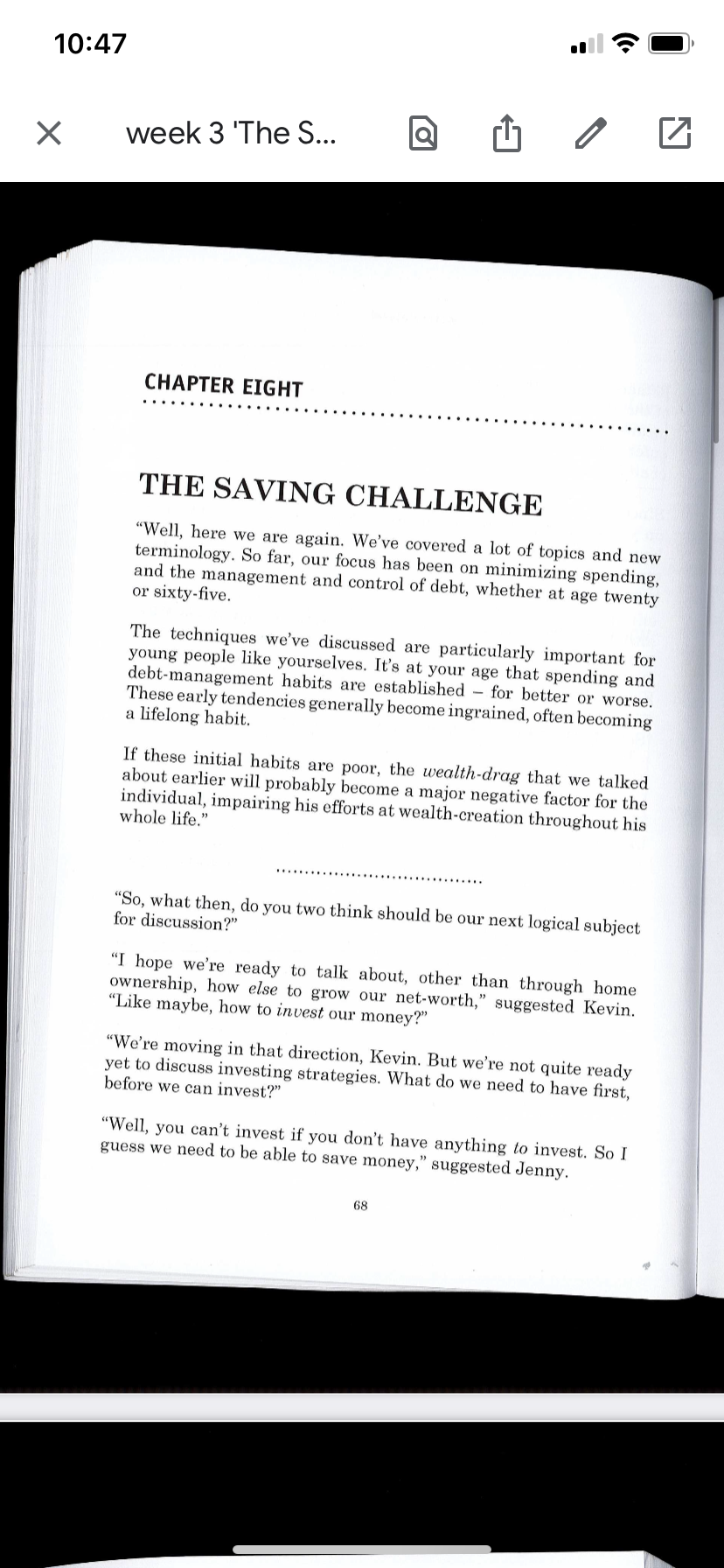
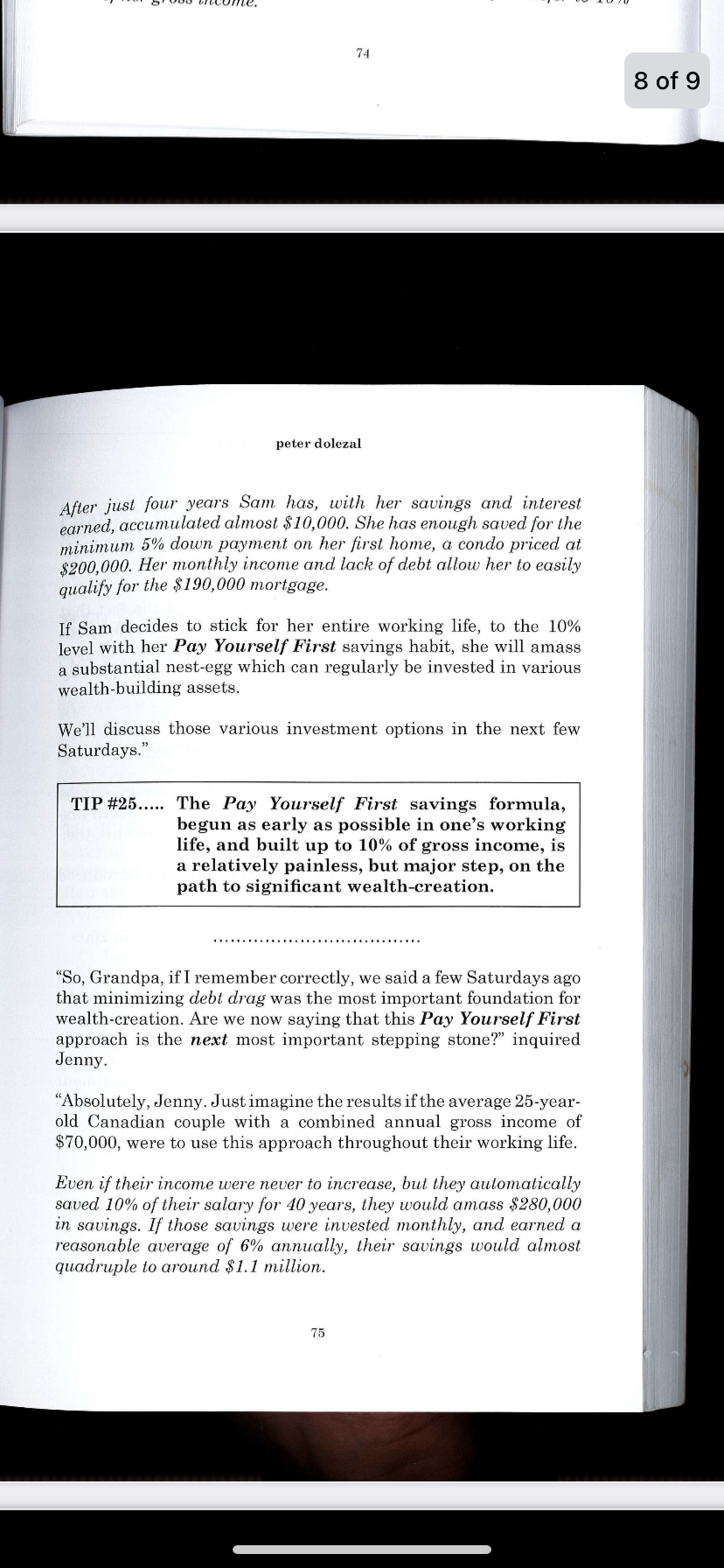
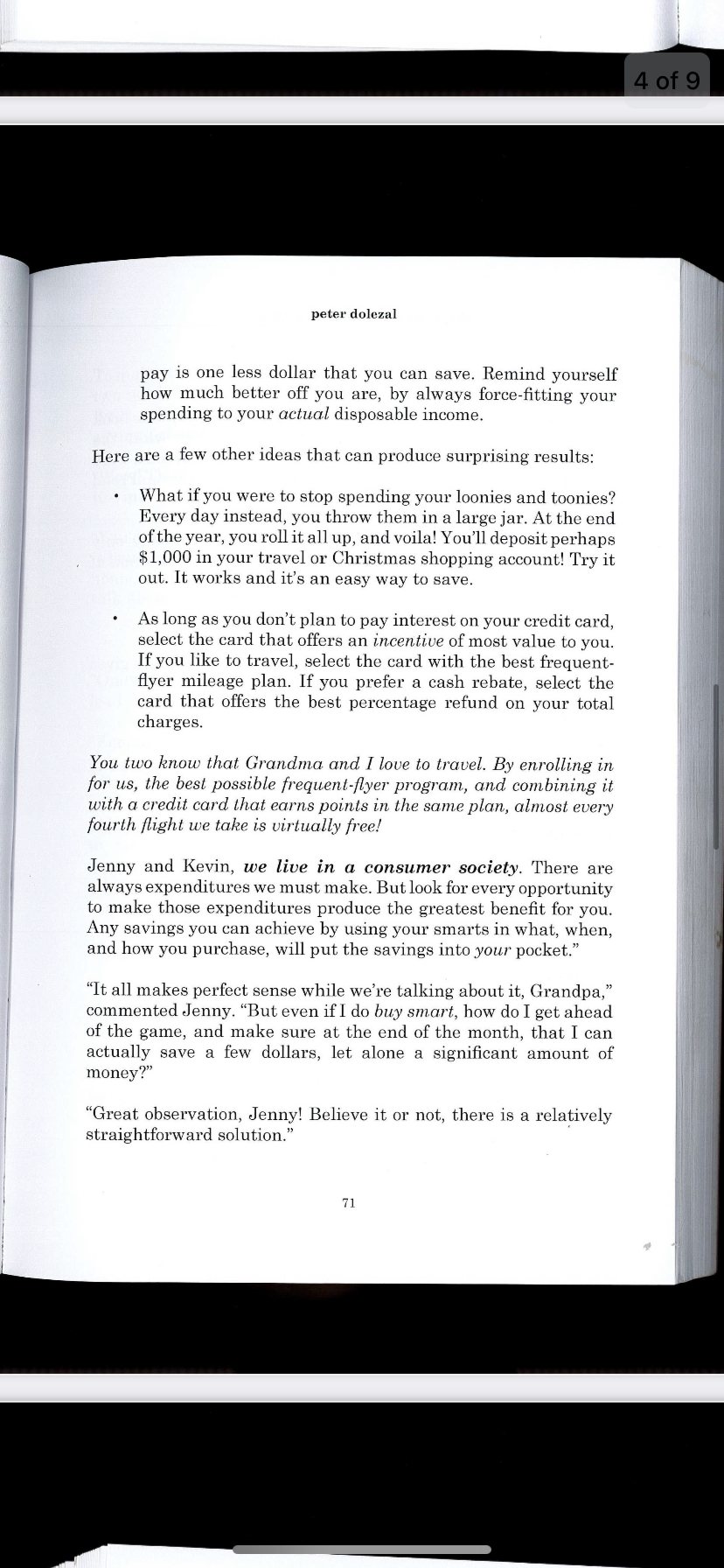
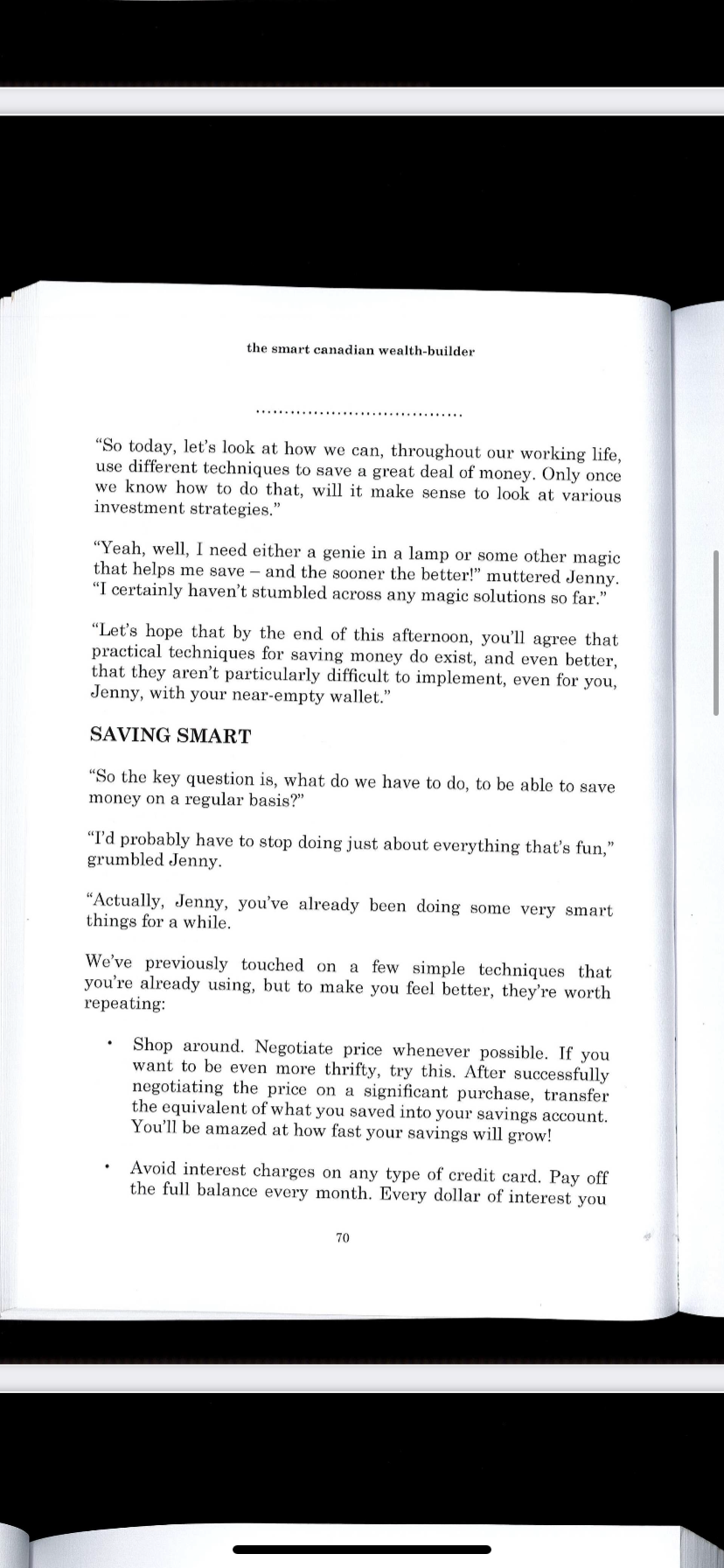
Question: Please read a short chapterTHE SAVING CHALLENGEform our bookThe Smart Canadian Wealth BuilderbyPeter Dolezal. What is it about? What can you understand and learn from
Please read a short chapterTHE SAVING CHALLENGEform our bookThe Smart Canadian Wealth BuilderbyPeter Dolezal.
What is it about? What can you understand and learn from it? Please choose the most important information,summarize it in 1-2 sentences only and submit your answer.
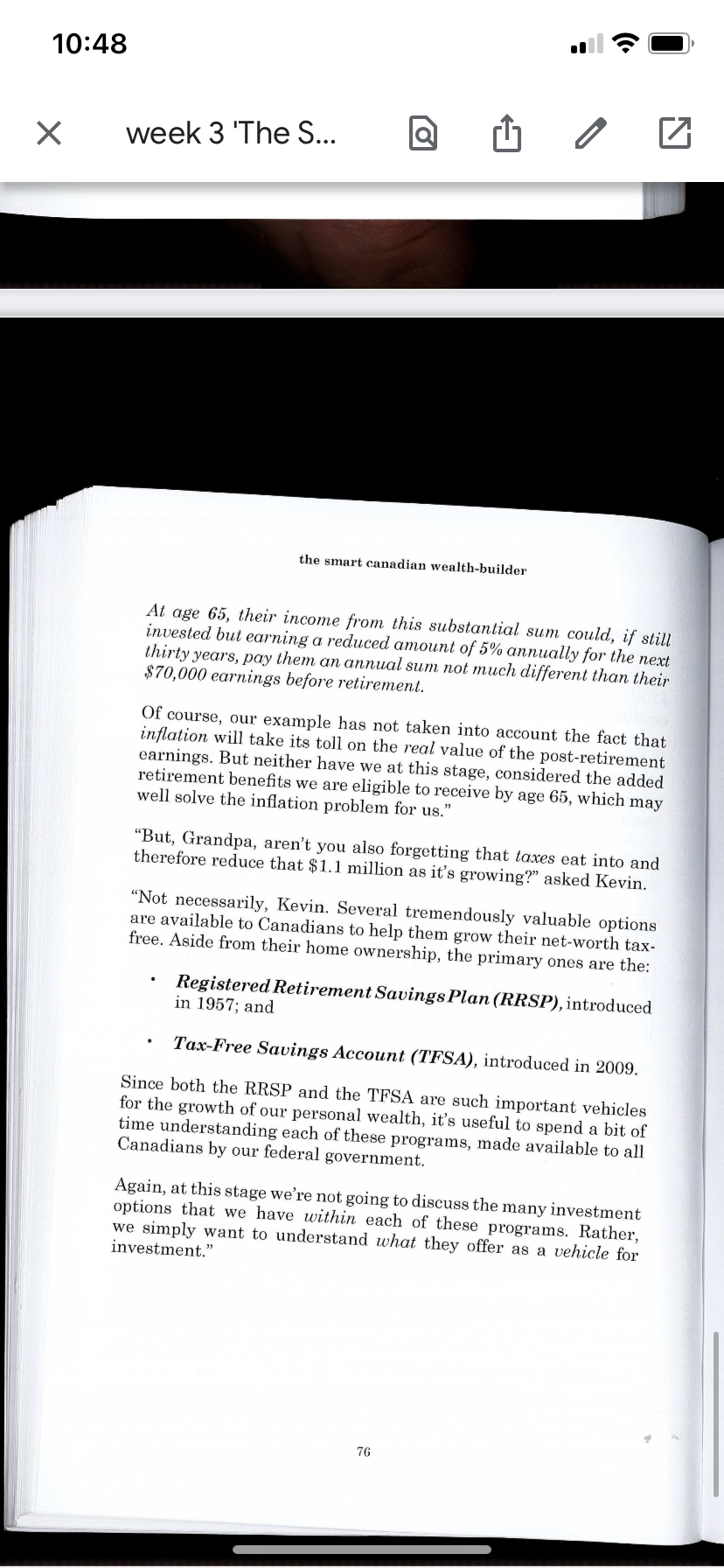
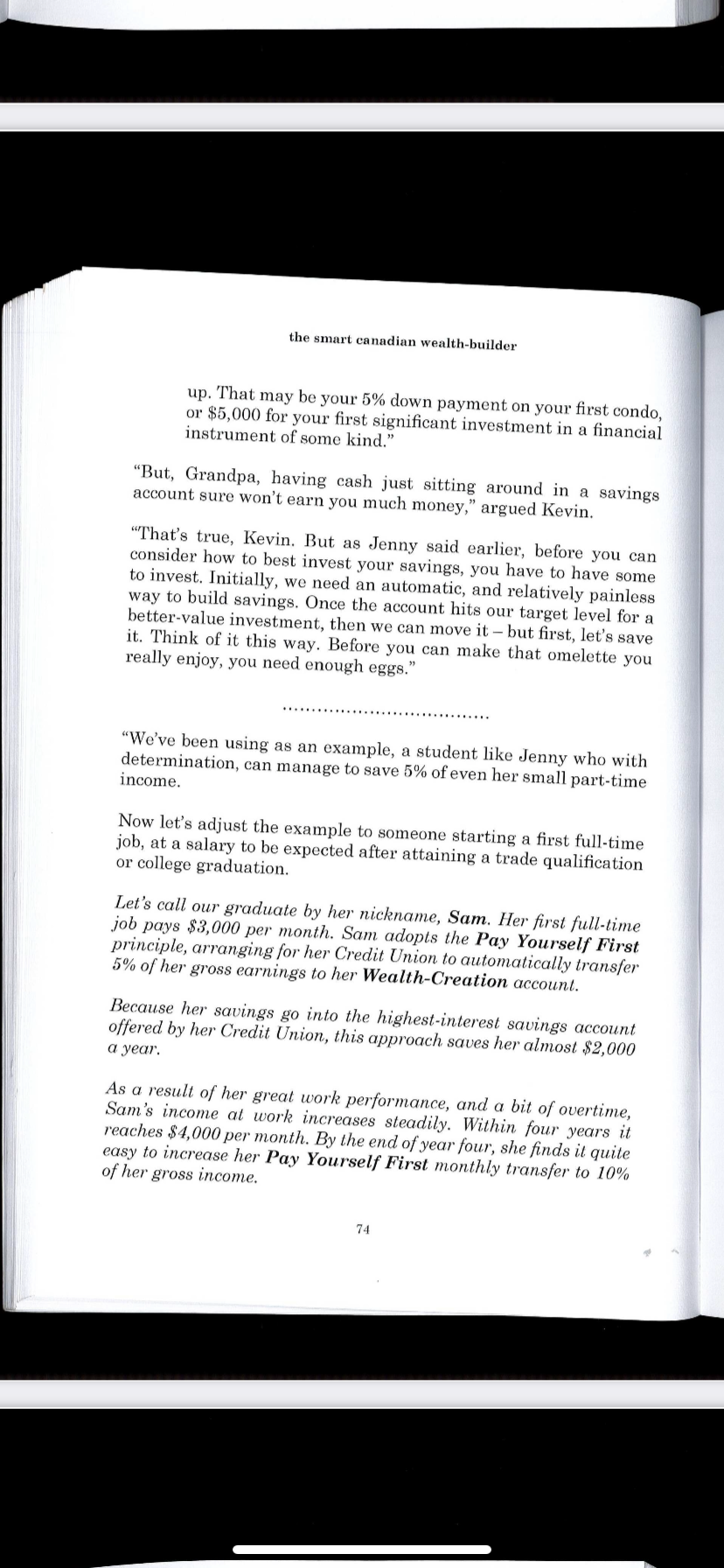
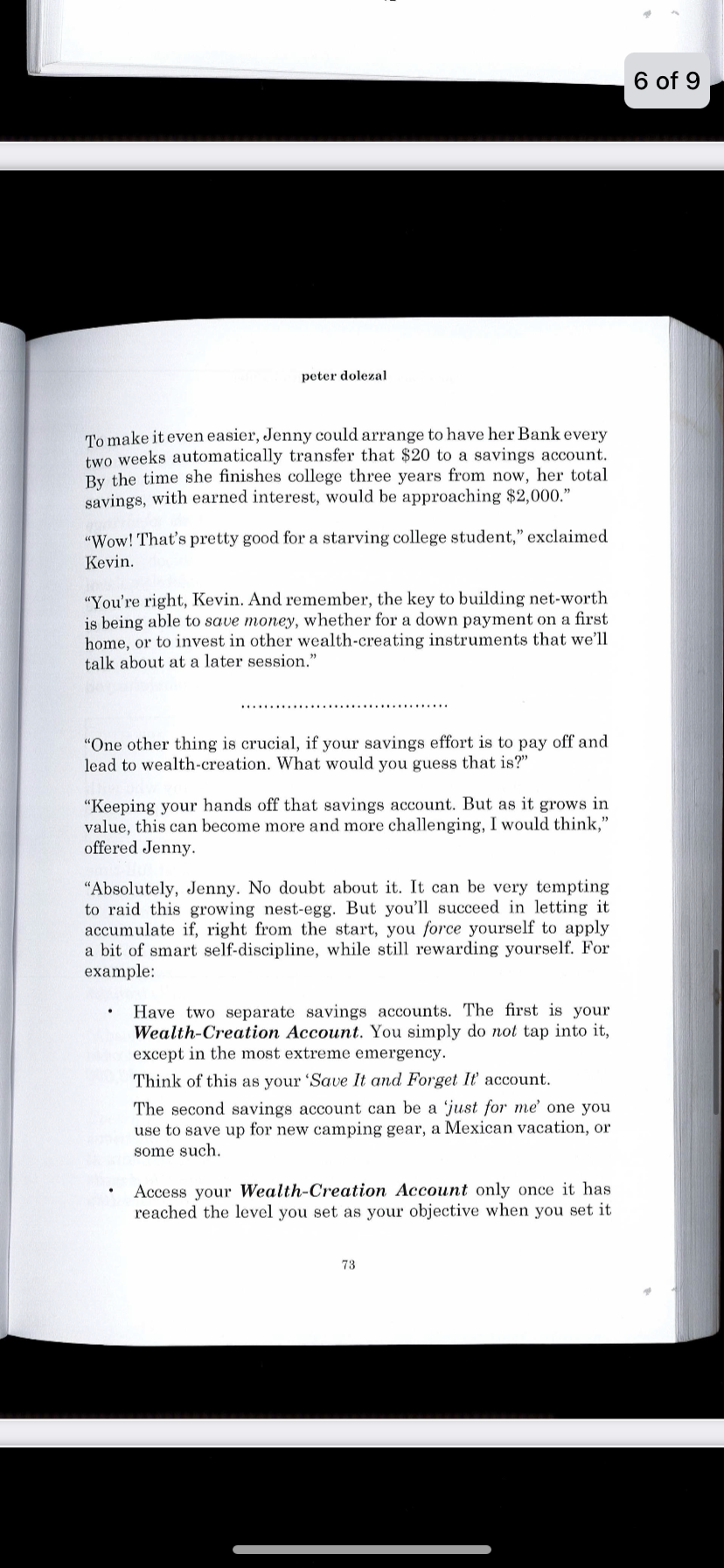
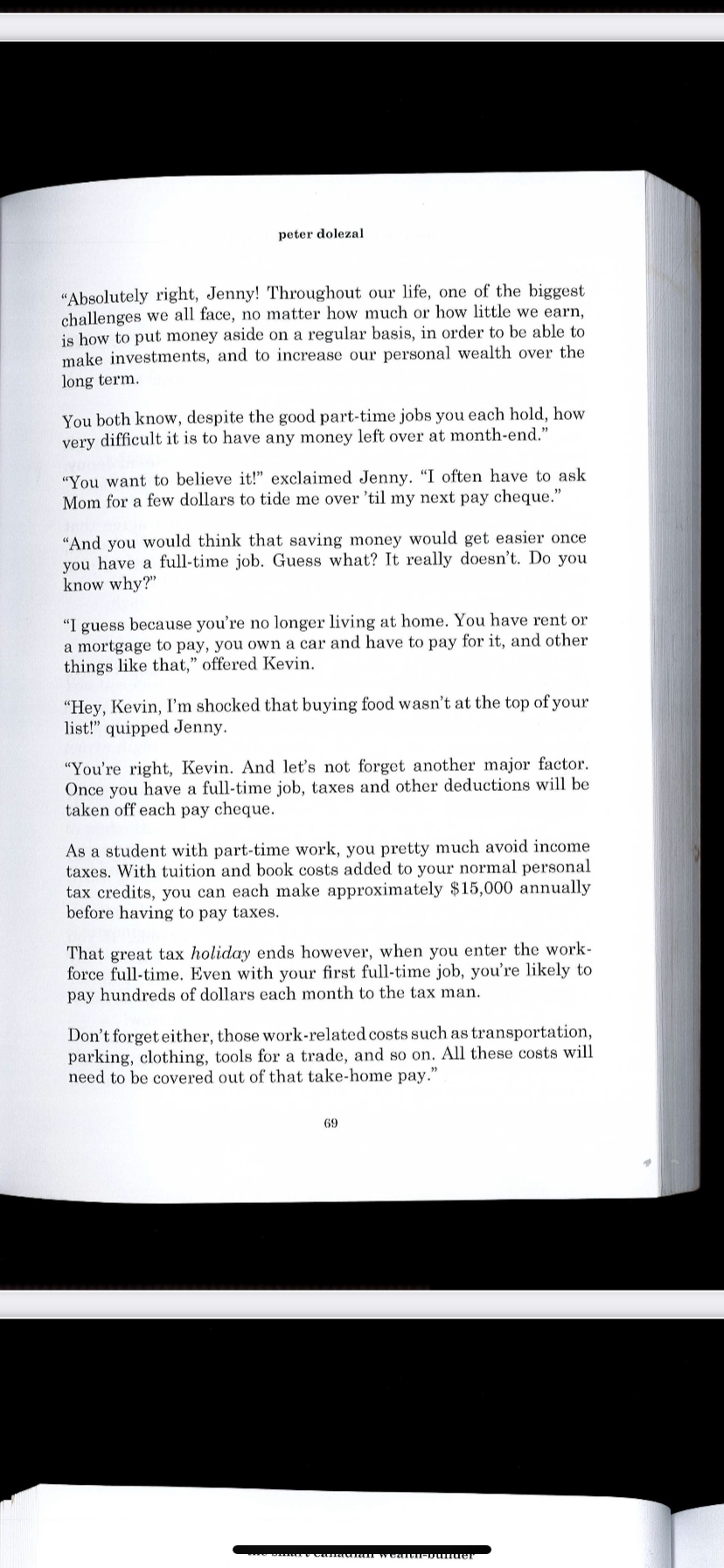
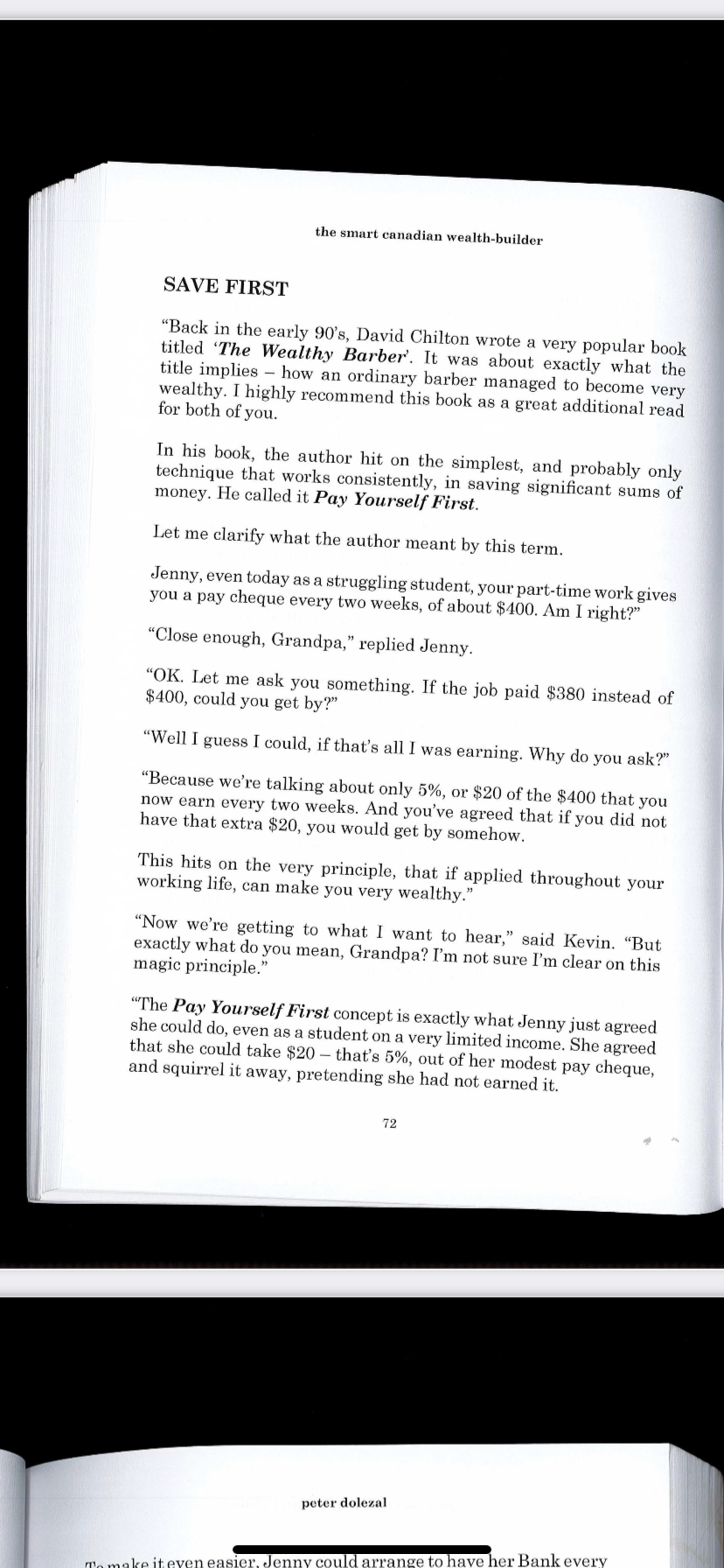
10:48 X week 3 'The S... the smart canadian wealth-builder At age 65, their income from this substantial sum could, if still invested but earning a reduced amount of 5% annually for the next thirty years, pay them an annual sum not much different than their $70,000 earnings before retirement. Of course, our example has not taken into account the fact that inflation will take its toll on the real value of the post-retirement earnings. But neither have we at this stage, considered the added retirement benefits we are eligible to receive by age 65, which may well solve the inflation problem for us." "But, Grandpa, aren't you also forgetting that taxes eat into and therefore reduce that $1.1 million as it's growing?" asked Kevin. "Not necessarily, Kevin. Several tremendously valuable options are available to Canadians to help them grow their net-worth tax- free. Aside from their home ownership, the primary ones are the: Registered Retirement Savings Plan (RRSP), introduced in 1957; and . Tax-Free Savings Account (TFSA), introduced in 2009. Since both the RRSP and the TFSA are such important vehicles for the growth of our personal wealth, it's useful to spend a bit of time understanding each of these programs, made available to all Canadians by our federal government. Again, at this stage we're not going to discuss the many investment options that we have within each of these programs. Rather, we simply want to understand what they offer as a vehicle for investment." 76the smart canadian wealth-builder up. That may be your 5% down payment on your first condo, or $5,000 for your first significant investment in a financial instrument of some kind." 'But, Grandpa, having cash just sitting around in a savings account sure won't earn you much money," argued Kevin. "That's true, Kevin. But as Jenny said earlier, before you can consider how to best invest your savings, you have to have some to invest. Initially, we need an automatic, and relatively painless way to build savings. Once the account hits our target level for a better-value investment, then we can move it - but first, let's save it. Think of it this way. Before you can make that omelette you really enjoy, you need enough eggs." "We've been using as an example, a student like Jenny who with determination, can manage to save 5% of even her small part-time income. Now let's adjust the example to someone starting a first full-time job, at a salary to be expected after attaining a trade qualification or college graduation. Let's call our graduate by her nickname, Sam. Her first full-time job pays $3,000 per month. Sam adopts the Pay Yourself First principle, arranging for her Credit Union to automatically transfer 5% of her gross earnings to her Wealth-Creation account. Because her savings go into the highest-interest savings account offered by her Credit Union, this approach saves her almost $2,000 a year. As a result of her great work performance, and a bit of overtime, Sam's income at work increases steadily. Within four years it reaches $4,000 per month. By the end of year four, she finds it quite easy to increase her Pay Yourself First monthly transfer to 10% of her gross income. 746 of 9 peter dolezal To make it even easier, Jenny could arrange to have her Bank every two weeks automatically transfer that $20 to a savings account. By the time she finishes college three years from now, her total savings, with earned interest, would be approaching $2,000." "Wow! That's pretty good for a starving college student," exclaimed Kevin. "You're right, Kevin. And remember, the key to building net-worth is being able to save money, whether for a down payment on a first home, or to invest in other wealth-creating instruments that we'll talk about at a later session." "One other thing is crucial, if your savings effort is to pay off and lead to wealth-creation. What would you guess that is?" "Keeping your hands off that savings account. But as it grows in value, this can become more and more challenging, I would think," offered Jenny. "Absolutely, Jenny. No doubt about it. It can be very tempting to raid this growing nest-egg. But you'll succeed in letting it accumulate if, right from the start, you force yourself to apply a bit of smart self-discipline, while still rewarding yourself. For example: Have two separate savings accounts. The first is your Wealth-Creation Account. You simply do not tap into it, except in the most extreme emergency. Think of this as your 'Save It and Forget It' account. The second savings account can be a 'just for me' one you use to save up for new camping gear, a Mexican vacation, or some such. Access your Wealth-Creation Account only once it has reached the level you set as your objective when you set it 73peter dolezal "Absolutely right, Jenny! Throughout our life, one of the biggest challenges we all face, no matter how much or how little we earn, is how to put money aside on a regular basis, in order to be able to make investments, and to increase our personal wealth over the long term. You both know, despite the good part-time jobs you each hold, how very difficult it is to have any money left over at month-end." "You want to believe it!" exclaimed Jenny. "I often have to ask Mom for a few dollars to tide me over 'til my next pay cheque." "And you would think that saving money would get easier once you have a full-time job. Guess what? It really doesn't. Do you know why?" "I guess because you're no longer living at home. You have rent or a mortgage to pay, you own a car and have to pay for it, and other things like that," offered Kevin. "Hey, Kevin, I'm shocked that buying food wasn't at the top of your list!" quipped Jenny. "You're right, Kevin. And let's not forget another major factor. Once you have a full-time job, taxes and other deductions will be taken off each pay cheque. As a student with part-time work, you pretty much avoid income taxes. With tuition and book costs added to your normal personal tax credits, you can each make approximately $15,000 annually before having to pay taxes. That great tax holiday ends however, when you enter the work- force full-time. Even with your first full-time job, you're likely to pay hundreds of dollars each month to the tax man. Don't forget either, those work-related costs such as transportation, parking, clothing, tools for a trade, and so on. All these costs will need to be covered out of that take-home pay." 69 IT weaten-bunder10:47 X week 3 'The S... CHAPTER EIGHT . . . . . . . . . . . . . THE SAVING CHALLENGE "Well, here we are again. We've covered a lot of topics and new terminology. So far, our focus has been on minimizing spending, and the management and control of debt, whether at age twenty or sixty-five. The techniques we've discussed are particularly important for young people like yourselves. It's at your age that spending and debt-management habits are established - for better or worse. These early tendencies generally become ingrained, often becoming a lifelong habit. If these initial habits are poor, the wealth-drag that we talked about earlier will probably become a major negative factor for the individual, impairing his efforts at wealth-creation throughout his whole life." ..... .... "So, what then, do you two think should be our next logical subject for discussion?" "I hope we're ready to talk about, other than through home ownership, how else to grow our net-worth," suggested Kevin. "Like maybe, how to invest our money?" "We're moving in that direction, Kevin. But we're not quite ready yet to discuss investing strategies. What do we need to have first, before we can invest?" "Well, you can't invest if you don't have anything to invest. So I guess we need to be able to save money," suggested Jenny. 6874 8 of 9 peter dolezal After just four years Sam has, with her savings and interest earned, accumulated almost $10,000. She has enough saved for the minimum 5% down payment on her first home, a condo priced at $200,000. Her monthly income and lack of debt allow her to easily qualify for the $190,000 mortgage. If Sam decides to stick for her entire working life, to the 10% level with her Pay Yourself First savings habit, she will amass a substantial nest-egg which can regularly be invested in various wealth-building assets. We'll discuss those various investment options in the next few Saturdays." TIP #25..... The Pay Yourself First savings formula, begun as early as possible in one's working life, and built up to 10% of gross income, is a relatively painless, but major step, on the path to significant wealth-creation. "So, Grandpa, if I remember correctly, we said a few Saturdays ago that minimizing debt drag was the most important foundation for wealth-creation. Are we now saying that this Pay Yourself First approach is the next most important stepping stone?" inquired Jenny. "Absolutely, Jenny. Just imagine the results if the average 25-year- old Canadian couple with a combined annual gross income of $70,000, were to use this approach throughout their working life. Even if their income were never to increase, but they automatically saved 10% of their salary for 40 years, they would amass $280,000 in savings. If those savings were invested monthly, and earned a reasonable average of 6% annually, their savings would almost quadruple to around $1.1 million. 754 of 9 peter dolezal pay is one less dollar that you can save. Remind yourself how much better off you are, by always force-fitting your spending to your actual disposable income. Here are a few other ideas that can produce surprising results: . What if you were to stop spending your loonies and toonies? Every day instead, you throw them in a large jar. At the end of the year, you roll it all up, and voila! You'll deposit perhaps $1,000 in your travel or Christmas shopping account! Try it out. It works and it's an easy way to save. As long as you don't plan to pay interest on your credit card, select the card that offers an incentive of most value to you. If you like to travel, select the card with the best frequent- flyer mileage plan. If you prefer a cash rebate, select the card that offers the best percentage refund on your total charges. You two know that Grandma and I love to travel. By enrolling in for us, the best possible frequent-flyer program, and combining it with a credit card that earns points in the same plan, almost every fourth flight we take is virtually free! Jenny and Kevin, we live in a consumer society. There are always expenditures we must make. But look for every opportunity to make those expenditures produce the greatest benefit for you. Any savings you can achieve by using your smarts in what, when, and how you purchase, will put the savings into your pocket." "It all makes perfect sense while we're talking about it, Grandpa," commented Jenny. "But even if I do buy smart, how do I get ahead of the game, and make sure at the end of the month, that I can actually save a few dollars, let alone a significant amount of money?" "Great observation, Jenny! Believe it or not, there is a relatively straightforward solution." 71the smart canadian wealth-builder "So today, let's look at how we can, throughout our working life, use different techniques to save a great deal of money. Only once we know how to do that, will it make sense to look at various investment strategies." "Yeah, well, I need either a genie in a lamp or some other magic that helps me save - and the sooner the better!" muttered Jenny. "I certainly haven't stumbled across any magic solutions so far." "Let's hope that by the end of this afternoon, you'll agree that practical techniques for saving money do exist, and even better, that they aren't particularly difficult to implement, even for you, Jenny, with your near-empty wallet." SAVING SMART "So the key question is, what do we have to do, to be able to save money on a regular basis?" "I'd probably have to stop doing just about everything that's fun," grumbled Jenny. "Actually, Jenny, you've already been doing some very smart things for a while. We've previously touched on a few simple techniques that you're already using, but to make you feel better, they're worth repeating: . Shop around. Negotiate price whenever possible. If you want to be even more thrifty, try this. After successfully negotiating the price on a significant purchase, transfer the equivalent of what you saved into your savings account. You'll be amazed at how fast your savings will grow! Avoid interest charges on any type of credit card. Pay off the full balance every month. Every dollar of interest you 70the smart canadian wealth-builder SAVE FIRST "Back in the early 90's, David Chilton wrote a very popular book titled 'The Wealthy Barber'. It was about exactly what the title implies - how an ordinary barber managed to become very wealthy. I highly recommend this book as a great additional read for both of you. In his book, the author hit on the simplest, and probably only technique that works consistently, in saving significant sums of money. He called it Pay Yourself First. Let me clarify what the author meant by this term. Jenny, even today as a struggling student, your part-time work gives you a pay cheque every two weeks, of about $400. Am I right?" "Close enough, Grandpa," replied Jenny. "OK. Let me ask you something. If the job paid $380 instead of $400, could you get by?" "Well I guess I could, if that's all I was earning. Why do you ask?" "Because we're talking about only 5%, or $20 of the $400 that you now earn every two weeks. And you've agreed that if you did not have that extra $20, you would get by somehow. This hits on the very principle, that if applied throughout your working life, can make you very wealthy." "Now we're getting to what I want to hear," said Kevin. "But exactly what do you mean, Grandpa? I'm not sure I'm clear on this magic principle." "The Pay Yourself First concept is exactly what Jenny just agreed she could do, even as a student on a very limited income. She agreed that she could take $20 - that's 5%, out of her modest pay cheque, and squirrel it away, pretending she had not earned it. 72 peter dolezal arrange to have her Bank every asier, Jenny cou
Step by Step Solution
There are 3 Steps involved in it
1 Expert Approved Answer
Step: 1 Unlock
Question Has Been Solved by an Expert!
Get step-by-step solutions from verified subject matter experts
Step: 2 Unlock
Step: 3 Unlock
Students Have Also Explored These Related Finance Questions!









 Study Help