Please read all and provide answers. Thank you.
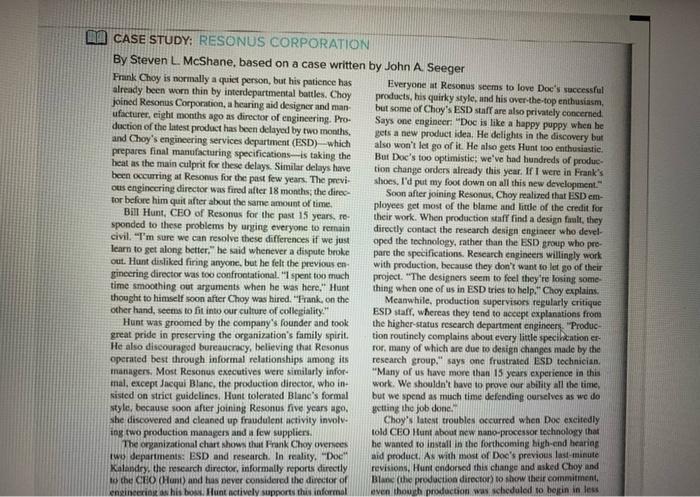
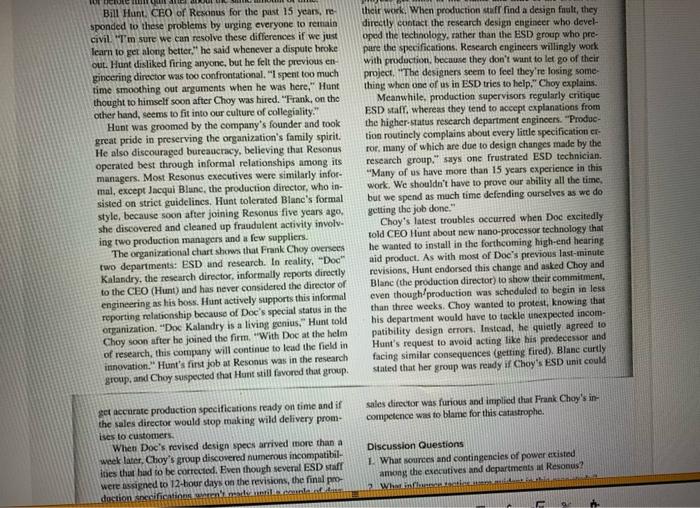
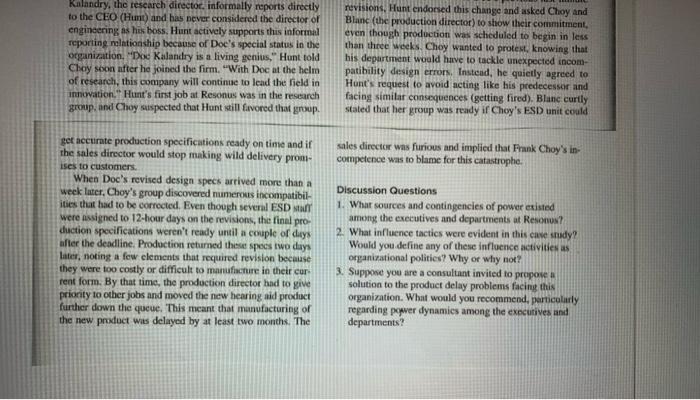
CASE STUDY: RESONUS CORPORATION By Steven L. McShane, based on a case written by John A. Seeger Frank Choy is normally a quiet person, but his patience has Everyone at Resonus seems to love Doc's successful already been worn thin by interdepartmental battles. Choy products, his quirky style, and his over-the-top enthusiasm, joined Resonus Corporation, a hearing aid designer and man but some of Choy's ESD staff are also privately concerned. ufacturer, eight months ago as director of engineering. Pro- Says one engineer: "Doc is like a happy puppy when be duction of the latest product has been delayed by two months gets a new product idea. He delights in the discovery but and Choy's engineering services department (ESD) which also won't let go of it. He also gets Hunt too enthusiastic, prepares final manufacturing specifications-is taking the But Doc's too optimistic, we've had hundreds of produc beat as the main culprit for these delays. Similar delays have tion change orders already this year. If I were in Frank's been occurring at Resons for the past few years. The previ shoes, I'd put my foot down on all this new development." ous engineering director was fired after 18 months, the direc Soon after joining Resonus, Choy realized that ESD em- tor before him quit after about the same amount of time. ployees get most of the blame and little of the credit for Bill Hunt, CEO of Resonus for the past 15 years. re- their work. When production stafl find a design fault, they sponded to these problems by wing everyone to remain directly contact the research design engineer who des civil. "I'm sure we can resolve these differences if we just oped the technology, rather than the ESD group who pre- learn to get along better," he said whenever a dispute broke pare the specifications Research engineers willingly work out. Hunt disliked firing anyone, but he felt the previous en with production, because they don't want to let go of their gineering director was too confrontational. "I spent too much project. The designers seem to feel they're losing some time smoothing out arguments when he was here." Hunt thing when one of us in ESD tries to help. Choy explains. thought to himself soon after Choy was hired. "Frank on the Meanwhile, production supervisors regularly critique other hand, seems to fit into our culture of collegiality ESD staff, whereas they tend to accept explanations from Hunt was groomed by the company's founder and took the higher status research department engineers Produc great pride in preserving the organization's family spirit. tion routinely complains about every little specintationer He also discouragod bureaucracy, believing that Resonus for, many of which are due to design changes made by the operated best through informal relationships among its research group," says one frustrated ESD technician managers. Most Resonus executives were similarly infor "Many of us have more than 15 years experience in this mal, except Jacqui Blanc, the production director, who in- work. We shouldn't have to prove our ability all the time, sisted on strict guidelincs. Hunt tolerated Blane's formal but we spend as much time defending ourselves as we do style, because soon after joining Resonus five years ago, getting the job done. she discovered and cleaned up fraudulent activity involv. Choy's latest troubles occurred when Doe excitedly ing two production managers and a few suppliers. told CEO Hunt about new nano-processor technology that The organizational chart shows that Frank Choy oversees he wanted to install in the forthcoming high-end hearing two departments ESD and research. In reality. "Doc" aid product. As with most of Doc's previous last-minute Kalandry, the research director, informally reports directly revisions, Hunt endorsed this change and asked Choy and to the CEO (Hunt) and has never considered the director of Blane (the production director) to show their commitment engineerint as his bow. Hunt actively supports this informal even though production was scheduled to begin in less CE Bill Hunt, CEO of Rescnus for the past 15 years, re sponded to these problems by urging everyone to remain civil. I'm sure we can resolve these differences if we just learn to get along better," he said whenever a dispute broke out. Hunt disliked firing anyone, but he felt the previous en- gineering director was too confrontational. "I spent too much time smoothing out arguments when he was here," Hunt thought to himself soon after Choy was hired. "Frank, on the other hand, seems to fit into our culture of collegiality." Hunt was groomed by the company's founder and took great pride in preserving the organization's family spirit. He also discouraged bureaucracy, believing that Resonus operated best through informal relationships among its managers. Most Resonus executives were similarly infor- mal, except Jacqui Blunc, the production director, who in sisted on strict guidelines. Hunt tolerated Blanc's formal style, because soon after joining Resonus five years ago, she discovered and cleaned up fraudulent activity involv. ing two production managers and a few suppliers. The organizational chart shows that Frank Choy oversees two departments: ESD and research. In reality. "Doc" Kalandry, the research director, informally reports directly to the CEO (Hunt) and has never considered the director of engineering as his boss. Hunt actively supports this informal reporting relationship because of Doc's special status in the organization. "Doc Kalandry a living genius, Hunt told Choy soon after he joined the firm, "With Doc at the helm of research, this company will continue to lead the field in innovation." Hunt's first job at Resonus was in the research group, and Choy suspected that Hunt still favored the group their work. When production staff find a design fralt, they directly contact the research design engineer who devel- oped the technology, rather than the ESD group who pre- pare the specifications Research engineers willingly work with production, because they don't want to let go of their project. The designers seem to feel they're losing some- thing when one of us in ESD tries to help." Choy explains. Meanwhile, production supervisors regularly critique ESD stall, whereas they tend to accept explanations from the higher status rescarch department engineers. "Produc tion routinely complains about every little specification et ror, many of which are due to design changes made by the research group." says one frustrated ESD technician. "Many of us have more than 15 years experience in this work. We shouldn't have to prove our ability all the time, but we spend as much time defending ourselves as we do getting the job done." Choy's latest troubles occurred when Doc excitedly told CEO Hunt about new nano-processor technology that he wanted to install in the forthcoming high-end hearing aid product. As with most of Doe's previous last-minute revisions, Hunt endorsed this change and asked Chory and Blanc (the production director) to show their commitment, even though production was scheduled to begin in less than three weeks. Choy wanted to protest, knowing that his department would have to tackle unexpected incom- patibility design errors. Instead, he quietly agreed to Hunt's request to avoid acting like his predecessor und facing similar consequences (getting fired). Blane curtly stated that her group was ready if Choy's ESD unit could sales director was furious and implied that Frank Choy's in- competence was to blame for this catastrophe. get accurate production specifications ready on time and if the sales director would stop making wild delivery prom- ises to customers When Doe's revised design specs arrived more than a week later, Choy's group discovered numerous incompatibil- ities that had to be corrected. Even though several ESD staff were assigned to 12-hour days on the revisions, the final pro doction specification by con el Discussion Questions 1. What sources and contingencies of power existed among the executives and departments at Resonus? Whichte Kalandry, the research director informally reports directly to the CEO (Hunt) and has never considered the director of engineering as his boss. Hunt actively supports this informal reporting relationship because of Doe's special status in the Organization. Do Kalandry is a living genius, Hunt told Choy soon after he joined the firm. "With Doc at the helm of research, this company will continue to lead the field in inntation. Hunt's first job at Resonus was in the research group, and Choy suspected that Hunt still favored that group. revisions, Hunt endorsed this change and asked Choy and Blanc (the production director) to show their commitment, even though production was scheduled to begin in less than three weeks, Choy wanted to protest, knowing that his department would have to tackle unexpected incom- patibility design errors. Instead, he quietly agreed to Hunt's request to avoid acting like his predecessor and facing similar consequences (getting fired). Blanc curtly stated that her group was ready if Choy's ESD unit could sales director was furious and implied that Frank Choy's in- competence was to blame for this catastrophe. get accurate production specifications ready on time and it the sales director would stop making wild delivery proui- ises to customers When Doc's revised design specs arrived more than a week later, Choy's group discovered numerous incompatibil- ities that had to be corrected. Even though several ESD were assigned to 12-hour days on the revisions, the final pro duction specifications weren't ready until a couple of days after the deadline Production returned these specs two days Later, noting a few elements that required revision because they were too costly or difficult to manufacture in their cur rent form. By that time, the production director had to give priority to other jobs and moved the new hearing aid product further down the queue. This meant that manufacturing of the new product wils delayed by at least two months. The Discussion Questions 1. What sources and contingencies of power existed among the executives and departments at Reson? 2. What influence tactics were evident in this case shady? Would you define any of these influence activities as organizational politics? Why or why not? 3. Suppose you are a consultant invited to propose solution to the product delay problems facing this organization. What would you recommend, particolarly regarding pgaver dynamics among the executives and departments