Question: please read and answer questions Practicing International Management Case 177 CHAPTER 6. POUTICAL ECONOMY OF TRADE Down with Dumping ATO Agrees to Probe EU Dots
please read and answer questions
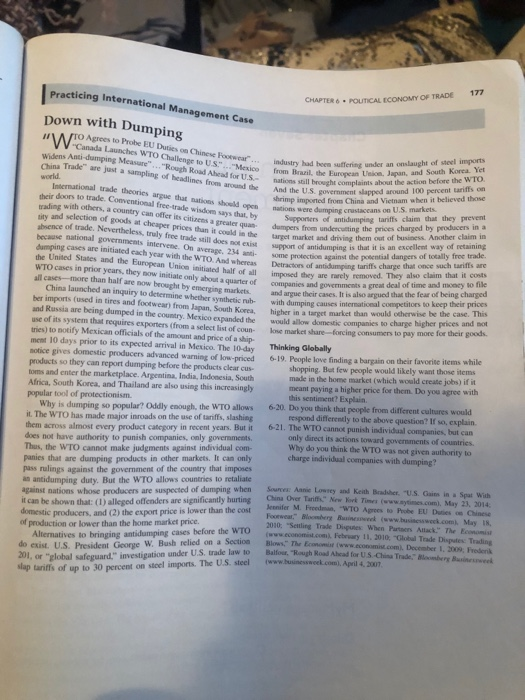
Practicing International Management Case 177 CHAPTER 6. POUTICAL ECONOMY OF TRADE Down with Dumping ATO Agrees to Probe EU Dots on Chinese Power Canada Launches WTO Challenge to U.S. -Mexico widens Anti-dumping Measure". "Rough Road Ahead for US- China Trade are just a sampling of headlines from around the industry had been suffering under an onslaught of steel imports from Brazil, the European Unica Japan and South Korea Yet nations still brought complaints about the action before the WTO. And the US government slapped around 100 percent tariffs on Shrimp imported from China and Vietnam when it believed those nations were during crustascans on U.S. markets. Supporters of antidumping tariffs claim that they prevent dumpers from undercutting the prices charged by producers in a target market and driving them out of business. Another claim in wel manda t part of antidumping is that is an excellen d e Detractors of antidampinganish d im that it cons companies and go some protection against the poental dangers of totally free trade. Detractors of antidumping tariffs charge that once wuch tariffs are imposed they are rarely removed. They also claim that it costs companies and governments a great deal of time and money to file and argue their cases. It is also argued that the fear of being charged with dumping causes international competitors to keep their prices e the would otherwise be the case i es to charge higher prices and the forcing consumers to pay more for the good International trade theories argue thua wir davos to trade. Conventional free-trade wisdom says that by wading with others, a country can offer its citizens a great quan and selection of goods at cheaper prices than it could in the hence of trade. Nevertheless, truly free trade till des se national governments intervene. On average 24 ping cases are initiated each year with the WTO. And whereas the United States and the European Union initiated half of all WTO cases in prior years, they now initiale only about a quarter of cases more than half are now brought by emerging markets. China launched an inquiry to determine whether synthetic rub- ber imports (used in tires and footwear from Shar and Russia are being dumped in the country, Mexico M use of its system that requires exporters from a select list of tres) to notify Mexican officials of the amount and price of a ship ment 10 days prior to its expected arrival in Mexico. The 10-day motice gives domestic producers advanced waning of low-priced products so they can report dumping before the products clear cus toms and enter the marketplace. Argentina, India Indonesia, South Africa South Korea, and Thailand are also using this increasingly popular tool of protectionism Why is dumping so popular? Oddly enough, the WTO allows it. The WTO has made major inroads on the use of tariffs, slashing them across almost every product category in recent years. But it does not have authority to punish companies, only governments. Thus, the WTO cannot make judgments against individual com- panies that are dumping products in other markets. It can only pass rulings against the government of the country that imposes an antidumping duty. But the WTO allows countries to retaliate against nations whose producers are suspected of dumping when it can be shown that c allssed offenders are significantly hurting domestic producers, and (2) the export price is lower than the cost of production or lower than the home market price. mine cases before the WTO Alternatives to bringing antidumping cases do exit US President George W. Bush relied on e n under US trade law to 201, or global safeguard." investigation slap tariffs of up to 30 percent on steel imports. The US Steel 6-19. People love finding a bargain on their favorite items while shopping. But few people would likely want those items made in the home market which would create jobs) if it meant paying a higher price for them. Do you agree with this sentiment? Explain 6-20. Do you think that people from different cultures would respond differently to the above question? If so, explain 6-21. The WTO cannot punish individual companies, but can only direct its actions toward governments of countries. Why do you think the WTO was not given authority to charge individual companies with dumping? Sun ane Lowry and Keith Bradsher. "USCamins China Cher Tai New York Tim (www.my c am Jenifer M Fred WTO Agros Pobe EU D O 2010: "Settling Trade Disputes When Partners Attack The E www.cons.com February 11, 2010. Global Trade Disputes Tradina Blow The Economia www.c it.com). December 1, 2000 Frete Balfour, Rough Road Ahead for US-China Trade www.businessweek.com, April









 Study Help