







Question: please read and solve the question at the last page (c) Nike - Case Study Established in 1964, Nike linc. (Nke) is one of the
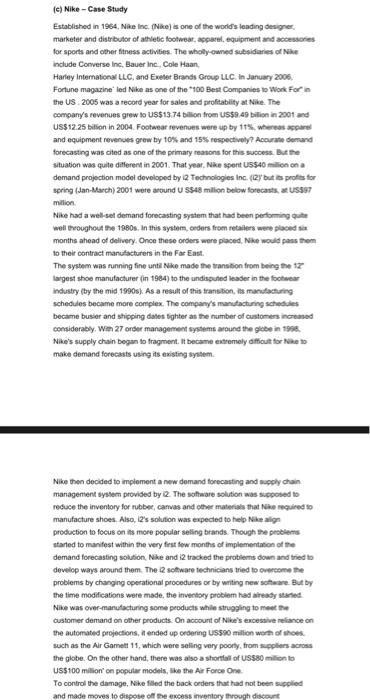
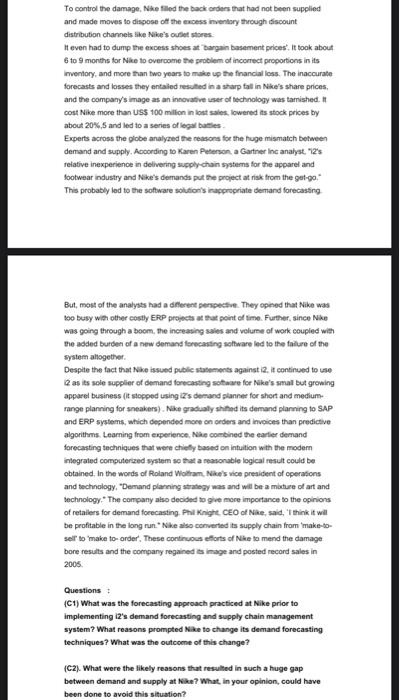
(c) Nike - Case Study Established in 1964, Nike linc. (Nke) is one of the wodids leading designer, marketer and distrbutor of athietic footwear, asparel, equipment and accessories for sports and other fitness activities. The wholly-owned subsidaries of Nhe include Converse inc, Bauer inc, Cole Haan, Harley International LLC, and Exeler Brands Croup ULC. In January 2006. Fortune magaxine' led Nike as one of the '100 Best Companies to Work For in the US. 2005 was a record year for sales and profitablity at Nike. The comparyys tevenues grew so US\$13.74 billon from US\$9. 49 bilion in 2001 and US\$12.25 bilion in 2004. Footwear revenues were up by 11th, whereas aspurel and equipment revenues grew by 10% and 15% respectively? Accarate demand forecasting was cited as one of the primary reatons for this success. But the stuation was quite ditlereet in 2091 . That year, Nave sqent US\$40 milich on a demand projection model developed by i2. Technologies inc. (12) but iss profts flor sering (dan-Macch) 2001 were asound U5948 millon below forecasts, at Us597 malion. Nike had a well-sel demand forecasting syatem that had been perfoning quat woll theoughout the 18B0s, In this system, ceders from retalers wene placed san months ahead of delivery, Once these orders were placed. Nhe would pass them to their contract manulacturers in the Far East. The system was running fine until Nike made the transicon from being the 12 largest shoe manufacturer (in 1964) to the undisputed loader in the footwear industry (by the mid 1990s), As a result of this transibion, iss manstacturing schedules became more complex. The company's manutachuring schediles became busier and shipping dases tighter as the number of customens increased considerably. With 27 order management systems around the globe in 1998 . Nike's supply chain began to fragment. It became extremely afficult for take to make demand forecasts using its existing system. Nike then decided to implement a new demand forecasting and supply chain management syssem provided by Q. The sofhaare solution aas sucposed to recuse the inventory for nubber, camas and other materisis that Nav required io manufacture shoes. Also, 12 's solution was expected to helo Nike allgn production to focus on ans more popular seling brands. Though the pesblems started to manifest within the very frst few months of implementation of the demand forecasting solution. Nike and 12 tracked the protlems down and tried to develop wigys around them. The if sotware technicians tried to overcome the problems by changing operational procedures or by writing new soth are. But by the time modifications were made, the inventory problem had aready sawhed. Nike was oper-manutacturing some products while strugging to meet the customer demand on other products. On account of Nike's excestive neliance on the automated projections, 1 ended up oroering USS90 million worth of ahoes. wach as the Air Gamett 11, which wore selling very poorly, from supplens across the giobe. On the other hand, there was also a shortall of USs80 milion lo US\$100 milion' on popular models, like the Air Force Ore. To control the damage, Nike filled the back oeders that had not been supplied To cantrol the damage, Nke filled the back orders that had not been supplied and made moves to dispose off the excess inventory through ilscount distribution channels like Nike's cushet stcores. It even had to dump the excess shoes at 'bargain basement prices'. It took about 6 to 9 months for Nike to overcoone the problem of inconrect proportions in its inventory, and more than two years to make up the financial loss. The inaccurate forecasts and losses they antaled resulted in a sharp tall in Nike's share prices, and the company's image as an innovative user of tech nology was tarvished. It cost Nike more than Uss 100 millon in lost sales, lowered tis stock prices by about 20%,5 and led to a series of legul buttes . Experts across the globe analyzed the retsons for the huge mismatch between demand and supply. Acoording to Karen Peeerson a Gartiner inc analyst, "12's relative inexperienoe in delivering sucply-chain systems for the apparel and footwear industry and Nike's demands put he project at risk from the get-go." This probably lod to the software solution's inappropriate demand forecasting. But, most of the analyats had a deferent senpettive. They ophed that Nike was too busy with other cosily ERP propets at that point of time. Further, since Nike Was going through a boom, the increasing saies and volurne of work ceupled with the added burdet of a new demand torveasting sothware led to the faliure of the system allogether. Despite the fact that Nike issued puble stacements against 12, it continued to sse 4 as its sole supplier of denand forecaiting sotware for Nike's smal but growing apparel business (it slopped using izs denand planner for short and medium range planning for sneakers) - Nke gradualy shited its demand planning to SAP and ERP systems, which depended more on orders and inveices than predictive algorittms. Learning from experience, Nhe combined the earfer demand forecasting techniques that were chiefy based on intuition with the modern inlegrated computerzed system so that a semonuble logical result could be obtained, In the words of Roland Wotram, Nace's wice president of operafions and technology, "Demand plarning strategy was and will be a mature of art and bechnology." The company abo decided to give more importance to the opinions of retalers for demand focecasting. Phil Knight. CEO of Nike, said, 'I think it will be profitable in the long nun. "Nike also converted its supply chain tram 'make-toselr to 'make to- order'. These contruous efforts of Nhe to mend the damage bore results and the company regained is inage and posted recond sales in 2008. Questions: (C1) What was the forecasting approach practiced at Nike prior to implementing i2's demand forecasting and supply chain management system? What reasons prompted Nike to change its demand forecasting techniques? What was the outcoene of this change? (C2). What were the likely reasons that resulted in such a huge gap between demand and supply at kike? What in your opinion, could have been done to avoid this situation
Step by Step Solution
There are 3 Steps involved in it

Get step-by-step solutions from verified subject matter experts
 Study Help