Question: Please read case study and answer question 3 in the case study discussion questions section. ques ne volumea e brought to Analytics for Disease Management
 Please read case study and answer question 3 in the case study discussion questions section.
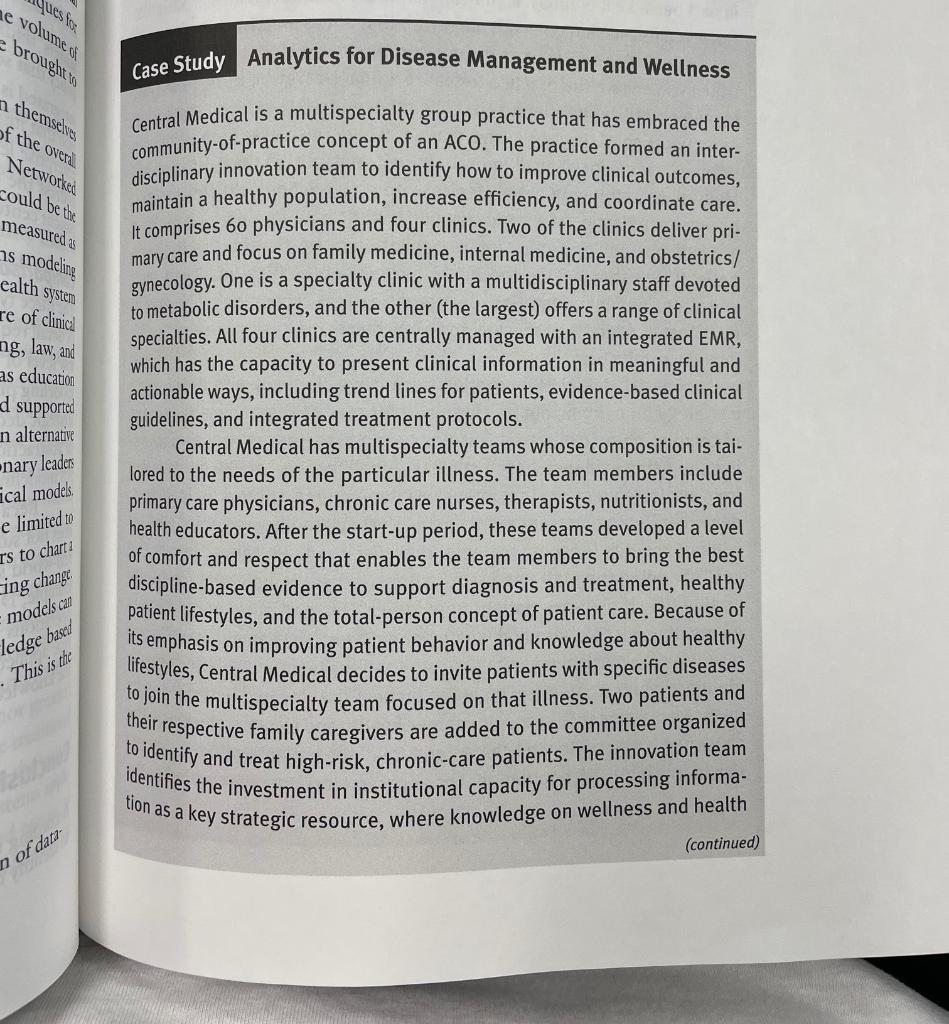
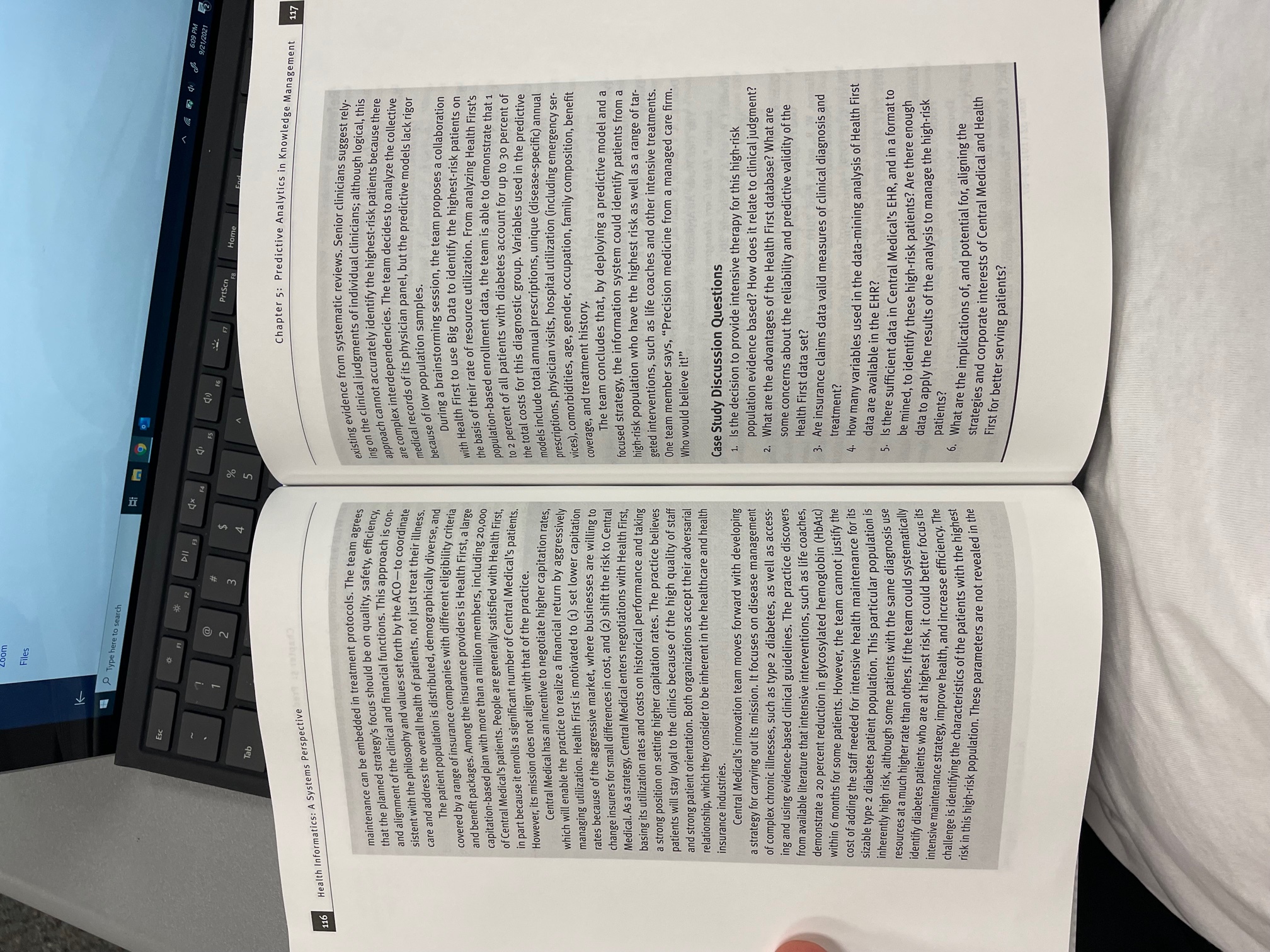
ques ne volumea e brought to Analytics for Disease Management and Wellness Case Study n themselves of the overal Networked could be the measured as modeling ealth system re of clinica ng, law, and as education d supported n alternative nary leaders ical models e limited to Central Medical is a multispecialty group practice that has embraced the community-of-practice concept of an ACO. The practice formed an inter- disciplinary innovation team to identify how to improve clinical outcomes, maintain a healthy population, increase efficiency, and coordinate care. It comprises 60 physicians and four clinics. Two of the clinics deliver pri- mary care and focus on family medicine, internal medicine, and obstetrics/ gynecology. One is a specialty clinic with a multidisciplinary staff devoted to metabolic disorders, and the other (the largest) offers a range of clinical specialties. All four clinics are centrally managed with an integrated EMR, which has the capacity to present clinical information in meaningful and actionable ways, including trend lines for patients, evidence-based clinical guidelines, and integrated treatment protocols. Central Medical has multispecialty teams whose composition is tai- lored to the needs of the particular illness. The team members include primary care physicians, chronic care nurses, therapists, nutritionists, and health educators. After the start-up period, these teams developed a level of comfort and respect that enables the team members to bring the best discipline-based evidence to support diagnosis and treatment, healthy patient lifestyles, and the total-person concept of patient care. Because of its emphasis on improving patient behavior and knowledge about healthy lifestyles, Central Medical decides to invite patients with specific diseases to join the multispecialty team focused on that illness. Two patients and their respective family caregivers are added to the committee organized to identify and treat high-risk, chronic-care patients. The innovation team identifies the investment in institutional capacity for processing informa- tion as a key strategic resource, where knowledge on wellness and health (continued) rs to chart: cing change models.ca ledge based This is the n of data Zoom Files K Type here to search 9 ESC * F2 DI x ro F4 6:09 PM 9/21/2021 @ (0) 2 # $ PrtScn 3 % 5 Home 4 Tab Chapter 5: Predictive Analytics in Knowledge Management 117 Health Informatics: A Systems Perspective 116 ing on the clinical judgments of individual clinicians; although logical, this existing evidence from systematic reviews. Senior clinicians suggest rely- approach cannot accurately identify the highest-risk patients because there are complex interdependencies. The team decides to analyze the collective medical records of its physician panel, but the predictive models lack rigor maintenance can be embedded in treatment protocols. The team agrees that the planned strategy's focus should be on quality, safety, efficiency, sistent with the philosophy and values set forth by the ACO-to coordinate and alignment of the clinical and financial functions. This approach is con- care and address the overall health of patients, not just treat their illness. covered by a range of insurance companies with different eligibility criteria The patient population is distributed, demographically diverse, and and benefit packages. Among the insurance providers is Health First, a large capitation-based plan with more than a million members, including 20,000 of Central Medical's patients. People are generally satisfied with Health First, because of low population samples. During a brainstorming session, the team proposes a collaboration with Health First to use Big Data to identify the highest-risk patients on the basis of their rate of resource utilization. From analyzing Health First's population-based enrollment data, the team is able to demonstrate that 1 to 2 percent of all patients with diabetes account for up to 30 percent of the total costs for this diagnostic group. Variables used in the predictive models include total annual prescriptions, unique (disease-specific) annual prescriptions, physician visits, hospital utilization (including emergency ser- vices), comorbidities, age, gender , occupation, family composition, benefit coverage, and treatment history. The team concludes that, by deploying a predictive model and a focused strategy, the information system could identify patients from a high-risk population who have the highest risk as well as a range of tar- geted interventions, such as life coaches and other intensive treatments. One team member says, "Precision medicine from a managed care firm. Who would believe it! in part because it enrolls a significant number of Central Medical's patients . However, its mission does not align with that of the practice. Central Medical has an incentive to negotiate higher capitation rates, which will enable the practice to realize a financial return by aggressively managing utilization. Health First is motivated to (1) set lower capitation rates because of the aggressive market, where businesses are willing to change insurers for small differences in cost, and (2) shift the risk to Central Medical. As a strategy, Central Medical enters negotiations with Health First, basing its utilization rates and costs on historical performance and taking a strong position on setting higher capitation rates. The practice believes patients will stay loyal to the clinics because of the high quality of staff and strong patient orientation. Both organizations accept their adversarial relationship, which they consider to be inherent in the healthcare and health insurance industries. Central Medical's innovation team moves forward with developing a strategy for carrying out its mission. It focuses on disease management of complex chronic illnesses, such as type 2 diabetes, as well as access- ing and using evidence-based clinical guidelines. The practice discovers from available literature that intensive interventions, such as life coaches, demonstrate a 20 percent reduction in glycosylated hemoglobin (HbA1c) within 6 months for some patients. However, the team cannot justify the cost of adding the staff needed for intensive health maintenance for its sizable type 2 diabetes patient population. This particular population is inherently high risk, although some patients with the same diagnosis use Case Study Discussion Questions 1. Is the decision to provide intensive therapy for this high-risk population evidence based? How does it relate to clinical judgment? 2. What are the advantages of the Health First database? What are some concerns about the reliability and predictive validity of the Health First data set? 3. Are insurance claims data valid measures of clinical diagnosis and treatment? 4. How many variables used in the data-mining analysis of Health First data are available in the EHR? 5. Is there sufficient data in Central Medical's EHR, and in a format to be mined, to identify these high-risk patients? Are there enough data to apply the results of the analysis to manage the high-risk resources at a much higher rate than others. If the team could systematically identify diabetes patients who are at highest risk, it could better focus its intensive maintenance strategy, improve health, and increase efficiency. The challenge is identifying the characteristics of the patients with the highest risk in this high-risk population. These parameters are not revealed in the patients? 6. What are the implications of, and potential for, aligning the strategies and corporate interests of Central Medical and Health First for better serving patients









 Study Help